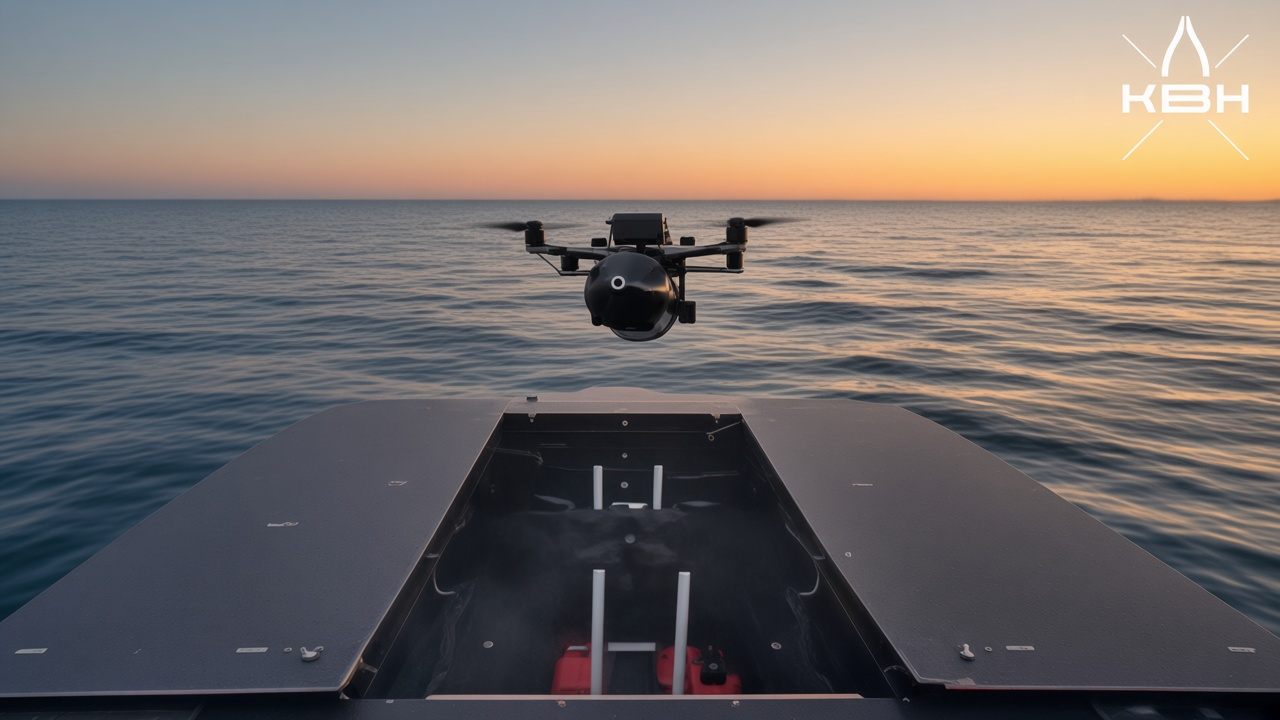
- Each hull can be assembled in an estimated four hours (by Russian estimates) using a cordless screwdriver and can travel up to 200 km while carrying up to 250 kg of payloads
- The Skorlupa comes with up to four communication modules and can carry up to four fiber-optic drones, allowing it to serve as both a mothership for attack or recon drones and a one-way attack craft
According to www1.ru, company CEO Alexey Chadayev says ten of the boats fit into the cargo bed of a single GAZelle light van when broken down, and that one hull goes together in about four hours with an ordinary screwdriver.
The hull is cut from water-repellent plywood, and Chadayev told the Russian government daily , in an interview published on September 8 (RU) around the International Technological Congress 2026, that the craft can be produced at any furniture factory and costs roughly a fifth of a conventional naval drone.
A low-cost alternative in an increasingly asymmetrical war?
As the Russia-Ukraine conflict enters its fifth year, both sides have innovated, focusing on drones and autonomous vehicles to save lives, operate remotely, and minimize costs.
The Skorlupa does just that: the developer cites a 200 km range and a 250 kg payload, letting operators use it remotely while cutting costs as Russia and Ukraine struggle to fund their war efforts.
It can also be used in two ways: as a one-way strike platform, delivering an explosive against a ship's hull; or as a mothership, carrying four fiber-optic aerial drones housed under a deck skin that folds open on command.
As the war drags on, it's increasingly becoming one that demands practical and cost-effective solutions that do not endanger lives, with Ukraine also often pulling off similar approaches, including retrofitting remote-controlled kits to Humvees and Operation Spiderweb, which ingeniously launched attacks from within Russia's borders on its airfields, dealing damage that amounted to billions of dollars.
Skorlupa does something similar that makes it immune to jamming: it is controlled by a physical fiber-optic cable that lets it function even in areas where it would otherwise be cut off from wireless communications. This is also why the KVN has become one of Russia's most-used FPV drones.
A non-emitting boat carrying non-emitting drones is effectively unjammable and hard to counter, and with millions of Russia's KVN drones already in play, it would be a well-supplied Unmanned Surface Vehicle (USV) to build up a naval and aerial threat in a region where Ukraine regularly takes the initiative on the former.
As Alexey Chadayev pointed out in his interview, "With a Skorlupa like this, you can wreck any seaport without missiles," while noting that it can be made at any furniture factory.

Rahim Amir is a UAE-based tech writer who enjoys building PCs as much as he enjoys writing about them. He has been professionally writing about PC hardware since 2023, focusing on buyer’s guides, hardware reviews, and sponsored content and features related to tech.
Having built hundreds of gaming PCs and being an avid gamer in his spare time, Rahim tends to have stronger opinions about hardware than most. This is particularly on display when he gets his way with powerful, but minimalistic RGB builds even as Small Form Factor (SFF) PCs come a close second.