If you simply look at the numbers, you might think that an R2 Performance lags way behind a top-spec R1S, which offers up to 1,025 horsepower with its quad-motor option. But that's not a fair comparison because a dual-motor R1S (533 hp and 0 to 60 in 4.5 seconds) actually has less horsepower and oomph than an R2 Performance (656 hp and a 0 to 60 time of 3.6 seconds). And when you combine that with a lighter curb weight of around 5,000 pounds (versus 6,600 to 7,100 pounds for the R1S), you get an SUV that pulls like a herd of stampeding buffalo. Torque is instantaneous, which makes accelerating onto an on-ramp or passing aggressively delightful. The R2 has so much power that even in its stiffest ride setting, you can still feel the entire car lurch upwards when you slam down on the accelerator.
Now there's no getting around that the R2's suspension is on the firmer side of things, even when it's on Rivian's more forgiving moderate setting. But I don't mind that, as that's sort of expected from a tallish SUV, plus it still lets you feel the road while providing good driver feedback regarding grip and stability. The R2 offers multiple levels of regen which makes one-pedal driving a breeze. Furthermore, while I didn't take it on the trails, the R2's off-road DNA showed through when I drove it across gravel and cobblestones. It casually eliminated the kind of excess turbulence that can result in a truly teeth-chattering ride.
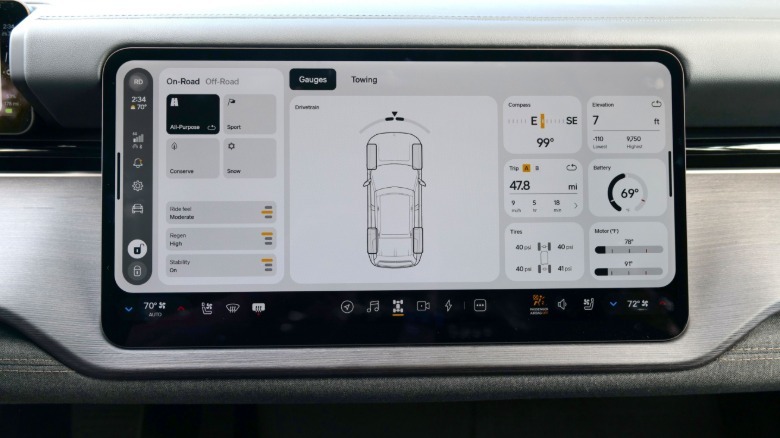
I also appreciate how Rivian didn't mess with the drive mode tab in the infotainment, which serves as a central menu for adjusting things like ride feel, regen, stability and more. This tab also lets you easily see stats like motor temperature, tire pressure and even things like the orientation of your wheels and the elevation. Those last two items can be very helpful in rough terrain.
For those who opt for Autonomy+ (which costs $50 a month or $2,500 for a one-time purchase, after your initial 60-day free trial on new vehicles), you'll get access to Universal Hands-free driving across more than 3.5 million miles of roads in the US and Canada. On the highway, hands-free driving was sublime. It easily handled lane changes and congested roads without drama. In some ways, it even felt a touch smoother than BlueCruise on my Mach-E, as the R2 followed curves a bit more gracefully compared to Ford's system, which can feel a bit robotic at times. I also really like how Rivian allows you to make micro steering adjustments when needed, which on other vehicles will often kick you out of hands-free mode.
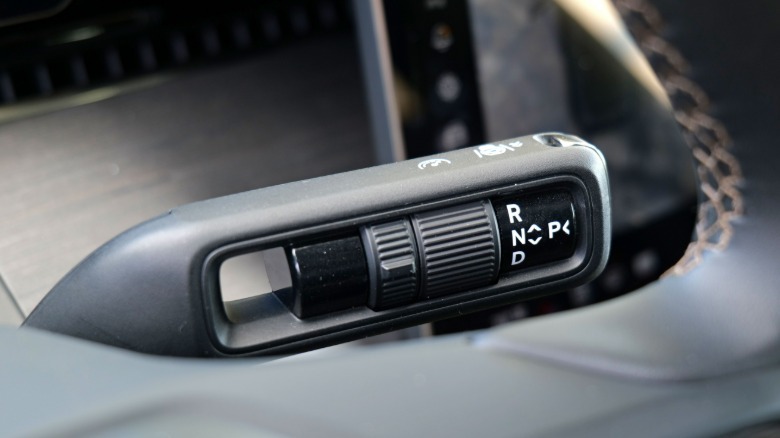
That said, while you can use hands-free driving on some surface streets (you'll know when the little icon lights up on the driver's digital cluster display), Rivian's tech needs a little more polishing there. I found that sometimes it would let me activate hands-free mode for just a few seconds, before quickly disabling it when it noticed road markers weren't distinct enough. This is also highly dependent on the specific road and how nearby lines look. So while you can go hands-free on some local streets, the R2 needs a little extra baby sitting. That's okay, because we know it's not meant to be 100 percent autonomous yet, right? Right. You can take your hands off the wheel, but don't close your eyes.
Finally, there are some other little touches that I really like, such as the camera feed from the sideview mirrors that automatically pops up in the driver's instruments when you hit your blinkers. This tech is becoming more popular on new cars and I hope it becomes standard equipment soon. Same goes for the bird's eye 360-view that activates when the car senses that you're maneuvering in tight spaces or when you shift into reverse.