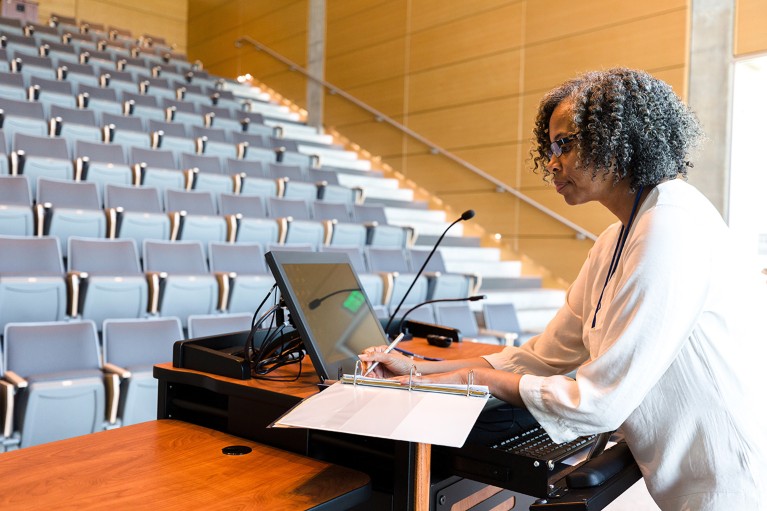
Ľubomír Tomáška still remembers the first university lecture he gave more than 30 years ago. He was a first-year PhD student when a senior teacher asked him to cover an introductory genetics class. The topic was DNA replication: a seemingly “easy ride” for Tomáška, who was doing his doctoral research on a similar topic. He read a chapter from the textbook and prepared a thick stack of transparent slides to project in front of the class — “this was pre-PowerPoint” — and walked in feeling set. “I was ready to go, but in ten minutes, I noticed that I had lost the attention of about 90 per cent of the people in the lecture hall,” recalls Tomáška, now a geneticist at Comenius University in Bratislava. “I felt like a cyclist climbing a steep hill without water and energy.”
Tomáška’s experience is familiar to many early-career academics. Across academia, especially during doctoral programmes, the focus is often on fostering research skills, rather than teaching skills. “PhDs teach you to be scientists and researchers, not teachers,” says Olivia Bizimungu, a PhD candidate in neuroscience at McGill University in Montreal, Canada.
Despite this, some graduate programmes require students to take on teaching responsibilities, even if they have limited experience doing so. Tomáška, now a sagacious university lecturer, says he often has PhD students enter his programme and immediately begin teaching. But even if you’re very familiar with a subject, it is not all smooth sailing. “Knowing the subject for university teaching is not enough to give a good lecture or seminar,” he adds.
Here, ten PhD students, postdocs and faculty members share their advice for anyone preparing to teach at university for the first time.
Build on existing materials
Before you embark on your first lesson, you should prepare course materials, such as lecture slides and handouts. Luckily, you don’t have to reinvent the wheel. There is usually an existing course that you can — and should — work off. “Don’t start from zero,” says Aeriel Leonard, a materials scientist the Ohio State University in Columbus. If it’s appropriate, then you might consider using old homework resources or assignments.
Tomáška also suggests that researchers see whether it is possible to undertake formal teaching courses at their universities.
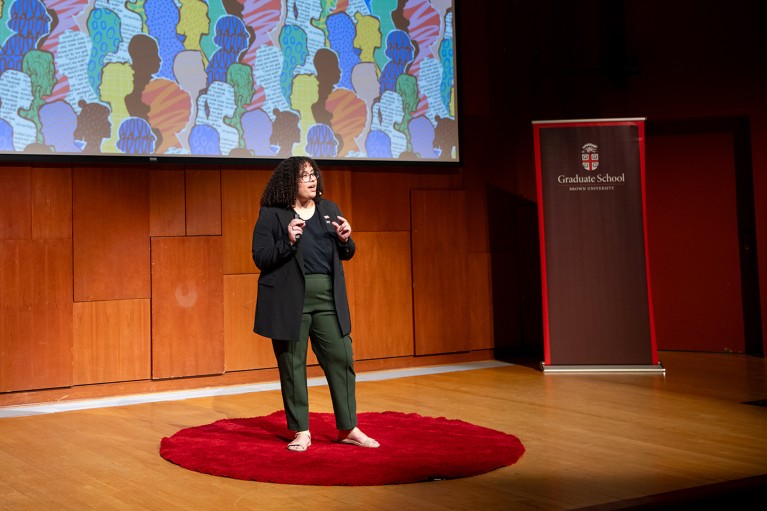
There’s also another great resource — academics themselves. Like Tomáška, when Melanie Ortiz Alvarez De La Campa — who earned her PhD in pathology at Brown University in Providence, Rhode Island, this May — first taught undergraduate courses, she assumed that having subject knowledge alone would be enough to teach well. Realizing that students process information at different speeds, she sought advice from experienced colleagues. “I learnt a lot from just talking to actual professors,” says Ortiz Alvarez De La Campa. “If you have the opportunity, sit in on some courses where you’re going to teach and see which professors resonate with you in terms of what they’re doing, and talk to them about it.”
The students aren’t the only ones learning. Once you have your material, you should also take time to learn it by heart. “Re-read and revise your teaching materials and practise delivering your lectures,” says Nirodha Weeraratne, a postdoc at Charles Sturt University in Wagga Wagga, Australia. “Guess what questions will be asked during discussions, and be ready with plausible answers.”
Just as you would do for a conference presentation, you will want to complete a run-through. Liza Bolton, a statistician at the University of Auckland, New Zealand, advises researchers to visit the classroom before their first lesson. “Log into the lectern, test your slides and check your connections,” she says. “Do you need a USB-C or HDMI dongle? What is the microphone situation?”
But remember, it does not have to be perfect. “The preparation you do for lesson 1 will look entirely different from lesson 100,” adds Bolton. “Don’t despair if you are over-scripting and over-timing right now.”
Engage students from the beginning
First impressions are important. Bizimungu suggests grabbing students’ attention early on, however you see fit. “Even if you start with something that there’s no way that they’ll understand, show them why what you’re about to teach is useful and interesting,” she says. For example, when teaching a motor-neuroscience class, Bizimungu started with a video on state-of-the-art brain–computer interfaces. Throughout the lecture, she connected the advanced technology in the video to concepts that the students had already encountered in class.
Marco Mello, an ecologist at the University of São Paulo, Brazil, says that you should tell a good story. “Harness the power of storytelling: a clear arc, a conflict, strong characters, a sense of movement and a reason for students to care about what comes next,” he says. “Know where the story begins, where it is going, and what you want students to remember when they leave.”
Preparation is also only part of the challenge: Jawad Ullah realized this when he gave his first lecture. “I had to read the room in real time and understand whether they were engaged, sceptical or quietly connecting the ideas to their own classroom experience,” recalls Ullah, a fourth-year PhD candidate in crop science at Hainan University, China. A short pause or a practical question can make the session feel more open, he suggests.
Like Tomáška, you might lose students along the way. To reengage them, Ortiz Alvarez De La Campa recommends trying to make the content more personal. “When a student can relate the material directly to something in their real life, or better yet apply it, it helps capture their attention,” she says. “If, as lecturers, we can help them see the real value of the knowledge at work, then they will deem it worth their time.”
Think like the student
While you are preparing the lecture, it can be helpful to put yourself in the students’ shoes. Leonard recommends that anytime you give a homework assignment, a quiz or an exam, you should complete it first to make sure that the students have the required knowledge to finish it. You should also get in the students’ mindset. If you’re excited to be there, it can rub off on them. “I always find it really motivating when I'm looking forward to some experiment I'm going to do during the lecture because it keeps my adrenaline high,” says Tomáška.
Teaching is not just about providing course material: it can also involve imparting practical advice. “Remember yourself years ago? What would you need the most at that time?” said Olesia Platonova, a PhD candidate in cognitive neuroscience at the Pasteur Institute in Paris.
Although lecturing is a tried-and-tested format, you can always vary what you are doing in class to keep it interesting. Kristina Monakhova, a computer scientist at Cornell University in Ithaca, New York, advises taking time to come up with interesting ‘think–pair–share’ activities for each lecture, during which students form individual ideas, discuss with a classmate (or several) and then share with the group.
Enjoying our latest content?
Log in or create an account to continue
- Access the most recent journalism from Nature's award-winning team
- Explore the latest features & opinion covering groundbreaking research