The best options when DJI's gimbal camera is too expensive or unavailable.
We may receive a commission on purchases made from links.
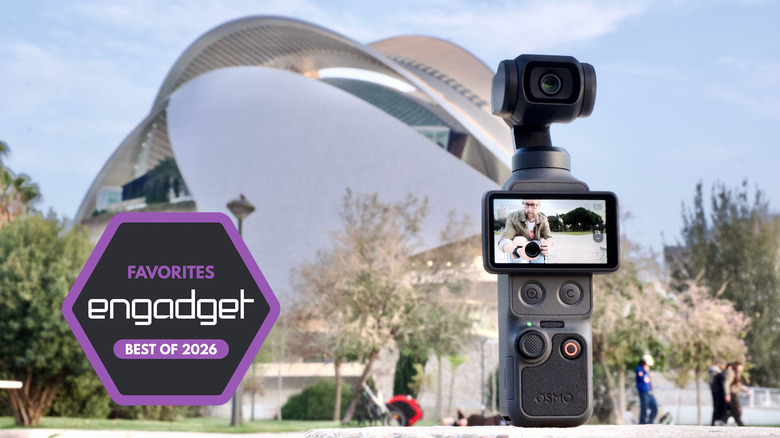
DJI's Osmo Pocket 4 is a fantastic gimbal camera thanks to features like sharp and color-accurate video, awesome stabilization and generous onboard storage. If you want to buy one in the United States, though, too bad: It's not officially available due to a ban on certain DJI products.
Luckily, there are other options. DJI's main rival, Insta360, has the excellent Luna Pro, which offers similar features and video quality. And DJI's original Osmo Pocket 3 is still available, and still a fantastic camera. There are also some... other choices from the likes of Agfa (which you may have heard of), along with Ordro and SJCam (which you probably haven't). I've tried them all, and I'll show you which ones to buy and which to avoid.
The gimbal cam category
DJI basically invented the gimbal cam category with its Osmo Pocket series, particularly the Pocket 3 model that came out in 2023. As I detailed at the time in my review, that model did a whole bunch of stuff that small cameras hadn't done before: motorized subject tracking, gimbal stabilization and automatic horizontal or vertical video orientation via a screen flip. All of that came at a reasonable starting price of $520.
Subsequent gimbal cameras have followed that template. The products are stick-like in shape, with a camera supported by a three-axis gimbal at the business end. The handle usually has a touch screen that can be flipped to change the video orientation (vertical or horizontal), along with a joystick to control the gimbal plus buttons for recording, power and other controls.
DJI owned this market for nearly the life of the Pocket 3 and has reportedly sold millions of them. Rivals only started to appear recently, most notably Insta360's Luna Pro and dual camera Luna Ultra. DJI also introduced its own follow-up, the Pocket 4, and a dual-camera model, the Pocket 4P, but neither of those are available in the US. Naturally, some copycats and cheaper models have come out of the woodwork as well. Some companies even tried importing DJI's Pocket cameras under different names, but those have now been banned as well so I won't be discussing those.
Further competition may be coming soon. Chinese smartphone company Oppo recently revealed that it's exploring a gimbal camera, and another phone maker, Vivo, may be doing the same. Those companies may see a growing market and want to jump in.
Best affordable Osmo Pocket 4 alternative: Insta360 Luna Pro
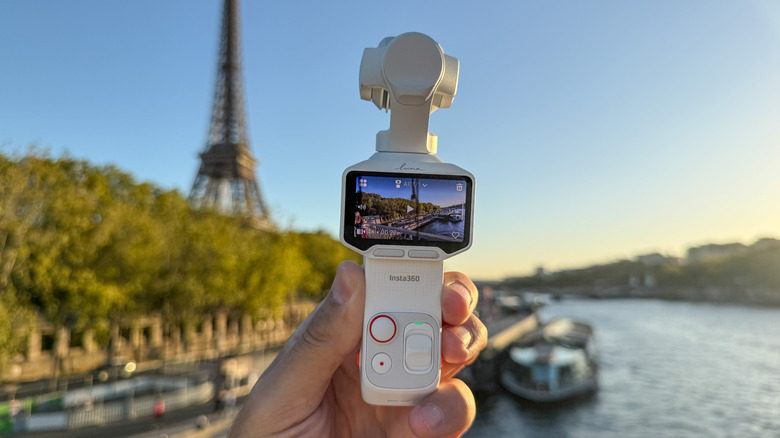
Insta360's Luna Pro is an impressive gimbal camera that's nearly on par with DJI's Pocket 4. To take on the Pocket 4's big 1-inch sensor and 20mm Hasselblad f/2.0 optics, the Luna Pro offers a similar 1-inch sensor with a 20mm f/1.8 Leica Summicron lens. The Luna Pro doesn't do 4K at 240 fps like the Pocket 4, but it does offer 8K at 30 fps that its rival lacks.
Both cameras support 10-bit log capture (I-Log for the Insta360 and DLog for DJI's Pocket 4), though the latter boasts a more impressive 14 stops of dynamic range. Recent tests have shown that while Insta360's Luna Pro offers excellent image quality in regular picture mode, its I-Log setting may have some deficiencies that impair dynamic range compared to the Pocket 4.
In other ways, the Luna Pro compares like-for-like with its DJI rival. Both offer automatic subject tracking, so you can set the camera up and have it follow you as you walk around. Stabilization in my testing was excellent and smooth, on par with the Pocket 4. Like its rival, you can switch from horizontal to vertical mode by rotating the screen. Battery life is excellent on both, rated at up to four hours for both cameras. The Luna Pro also offers internal storage, but it's less than half that of its rival at 47GB (compared to 107GB).
There are a couple of areas where the Luna Pro beats the Pocket 4. For one, you can shoot vertical video at up to 4K 30 fps on the Insta360 model, compared to just 3K for DJI's cam (that's because of the higher 8K resolution which crops down to 4K). The Luna's display is also detachable, letting you walk away from the camera and still line up shots.
The Luna Pro costs $600, which is the same as the Pocket 4 but more expensive than the other offerings. It's also cheaper than trying to import a Pocket 4 if you live in the US. If that's affordable for you, I'd suggest this unreservedly as the best alternative to the Pocket 4.
Best affordable Osmo Pocket 4 alternative - runner-up: DJI Pocket 3
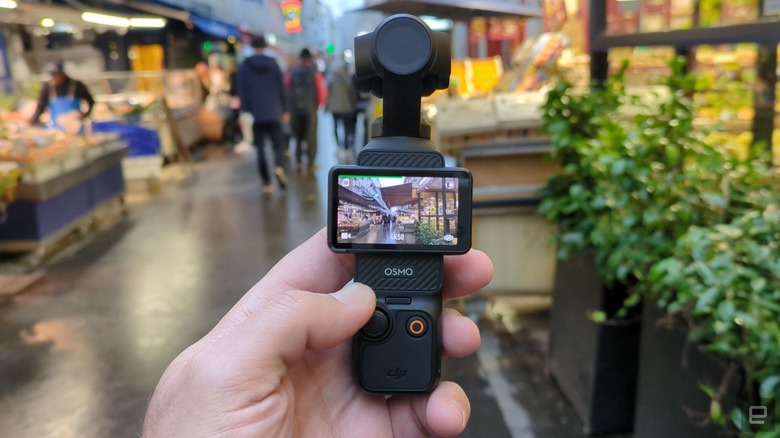
Because it was previously approved, DJI's Pocket 3 is officially available in the US, complete with support, for around $439. Though a little old and more expensive than other models in this roundup, it's still better than anything else you can find in this price range.
The Pocket 3 has a 1-inch sensor like the Pocket 4, along with the same 20mm f/2.0 lens. It can shoot 4K at 120 fps and not 240 fps like the Pocket 4, a fairly minor drawback. It's also limited to 10-bit D-LogM, unlike the Pocket 4 that offers full D-Log capture with more dynamic range. For photos, the Pocket 3 offers a low 10 megapixels of resolution, while the Pocket 4 can capture 37MP still images.
DJI's older gimbal also offers motorized subject tracking like its new sibling, along with incredibly smooth optical stabilization via the three-axis gimbal. The screen is slightly less bright (700 nits compared to 1,000 nits), but just as sharp and allows you to change the orientation from vertical to horizontal at a flip — again, just like the Pocket 4.
A key feature missing is the built-in storage, with capture only available via microSD cards. Battery life is not quite as good, but still excellent for a standalone camera. All told, most users would barely notice the difference between the two models, so I'd highly recommend the Pocket 3 as a mid-priced option over any other models.
Best affordable Osmo Pocket 4 alternative - budget pick: Ordro UHD-M5 (aka AgfaPhoto Realimove MC3X)
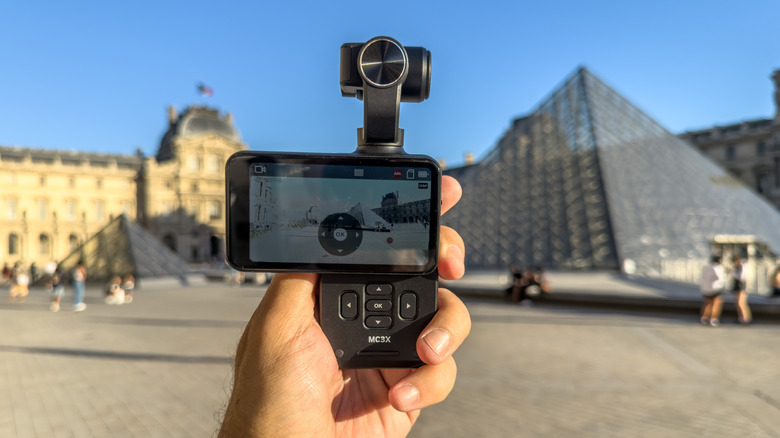
Beyond DJI and Insta360, we're getting into lesser-known brands. That's the case with the $270 Ordro UHD-M5, which has some interesting features but appears to have been manufactured by a "white label" company. I say that because I also received another test model called the AgfaPhoto Realimove MC3X (limited to Europe) with an identical design.
The Ordro M5's standout feature is a 3.5-inch screen that's considerably bigger than the displays on any rival products. Like the Pocket 4, it flips to automatically change video from a vertical to horizontal orientation. The gimbal is controlled on-screen, which should make it easy for beginners to use.
The drawback is that the M5's display is washed out in bright sunlight and not as sharp as the OLED screens on DJI and Insta360's models. The body is also very wide to accommodate the big display, which can make holding it a bit awkward.
It supports 5K 30 fps video and 4K at 60 fps, but has a 1/2.5-inch sensor that's tiny compared to rivals. As a result, picture quality was solid for a camera in this price range, but not as sharp or color rich as DJI and Insta360's offerings. The gimbal did a good job stabilizing footage while I rode an e-bike and walked.
One interesting trick feature is the IR night vision lights that let you record black and white video in near darkness. It did work, though quality was pretty fuzzy. Overall, the Ordro M5 is a decent beginner's gimbal camera, though I'd recommend the Pocket 3 instead if you can manage the extra $150.
An affordable Osmo Pocket 4 alternative - the weird option: The SJCam C400
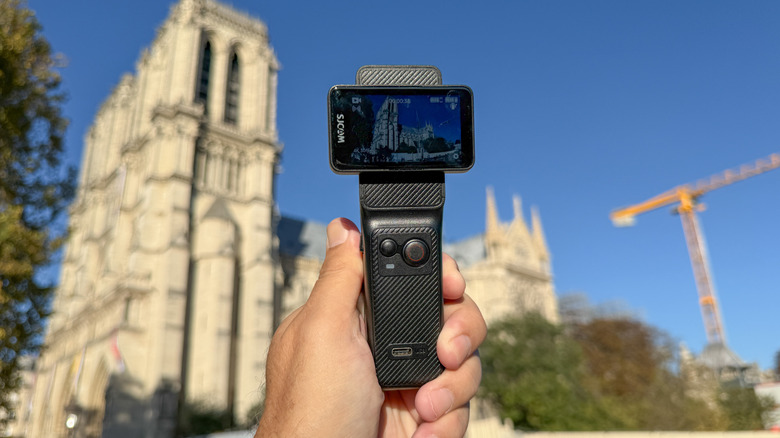
The SJCam C400 is definitely the oddball of the group. It's held and operated like a gimbal camera, but actually lacks a three-axis stabilizer and relies on digital stabilization. It's much like Insta360's Go 3S, in that the tiny camera itself detaches from the handle, so that it can be used remotely and even has its own screen. At the same time, video can be monitored remotely from the main display.
The C400 has a solid-feeling build, and the detachable camera is small enough to fasten to a hat or a pet, though it's heavier than the remote cam on the Go 3S. When affixed to the handle, the main screen can be flipped to change the aspect ratio from vertical to horizontal, like all the other models I tested.
It can output up to 4K 30 fps video, but unfortunately, the quality isn't great. Sharpness isn't good in the middle of the image, and it's even worse at the corners. It looks oversharpened and has strange artifacts that cause blotchy video when you move the camera. The digital stabilization works well enough, but without a three-axis gimbal, motion blur rears its ugly head when light levels are too low.
On the plus side, battery life is very good at over 180 minutes. It's also very inexpensive at $189 in a kit with a waterproof case, lanyard and other accessories. With such poor image quality, however, it's hard for me to recommend even at that price.
Other products we considered
Gimbal cameras are still a fledgling category so there aren't as many products to choose from as with, say, action cameras. However, here are a few picks that we considered but ultimately rejected:
-
Any DJI rebrands or exports: We won't recommend an expensive import or rebrand product like the Xtra Muse that may be banned or has no manufacturer support.
-
This product was originally on our slate but has since become unavailable.
-
This is the same white label product as the AgfaPhoto and Ordro models.
-
Phone gimbals: Another type of product not included here are phone gimbals. Those fall into a separate category as they're more complex to use, often requiring considerable setup before you can shoot anything.
How we selected these products
Engadget chose these products based on our previous reviews and judgement, as well as in-depth category research. We have tested hundreds of camera products over the years, including gimbal, action, compact and mirrorless models.
To test these gimbal cameras, we used them in a variety of environments to gauge video quality (in daylight and at night), stabilization and ease of use. Factors like battery life and built-in storage were also taken into account. The products chosen were based on all of those factors, with video quality weighted the heaviest, followed by stabilization and ease of use.