The use of artificial intelligence in science is producing a conundrum: individual researchers are becoming more productive, while the scientific enterprise as a whole is exploring a narrower range of ideas.

Will AI spark a scientific renaissance — or a diffuse monoculture?
For instance, academics who adopt AI tools publish about three times as many papers and receive nearly five times as many citations as do their peers. Yet, analyses of the scientific literature show that AI-assisted research spans 4.6% less topical ground than does non-AI work, with this pattern being present in more than 70% of the subfields studied1.
The problem is not technological, but institutional. AI tools expand scientists’ capacity to explore, but systemic incentives mean that researchers use this capability to focus more intensely on problems that institutions can easily recognize, evaluate and reward, rather than breaking new ground.
These dynamics did not originate with AI: research has shown that papers and patents have become less disruptive over the past six decades2. But AI is accelerating these changes, because speed and pattern recognition in large bodies of work are precisely what a narrowing system will focus on most intensively. The academic career structure reinforces this effect. AI makes extending a familiar research line faster and cheaper than entering unfamiliar terrain, and existing incentive systems reward such speed.
To address these concerns, we put forward three recommendations.
Make new terrain measurable
Current funding systems overwhelmingly reward the downstream exploitation of existing data rather than the upstream creation of new data sets and measurement capabilities. By applying increasingly powerful AI models to public data sets, researchers can often generate publishable results at relatively low cost.
For instance, Google’s Graph Networks for Materials Exploration (GNoME) is a deep-learning tool that has identified 381,000 candidate stable inorganic crystals, expanding the known materials landscape by an order of magnitude3. Meanwhile, AlphaFold, a protein-structure prediction system created by DeepMind in London, has generated more than 214 million potential protein structures, making biological interactions inspectable at an unprecedented scale4.

By contrast, building a longitudinal cohort study or launching a biodiversity-monitoring programme can take years of sustained investment before any publishable findings are produced.
This asymmetry is widening: the costs of making predictions with AI models have fallen roughly 100-fold in the past two years, whereas building new observational infrastructure still carries high long-term operational costs5–7. This means that the gap between what is cheap to exploit and what is expensive to explore widens every few months.
We call on funders to deliberately subsidize the data infrastructure, especially in neglected domains such as diseases that have been excluded from major cohort studies. These investments are slow and unglamorous, but they are essential if AI is to work with observations from previously overlooked areas.
Stop punishing pivots
Universities and funding agencies must stop penalizing researchers who use AI to enter new fields. AI tools reduce the informational cost of pivoting — an ecologist entering genomics, for example, can now traverse unfamiliar literature faster. But evaluation systems still penalize pivots into other subfields8. Hiring committees assess candidates on a continuous publication record in a single domain and funding agencies often treat preliminary data from the applicant’s previous work as a prerequisite for support.
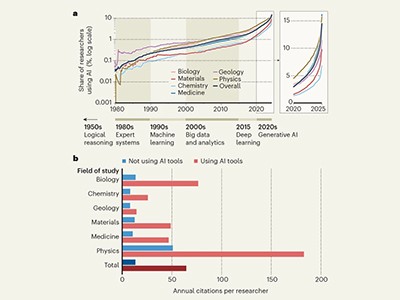
AI tools boost individual scientists but could limit research as a whole
Enjoying our latest content?
Log in or create an account to continue
- Access the most recent journalism from Nature's award-winning team
- Explore the latest features & opinion covering groundbreaking research