Thirty years ago, Europe’s GDP was roughly on par with the US, Alexander Rinke told TNW. Today it is dramatically less. The Celonis co-founder and co-CEO does not want AI to make that gap wider.
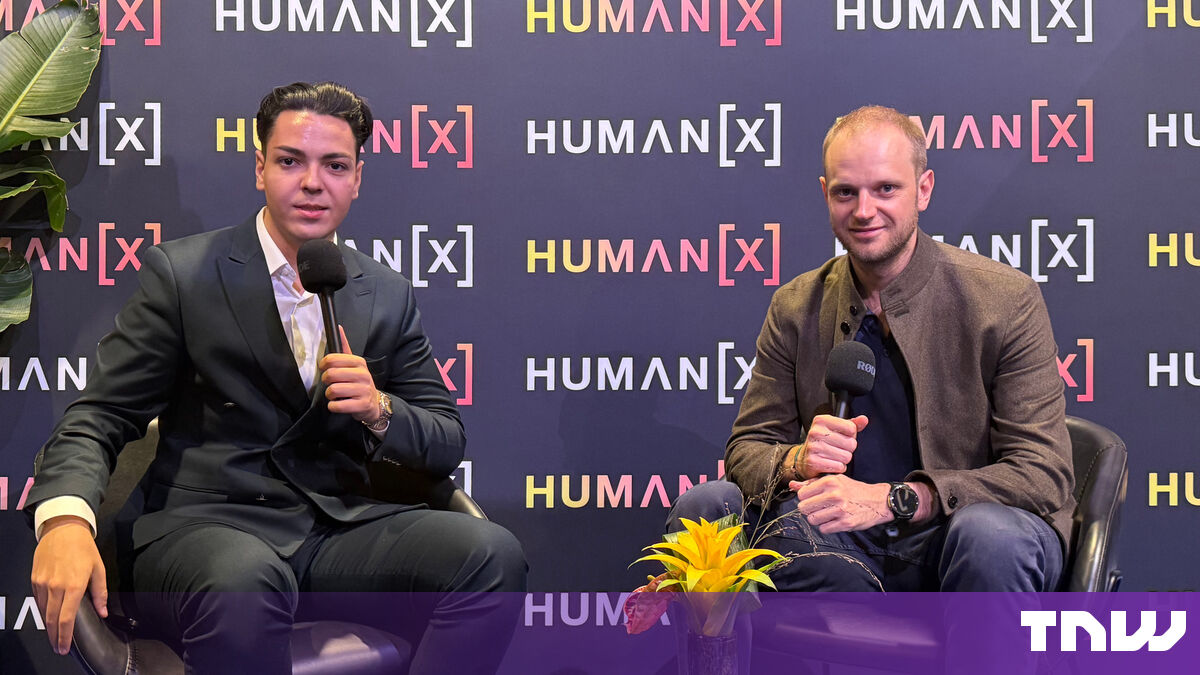
Rinke spoke to Cristian Dina for the TNW Podcast at HumanX in Amsterdam on 23 September. Earlier that day he had joined a panel on stage called “Can Europe Actually Build Sovereign AI?”. Earlier guests include Steve Lucas of Boomi, Arvind Jain of Glean, and Daniel Dines of UiPath. The full conversation is in the video below.
Local champions, not distrust
Countries and groups of countries such as Europe want control over parts of the AI stack, Rinke said. They want to know where their data and their IP go. Europe also needs its own companies to take part in an AI economy that will be huge.
“We need to really foster local champions, not because we don’t trust the Americans or we think AI is going to kill us all. Just because we want to make sure we take part of the upside.” Alexander Rinke, Celonis
Celonis is one example, he said. Its headquarters are in New York and Munich, and it has more than 20 offices around the world, with a strong presence in Germany, Spain and the UK. Europe is “not a satellite for us,” he said.
Owning the weights
For a company or a public agency, sovereign AI means owning its own AI, Rinke said. In the end, that means owning the model weights.
“They don’t want to give all of their data to any model to train on that data.” Alexander Rinke, Celonis
Every organisation is like a snowflake, he said, so its processes and their context are unique. That needs open platforms that can be installed in sovereign environments. Celonis keeps a customer’s process data with the customer and does not send it anywhere. It also helps customers tune open-source models for specific business tasks. For those tasks, he said, they can get the same or better results than with frontier models.
An x-ray for business processes
Rinke started Celonis 15 years ago with his co-founders, Martin Klenk and Bastian Nominacher. They first wanted to build models that could simulate how a business works. To feed a simulation, they needed to know how the business ran today, and companies could not tell them.
“So we built an x-ray machine that looks at the data the business generates and x-rays how the processes work.” Alexander Rinke, Celonis
Celonis now calls this process intelligence. It maps how work really gets done, across systems and outside them, so companies can redesign it with AI. The company has about 3,500 people, he said.
Celonis recently bought Ikigai Labs, an MIT spin-off. Ikigai builds specialised models for tabular and time-series data and for what-if simulation. A large language model can use them as a tool, Rinke said, for jobs such as forecasting a supply chain or deciding whether to settle an insurance claim.
Asked about an IPO or new funding, Rinke spoke about the next phase of growth instead. He pointed to the Context Model that Celonis launched and to the Ikigai deal. Celonis describes the Context Model as a living model of a business in motion, built from its operational data and connected to its strategy.
Product-market fit is easy to claim
Many startup pitches claim product-market fit that the company does not have, Rinke said. His test has four questions. Is the product valuable? Is it uniquely valuable, or easy to replace? Is it repeatable, or custom each time? Will customers keep paying for it?
“It’s easy to say that you have. It’s very easy to put on a slide for VCs.” Alexander Rinke, Celonis
If the answer to all four is yes, the next step is what he calls product-market-people fit: the organisation needed to scale it. Scaling too early can grow revenue that does not last, he said, especially in a boom market like AI.
Celonis was his first real venture. The founders started it during their studies, and Rinke put his master’s on hold and never finished it. They bootstrapped for five years, and winning the first enterprise clients without references was very hard, he said.
Build for customers, not rounds
Venture capital is a good idea if a company wants to move quickly, Rinke said. But it does not replace the work a bootstrapped company has to do.
“You shouldn’t build the company to raise capital. You should build the company for customers.” Alexander Rinke, Celonis
He now works much more closely with Celonis engineers than he did a few years ago. He oversees some technical projects himself and is involved in how the company adopts AI internally. Asked whether he is technical, he said: “Yeah, pretty technical.”