The recent incidents concerning RAF Fairford in Gloucestershire have highlighted that fact that the US military does have quite a significant presence on UK soil. What this presence fully amounts to, though, is unclear.
According to news reports there are “at least” 15 US military bases in the UK, while other sources have the figure at 12 or 13. The UK government says that there are only 11.
In 2024, the Pentagon defence headquarters in the US listed 16 American military locations along with six unspecified “other sites”. This confusion over the number might come from defining the term “US military base”. Some might be seen as actually UK stations, but with a significant presence of US service personnel serving on them.
There are said to be approximately 12,300 US service and non-military personnel from the National Security Agency (NSA) and the Central Intelligence Agency (CIA), for instance, stationed at these bases. The presence of these bases has, down the years, raised some controversy. Many of us might remember the anti-nuclear Greenham Common Peace Camp protests in the 1980s and 90s.
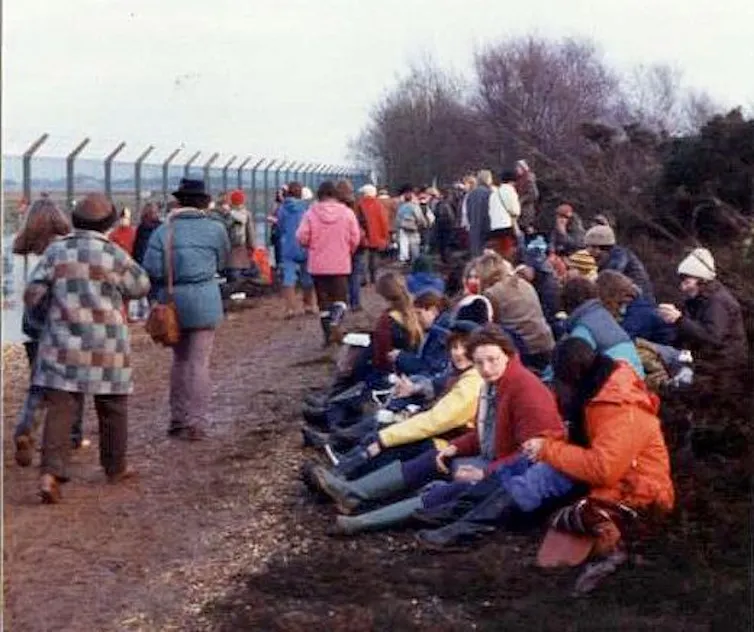
The US, however, sees them as strategically vital, and the UK government, ever conscious of its need to support its principal Nato military alliance ally, is not going to remove them anytime soon.
The bases are a legacy of the large number of US air stations and army depots that were set up across the country during the second world war.
At the end of the war, the rapid downsizing of these bases was halted to some degree by the escalating cold war in the late 1940s. In the 1990s, and with the cold war over, there were still about 100 bases remaining.
Twelve of the current bases are Royal Air Force (RAF) stations, and all of their names are still preceded by the term RAF, such as RAF Fairford. Not all of these stations have aircraft based at them; some are radar, early warning or satellite tracking stations, and others may be described as monitoring stations or communications centres.
All of these bases are classed as being under UK military control, but they often only have a nominal number of UK personnel serving at them. Their legal basis was fixed by the Nato Status of Forces Agreement of 1951 and the subsequent Visiting Forces Act of 1952.
US service personnel are largely exempt from local British civil and criminal law for offences committed on duty or against US personnel or property. This has led to some legal grey areas covering the activities of some American personnel.
There was the case of the alleged tapping of German Chancellor Angela Merkel’s phone in the early 2000s by a joint NSA/CIA unit known as the Special Collection Service, operating from RAF Croughton in Northamptonshire.
This same US base also attracted much controversy in 2019 when the car driven by the wife of a US intelligence operative stationed there, was in an accident outside the base. Motorbike rider Harry Dunn, who was British, was killed in the collision. Croughton is important in that, not least, it processes approximately one third of all US military communications in Europe.
Suspected terrorist incident
Concerns have also been raised about the use of RAF Fairford by US bombers (B1-Bs and B-52s) to conduct “defensive strikes” against Iran. These aircraft are not normally based at Fairford, but the station does have a permanent unit designed to support the operations of US heavy bombers (420th Air Base Group). The bombers were suddenly withdrawn recently after a suspected terrorist incident, with some men arrested outside the base. They have since been released on bail.
The other major US air bases are RAF Lakenheath in Suffolk and nearby RAF Mildenhall. Lakenheath has the largest US military presence in the UK. It is home to some 7,000 US service personnel. It is a fighter station (48th Fighter Wing) and the base for F-35A and F-15E aircraft. RAF Mildenhall, with approximately 3,200 US personnel, is a base for refuelling and other specialised aircraft.
Interestingly, Mildenhall was due to close by 2023 as part of a general US military European consolidation plan, and most of its aircraft were due to be sent to Fairford. This decision was reversed, however, in 2020 when the US Secretary of Defence announced that it made “obvious strategic sense” to keep it open. This move is perhaps indicative of just how important these airbases are to the government in Washington.
Fairford, for instance, is the only US bomber base in Europe, and much of the current operation against Iran relies not just on the activities of these three major air bases, but also on several support bases in the south of England.
Arguably though, the most strategically vital stations are the two in North Yorkshire – RAF Menwith Hill and RAF Fylingdales. Menwith Hill acts as a satellite ground station, a communications intercept facility and a ballistic missile early warning site.
It has been called the largest electronic monitoring station in the world. Fylingdales also acts as a missile early warning site and can detect and track objects in space.
These bases are integral elements in that most important of US military systems – its ballistic missile defence shield.
With international tensions at a high point, US military bases in the UK, controversial or not, are set to stay.