Andy Burnham, Everton fan and prime minister, has declared the ban on drinking pitch-side at football games to be discriminatory given that fans of other sports, even in the same ground, could happily enjoy a beer while watching a game.
There have been several drinking trials in the women’s game. Surveys and police data showed overwhelmingly positive feedback, noting that there was a safe family-friendly environment and no alcohol-related arrests during trial periods. As a result, this season will be first where drinking is permitted in the stands in the Women’s Super League (WSL) and WSL2 (Women’s Championship).
Evidence from women’s fixtures, however, does not necessarily indicate what might happen at high-attendance men’s fixtures with different crowd demographics, rivalries and policing arrangements.
While it might seem like a nice idea to allow drinking back into the stands, there are those who are asking who is this really for? In recent years, a vocal portion of football’s traditional fan base has felt pushed out of the game they helped build.
There is a sense that executives of the teams they support are prioritising new fans with deeper pockets who are after an experience rather than a community. So the greatest resistance or probably indifference to the idea of restoring alcohol may well come from those who are hostile to further commercialisation of their experience.
Increasing revenue margins
Clubs with expensive stadiums to run and exorbitant player wages to pay inevitably seek to maximise the revenue generated by every spectator. They do this not simply through the ticket prices – the higher, the better – but through merchandise, food and drink.
Stadiums are increasingly kitted out with on-site bars, lounges and stands selling food and drink at a premium. For example, the Tottenham stadium offers an extraordinarily diverse range of food and drink including the longest bar in Europe, its own brewery and 58 outlets.
There has also been the introduction of “fan zones” near stadiums for national games. These are spaces built to watch the match on a big screen and have a beer, or next to a stadium for supporters to gather before and after the game. This season Manchester United announced plans to open The Paddock, a 1,300 capacity venue just 15 metres behind the famed Stretford End at their stadium Old Trafford. There will be local food options, drink selections and live entertainment before and after home matches.
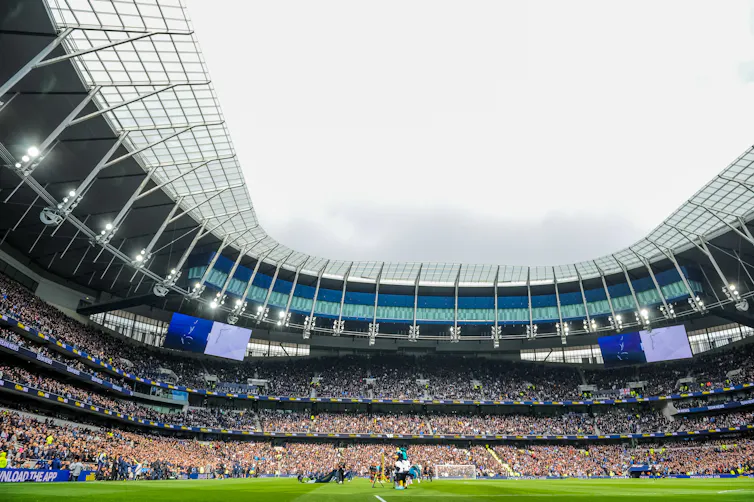
Clubs are clearly trying to attract more new fans who want to engage with such new offerings. While drinking on the pitch at the ground may have a marked difference for them, regular matchday attendees are more concerned that the commercial imperatives behind these additions have changed their matchday experience – and not for the better.
These offerings are built in order to make fans come earlier, stay later and spend more money. For many of the more traditional fans, often those who are older or those with less spending power, this is all on the periphery. Instead, a pre-match beer in a local pub and entry into the ground just before the kick off are still the norm.
A recent study conducting interviews with supporter groups during the 2024-2025 season found widespread concerns that clubs are increasingly prioritising short-term revenue generation over maintaining longstanding, community-based support.
For instance, one of the active fan groups at Manchester United has set out its aim: “To make Old Trafford the most vibrant, imposing, authentic football stadium in the Premier League.” The emphasis is on the traditional experience, with a local bar close to the ground not in the stadium itself. Gathering with a like-minded group who have a set of shared values is fundamental.
Does loyalty no longer count for anything?
There is a feeling that clubs are less interested in fan loyalty than extracting as much money as possible from every attendee. The traditional base is being shoved aside to make way for new fans and tourists who will splash a lot of cash on one-off visits. Such feelings have been bolstered by recent crackdowns on season ticket holders. This has included the introduction of minimum attendances at several clubs. For instance, Chelsea season ticket holders must attend 13 of 19 Premier League home games, while Manchester United season ticket holders must attend 16 out of 19. There have also been a swath of disqualifications for sharing tickets.
Some do feel clubs are trying to displace existing season ticket holders to free up seats for high-spending fans. Tickets for these open seats, especially those in sought-after areas of the ground – such as behind the dugouts – can be offered for sale on a match-by-match basis and with dynamic pricing, maximising revenue. Ticket prices have increased dramatically by an estimated 800% between 1990 and 2025, pricing many people out.
The modern fan is being increasingly viewed through the very different lens of consumerism. This transformation undoubtedly appeals to those who prioritise match-going as an experience – but not those who desire what they perceive to be authenticity.