This article is the second in a series discussing the results of Nature’s 2026 science-job satisfaction survey. It’s the latest edition of such surveys, which started in 2010; the last two took place in 2018 and 2021. The 2026 survey, created in partnership with Thinks Insight & Strategy, a research consultancy in London, launched in May and was advertised on nature.com, in Springer Nature digital products and through e-mail campaigns. It had 3,882 self-selecting respondents across 133 countries with 31% describing themselves as female and 19% as belonging to a minority ethnic group in their country of work. The full survey data sets are available at go.nature.com/4b2drrc.
Umar, a mathematics lecturer in northern Nigeria, has worked at his university for more than ten years. In that time, he’s had only one pay rise: in 2024, when the government raised the national minimum wage. With no inflation- or promotion-based adjustments, his income no longer covers his basic living costs. Instead, he has to borrow money, take on extra jobs and cut back on essential spending. “Unfortunately, my experience is not an isolated one” for Nigerian scientists, he says.
On the other side of the Atlantic Ocean, Ashley — an early-career physicist employed on a fixed-term contract in a university in the eastern United States — says she is much worse off than her parents, neither of whom have degrees. “It’s really messed up that I have a job that requires a PhD in science, yet I’m paid US$20,000 less per year than my father earned at his job 20 years ago, before accounting for inflation.” Ashley lists the things she can’t afford, including children (her pay won’t cover childcare, nor putting them through university) and home ownership. She thinks she did everything ‘right’ — for example, having jobs alongside her undergraduate studies to avoid debt. “Yet I am still locked out of the middle-class existence I have worked myself half to death for,” she says, adding: “It sucks. It really, really sucks.”
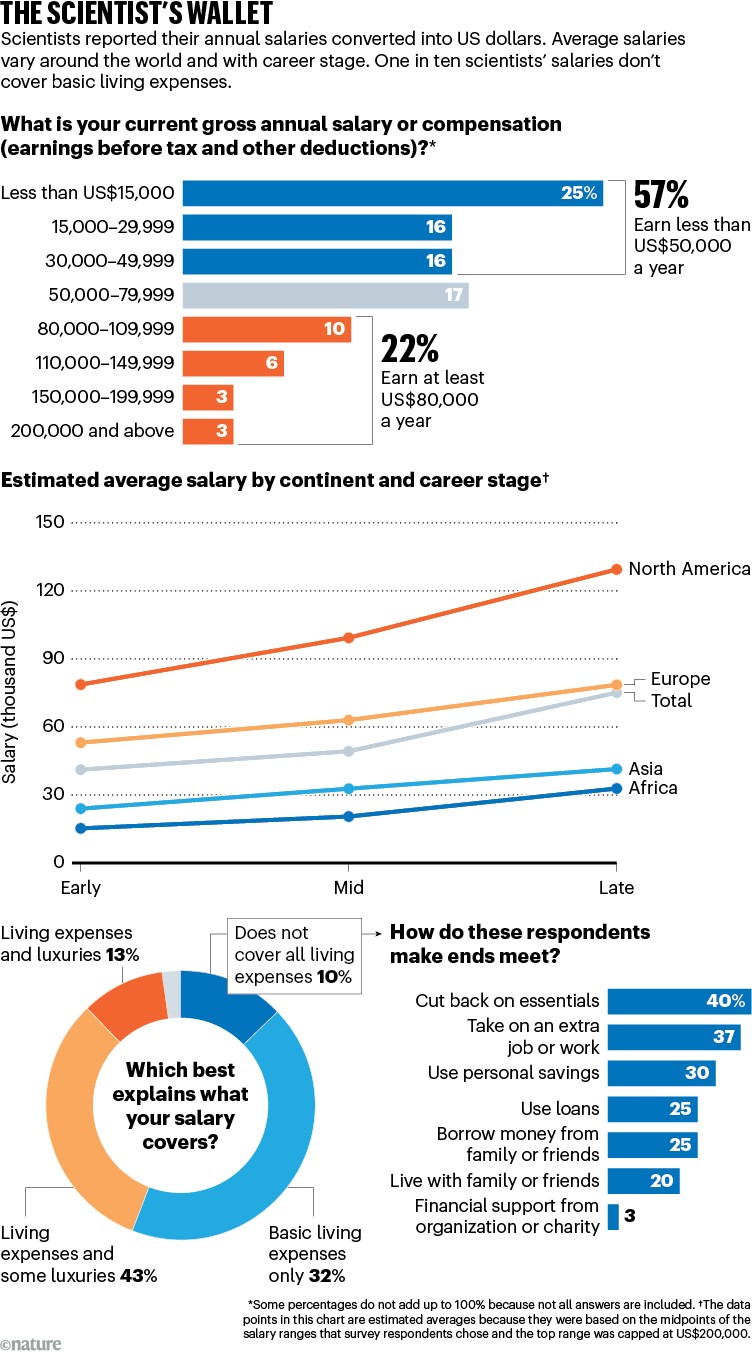
Umar and Ashley (not their real names) live in countries with vastly different resources for research and costs of living. But their stories reflect a global theme. When Nature’s careers team surveyed them and nearly 4,000 other scientists earlier this year about their salaries, less than half said they had received a pay rise in the past 12 months. Around one-third said that their salaries covered only basic expenses, and one in ten said their income failed to do even that.
The survey asked respondents to convert their gross (before-taxes) salary into US dollars, then choose the range into which it falls. More than half earn less than US$50,000 a year, and 22% make at least $80,000. In 2021, when Nature last ran this survey, 38% earned below $50,000 and 32% earned $80,000 or more. But this apparent drop in global salaries might be because of geographical shifts in those surveyed — particularly a rise in respondents from Asia, who made up 10% in 2021 and 39% this year. From continents with enough respondents for comparison, North American scientists earn the most, followed by those in Europe, then Asia (see ‘The scientist’s wallet’).
Industry salaries exceed those in academia by 66%, and more scientists in industry are satisfied with their salary (58%) than are those in academia (43%). But even in the private sector, some think that they should earn more. “It feels like I’m making less and less every year,” says a researcher working at a biomedical technology company in a large city in the midwestern United States, who, like many scientists Nature spoke to, asked to remain anonymous when discussing pay concerns.
She moved from working at a university to her current job four years ago after discovering that she was pregnant, because she judged childcare expenses to be unaffordable on her previous salary. But despite having a dozen years of work experience in both industry and academia, she says that she is still paid like a recent graduate.
“I love science and what I do, but I also feel undervalued,” she says.
Purchasing power
Scientists in the United States earn the most out of the ten countries in the survey that had more than 100 respondents, which means the results from these nations can be compared sensibly. Some 65% of United States-based scientists report earning more than $80,000 a year. The lowest wages are found in India, where 53% earn less than $15,000 a year. Comparing continents, the lowest salaries are found in Africa, where 61% earn below $15,000 per year.

We need to talk about salaries in science
However, the survey’s self-reported salary figures in converted US dollars do not reflect what those incomes can buy on the ground. A dollar buys more in India than in the United States: nearly five times more. According to purchasing-power calculations by the International Monetary Fund, a $15,000 salary in India is comparable to a $70,000 salary in the United States. When adjusted for purchasing power, average salaries in the survey for Canada overtake those in the United States, salaries in Germany come close to US ones and the wide salary gaps between emerging economies and wealthier nations shrink. And it’s important to note that a nation’s average salary in the survey can be skewed by sample biases with respect to factors such as location within a nation, employment sector and career stage.
In Brazil, where 21% of respondents report earning less than $15,000, a low or modest salary by US or western-European standards can “provide a reasonably comfortable life locally”, especially outside the most expensive cities such as Rio de Janeiro or Sao Paolo, says Haroldo Ribeiro, a physicist at the State University of Maringá in Brazil. “Still, I would not conclude that Brazilian scientists are generally well paid,” he says. Although salaries in public universities there have increased in the past few years, this comes after a long period of stagnation, he says, making it a recovery, not a raise.
Strings attached
Only 44% of people in the total sample are satisfied with their pay, but this varies between countries. Significantly more scientists in Canada (61%), Germany (68%) and the United States (55%) are satisfied with their income than the global average. The countries with at least 100 respondents that had the lowest numbers of scientists satisfied with their salary are Turkey (27%), China (39%) and Italy (40%).
China’s lower-than-average satisfaction with salary comes despite survey data suggesting that Chinese salaries have risen in US-dollar terms since Nature asked scientists the same question in 2021. Some 11% of Chinese respondents reported earning more than $80,000 this year, nearly doubling from 6% in 2021. Over the same time, in the United Kingdom, the proportion earning more than $80,000 grew from 19% to only 22%.
Salaries can vary substantially between China’s economically developed coastal areas, and its more-sparsely populated west, as well as between universities, says survey respondent Jingrui Sun, a freshwater ecologist at Yunnan University in Kunming, China. He describes his salary as “sufficient for me to live comfortably”, and says that it is common for research-intensive universities and institutions in wealthy parts of the country to offer employees performance-related pay, as well as housing subsidies and laboratory start-up packages.
But good salaries in China come with extra demands, Sun says. “Part of the package is linked to periodic assessments, and if the required targets are not met, remuneration in the following period can be reduced substantially.” He says a few of his colleagues have had their pay docked this year, after their university introduced more-stringent assessment criteria. “Such changes can have real consequences for staff retention, and have prompted academics to leave and take positions at other institutions,” he says.
Falling behind
Annual pay rises are not the global norm, the survey shows. Only 45% of respondents say they had received a raise in the previous 12 months, and 6% report a cut in pay. Industry researchers are more likely than the average result to have had a pay rise (54%), whereas the opposite is true for those who earn less than $50,000 a year (42% of whom received one).
Many survey-takers are frustrated that they aren’t getting paid more. One non-tenure-track US researcher who works in a biology department says that she exceeds her department’s tenure criteria and outperforms several of her tenure-track colleagues. Those colleagues are paid at least $20,000 more than her annually and get more research funding. “Yet my department chairs keep looking me dead in the eye and saying there’s no appetite for raises” for people like her, she says.

What’s the secret sauce for happy scientists at work? These eight countries offer some clues
When salaries grow, it’s often not enough. One researcher with a fixed-term contract in Pune, India, says his public-sector salary has not kept up with “skyrocketing urban inflation” in the city of seven million people. He says that rent, public transport and groceries consume most of his pay. “At this salary, no one can even think of home or car loans,” he says. Add a child, he says, and “it’s just a matter of survival”.
In Europe, where 27% of respondents report earning more than $80,000 a year, salaries vary massively between countries, says Norbert Bencze, president of Eurodoc, an organization for early-career researchers in Europe. “A good salary in the Netherlands is something very different from a good salary in Poland or Hungary.” However, living costs outpacing pay increases are a common problem across the continent, he says. “Some researchers have seen their actual purchasing power fall quite radically, in some cases cut in half over the past ten years, even though they got regular pay rises.” Although Nature’s salary survey was of post-PhD researchers and lab technicians, Eurodoc’s survey of doctoral pay in 2025 showed that PhD students earned below minimum wage in five European countries: Hungary, Ireland, Poland, Romania and Ukraine (see go.nature.com/4s7m1tu).
Fairer, more transparent salary-setting would be welcome, even if scientists’ wages continue to underwhelm, survey participants say. “It is not only about paying more, but about making compensation feel clear, consistent and linked to contribution,” says a materials scientist in India. People should understand how salaries are decided, what the path to a raise or promotion looks like and whether their pay is competitive with the market, he says.
Researchers who had not taken the survey felt similarly when Nature spoke to them about the results. In Portugal, academic salaries have risen in recent years, mainly to keep up with inflation, says Ronaldo Sousa, an aquatic ecologist at the Interdisciplinary Centre of Marine and Environmental Research near Porto. However, to get a pay rise that is substantially above inflation, scientists must move up the academic ladder, for example from assistant professor to associate professor. “We might publish a dozen high-impact papers in a year, but this will not necessarily result in any increase in salary,” he says.
Enjoying our latest content?
Log in or create an account to continue
- Access the most recent journalism from Nature's award-winning team
- Explore the latest features & opinion covering groundbreaking research