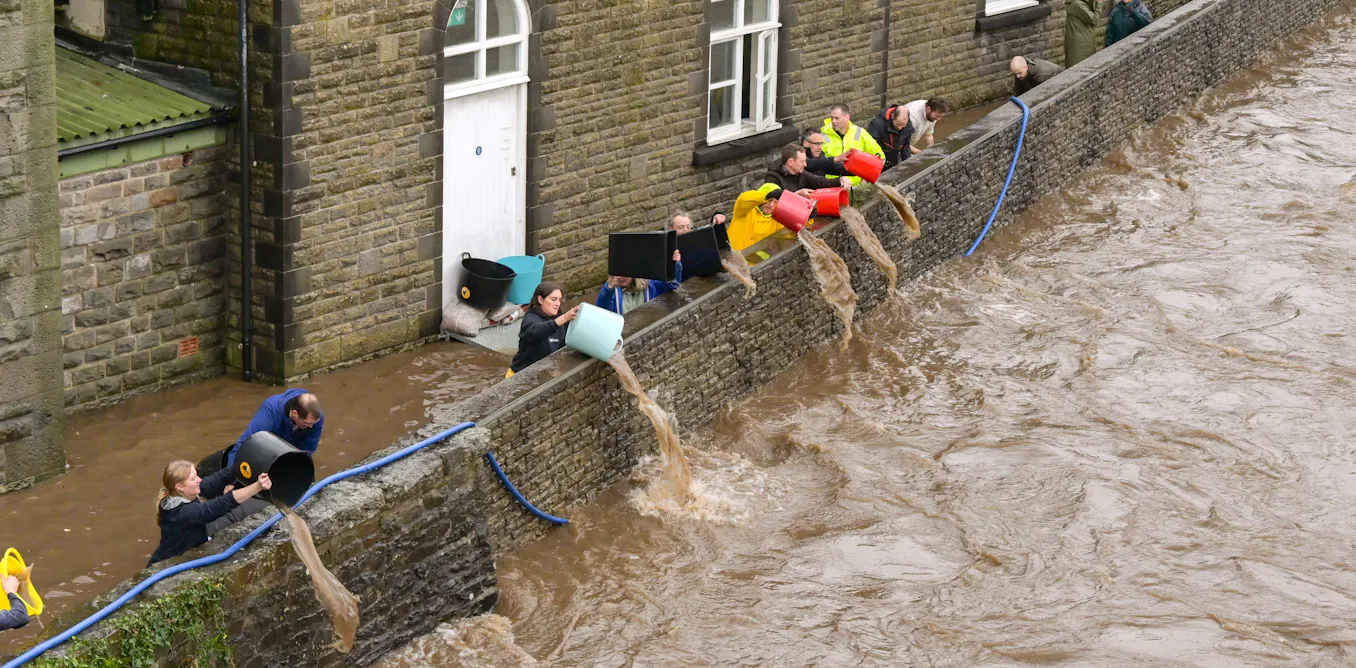
Climate change is increasing flood risk across the UK. As floods become more frequent and intense, communities are increasingly encouraged to become resilient and “live with water”. Yet in some flood-prone areas, residents are rejecting these calls, concerned that resilience is less about helping communities and more about transferring responsibility from institutions to citizens.
Resilience is often considered to be a positive idea. It suggests that people can adapt to uncertainty, to prepare for disruption, and recover quickly when floods strike. But my research suggests many communities are deeply uncomfortable with this messaging. Some reject it altogether.
My research with three flood action groups in north-west England drew on 17 semi-structured interviews and extensive participant observation over a five-year period.
One resident told me rather bluntly: “Resilience offers hope. But for me it’s false hope. A way of telling people, you’ll flood. What are going to do about it?”
Debates about resilience reveal more fundamental concerns: who should bear responsibility for managing the consequences of climate change? And how much can reasonably be expected of citizens and communities?
For much of the 20th century, flood management was dominated by efforts to protect people and property through engineered defences, embankments and complex drainage systems. Though this approach continues to this day, governments and policymakers now also encourage people to “live with water”, accepting that some degree of flooding is inevitable. Property owners are advised to install flood doors, change flooring and fit water-resilient furniture and kitchens. They’re also encouraged to sign up for warnings, arrange adequate insurance cover and develop action plans for when the waters rise.
On the surface, this seems sensible. Who would not want communities that can recover quickly from disasters? Yet it can sit uncomfortably with many of those expected to become more resilient.
Read more: Driving through water is the biggest cause of death during floods – here’s how it can happen
Many participants in our research expressed concern that resilience agendas shifted responsibility away from institutions onto communities. Several people I spoke to rejected the language of resilience because it implied they should adapt to repeated flooding and recover independently. As one participant reflected: “Resilience? It’s safe to say I’m not a fan. It’s all about (pointing a finger at themselves). You’re the one with the problem.”
Some residents were particularly sceptical about interventions such as property level resilience measures, which have become increasingly important for community flood risk management. Many viewed these measures as sticking plasters rather than solutions to the underlying causes of recurring flood risk. As one flood action group leader explained, “people want to see spades in the ground. They want to see defences going in”.
Resilience is becoming politically contested
Though often presented as a technical solution, resilience has become a source of contestation and debate. Rather than accepting expert advice at face value, many residents challenged authorities, questioned planning decisions, and demanded greater accountability and investment in flood protection.
Such concerns do not occur in a vacuum. Many flood-affected communities have experienced prolonged pressure on public services and local government budgets. Against this context, calls to become more resilient can be interpreted as yet another expectation that communities manage problems that were once addressed collectively.
In particular, many objected to resilience when it appeared a substitute for investment, protection and institutional responsibility. As one interviewee put it: “All these agencies and the council, they’re telling us to be resilient. But what are they doing to help us be resilient and protect us? What are they doing to be resilient themselves?”
Adaptation is essential. But if the notion of resilience is to receive public acceptance, it can’t become a substitute for public investment and institutional accountability. Communities are more likely to embrace resilience when it’s a collaborative effort involving local authorities, agencies and community organisations. Resilience then becomes a shared responsibility, rather than an expectation placed upon residents.
Communities are not rejecting adaptation. But they are questioning approaches that ask them to live with water while feeling increasingly alone in dealing with its consequences.