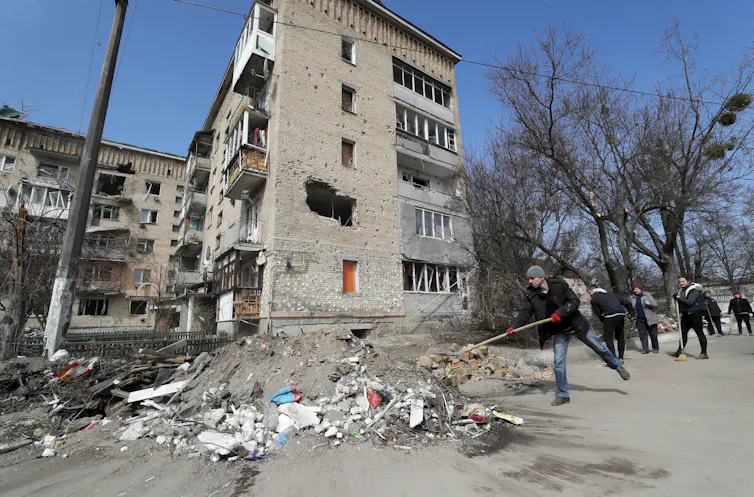
In the early days of the full-scale invasion of Ukraine, Russian armoured columns pushed east along the Zhytomyr highway towards Kyiv. Makariv, a small settlement of about 10,000 people 36 miles west of Kyiv, sat on their route. The town was wrecked in the month of fighting that ensued.
Roughly 40% of the settlement’s infrastructure was destroyed and the bodies of 132 executed civilians were recovered by April 2022. A 2026 account puts the total death toll as high as 238. Yet Makariv was never taken. It held, with Russian forces only taking control of about 10% of its land, and Kyiv held behind it.
“For some reason, Makariv was bypassed in the press,” said local museum curator Vitaly Gedz in a 2026 interview. “They wrote about Makariv twice, ‘it was occupied and then liberated’ … It was only 10% occupied, but it was very badly destroyed.”
On a visit to Makariv the previous year, we visited Gedz’s museum. Among the objects on display there were military maps recovered after Russian forces withdrew. Russian units were found to be carrying Soviet-era sheets, some of which dated back to 1969, with the modern border between Russia and Ukraine often added in pen.
In the early days of the invasion, Ukraine’s national road agency also asked communities to take down road signs to disorientate the advancing Russian columns. For a few weeks in 2022, being hard to read was a defence for Makariv. It is not any longer.
What the record cannot see
Ukraine’s recovery needs currently stand at nearly US$588 billion (£435 billion) – almost three times its GDP for 2025. This total is still moving. Damaged energy assets alone rose by roughly 21% between February 2025 and February 2026, when the fourth and fifth assessments of Ukraine’s reconstruction needs were released.
According to a recent BBC analysis, Kyiv is also now suffering more daily air raid alerts than at any time in the war so far. This bombardment comes weeks after the deputy speaker of the Russian parliament, Pyotr Tolstoy, urged strikes on Ukrainian cities “to demoralise the public”.
Funds for reconstruction across Ukraine must therefore be rationed, and this rationing runs on records with a particular shape. Ukraine’s national recovery and reconstruction is managed using two main online databases. The first of these is the Register of Damaged and Destroyed Property.
This register records which buildings have been harmed, who owns them and what they are worth. An entry is what allows households and businesses to claim compensation, and it will form the basis of any future reparation claim against Russia.
Getting a building on to this list is the responsibility of each individual council. The fourth assessment of Ukraine’s reconstruction needs found that, in December 2024, the register held information about “90+ percent” of damaged apartment blocks in Ukraine but only “nearly 60 percent” of damaged single-family houses.
One survey of a block registers hundreds of dwellings, while a street of houses must be walked gate by gate by staff small councils generally do not have. Like many other small settlements across Ukraine, Makariv is built mainly of houses, the category the register is worst at recording.
The second database is the Digital Reconstruction Ecosystem for Accountable Management. More commonly known as Dream, this is the official platform for the Ukrainian government’s public investment plan. Councils enter their own projects and funders choose from what is there.
The project data local authorities need to provide include descriptions, building designs, budget breakdowns, contracting and payment records and even photos, all of which take time and require money to record. This matters in towns and villages where public servants may not have the resources or experience.
We looked up what Makariv has put into Dream. Its council has registered 70 projects on the portal. Nearly 50% carry no costed amount at all, compared with 24% nationally. An uncosted project cannot be funded, bundled or compared.
This absence has consequences. In July 2025, we held a workshop in Makariv with around 30 residents, including teachers, clerical staff, museum workers and veterans. Interrupted by air alerts, they marked a plan of the settlement spread across two tables.
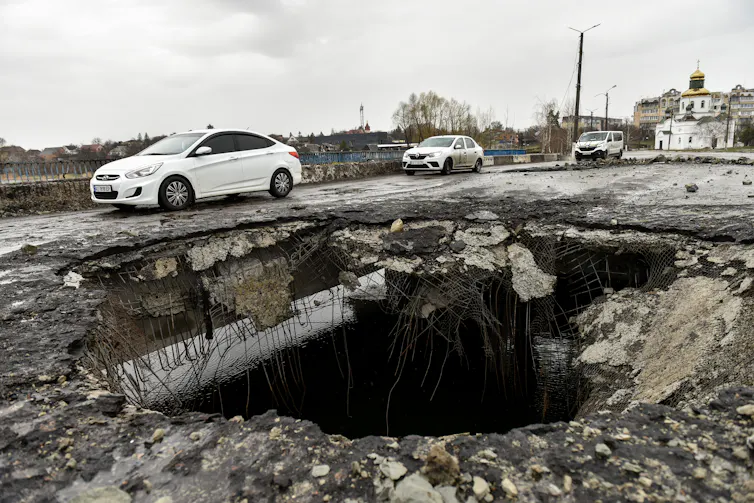
One woman traced her journey to work, which has grown from 5 miles to 20 miles since the overpass where the Makariv road crosses the Zhytomyr highway was wrecked in 2022. Others pointed out that when a fire breaks out in Makariv or the outlying villages, the fire engine now comes from Byshiv nearly 14 miles away as Makariv’s own station has been destroyed.
None of this argues against digital reconstruction. Ukraine’s systems are among the most transparent anywhere. It is an argument about who does the work of being counted, because a system that asks local authorities to enter themselves will always favour those with staff to spare.