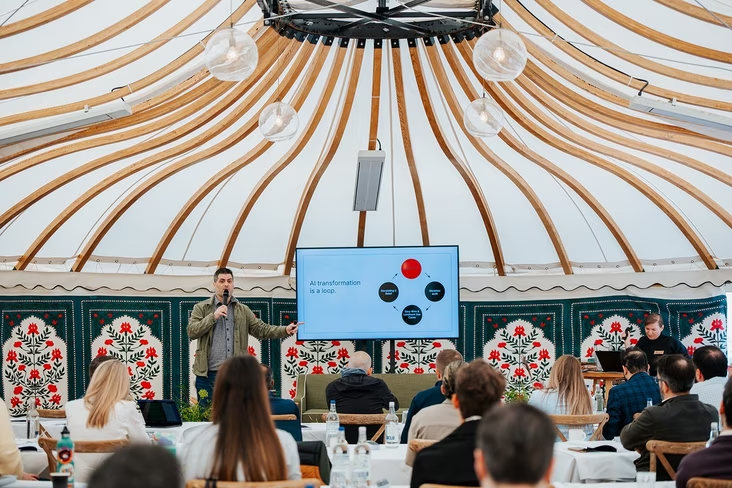
Grady Sokaras, Zapier’s head of sales, opened a session at the company’s private AI retreat with a line about the kind of product Zapier sells.
“A tool is never the solution,” Sokaras said. A company that buys the product and expects a transformation gets “one more piece of dependency or shelfware”.
The retreat was Zapier Outpost Windsor, held at Oakley Court, on the Thames near Windsor, from 8 to 10 September. Zapier covered flights, lodging and meals for the twenty-odd enterprise operations and AI leaders it invited, me included. The day’s sessions were led by Philip Lakin, Zapier’s director of AI transformation, and Alex Maxwell, who runs Zapier’s AI Leaders Lab.
The number Maxwell opened with was not Zapier’s. It came from MIT NANDA: 95% of enterprise AI initiatives fail to deliver measurable ROI, across some $30bn to $40bn in spending. “This is a system design problem,” the slide read. TNW has covered the same gap, including the McKinsey AI productivity paradox, the knowledge decay that AI output creates for other people, and Starbucks’s inventory tool.
Adoption is not the finish line
Maxwell framed Zapier’s own journey as “performing open heart surgery on ourselves”. Zapier ran hackathons, appointed champions, built fluency rubrics and tracked daily usage. The slide put AI adoption at 100%, “every team, every day”. Chief executive Wade Foster puts the figure at 97% in his published account.
“Adoption is not transformation. An AI fluent organization that doesn’t transform the work itself just gets faster at the same thing,” the next slide read.
UK business AI adoption has been widening, not deepening. Zapier’s argument is that the 95% failure rate is not a technology problem but an organisational design one. Design, in Zapier’s playbook, means roles, incentives and use-case architecture.
The three roles that have to exist
Sokaras described a structure the company sees in the organisations that get results in AI transformation and change management. Zapier runs itself the same way.
The first is a C-level issuer. Someone at the top sets the mandate, and the mandate has to carry constraints. A target of more growth without more headcount works. Open-ended encouragement does not.
“If there are no constraints and you’re just asking people to change, they’re not going to change,” Sokaras said.
The second is an AI transformation guild. Members come from different lines of business, and the guild work sits in their job description, not on top of it. Thirty to forty percent of their time is formally assigned.
The third is empowered users in the lines of business, the people who spot problems worth solving. They do not need to build anything. They need to understand what is possible well enough to recognise where the work is broken.
Above all three sits a single AI transformation leader, accountable for delivery. Sokaras called the role the “single throat to choke”.
Three types of use case, and one ambush
Role-based use cases create no dependency on a system. One person makes their own work faster, and nobody else relies on the output.
Team-based use cases are different, because several people rely on the output. This is where Philip Lakin told the room to bring in the operations team. A change upstream can break the work of everyone downstream. Sokaras called that “prioritization by ambush”.
Org-based use cases, such as an IT helpdesk, start with the business systems and operations teams, as product requirements. Cases can move up the ladder. Five people building their own version of the same dashboard is a signal, Lakin said, not five solutions.
The proof point: $1.2m from one workflow
Zapier’s own example was an always-on AI sales development representative workflow. Leah Miranda, on Zapier’s lifecycle marketing team, spotted the opportunity. The manual version cost 30 to 45 minutes of research per lead, and warm leads went cold.
The workflow triggers when a target account engages with content. It researches the company, pulls the contact from HubSpot and drafts a personalised email. An account executive reviews the package in Slack before anything goes out.
The numbers on the screen: $1.2m in pipeline and 184 deals created, 10 hours a week saved per account executive, 480 hours a year reclaimed, 4.5 full-time equivalents unlocked and $15,000 to $20,000 of tooling avoided. The figures are Zapier’s own, and I have not verified them. The slide called it the team’s landmark: high-value, cross-functional and visible to leadership. A case like that, Lakin said, is what gets people believing.

What the room pushed back on
The sharpest exchange came from someone who has run this play before, in the era of robotic process automation. A champion gets 20% of their time. A month later the champion’s manager has filled the time back up. In that case, Lakin said, the aligned leadership was never really there.
“Unless you create the time and you show that you actually value it, what you compensate, what you incentivize, and what you create time for, it’s never gonna happen,” Lakin said.
The vendor in the room
Every attendee can bring in Zapier’s forward-deployed engineering team to build one use case for free, whether or not it runs on Zapier.
“Working with AI is a human change management exercise, and people need fast rewards to feel like it is something that is for them,” Sokaras said.