Nvidia is more than just a leader in graphics and AI hardware. It has also become a titan of the networking industry with bigger datacenter Ethernet sales than any other vendor.
In Q2, Nvidia's networking revenues topped $17.5 billion. To put that in perspective, Cisco's revenue during that same period, across all products, was $17.3 billion.
GPUzilla's arrival as a networking power feels sudden, yet Jensen Huang started working towards this status in 2019 with the $6.9 billion acquisition of long-time networking partner Mellanox .
At the time, Mellanox wasn't a big name in Ethernet switching. The company was mostly known for its ConnectX NICs and InfiniBand switches. Outside of high-performance computing (HPC) and supercomputing clusters, and a big deployment at Microsoft, InfiniBand wasn't widely deployed in hyperscale datacenters.
Buying Mellanox allowed Nvidia to reposition itself as a system builder, which means something different in the context of distributed compute. Nvidia understood its datacenter customers weren't interested in buying GPUs or even servers; they wanted clusters of systems. For that, Nvidia needed interconnect and Mellanox's InfiniBand fit the bill.
Relentless co-design
Over the years, Huang has talked about co-design – designing components and software to work together for specific set of jobs rather than to be the best GPU, switch, or NIC. Its work with Mellanox is a prime example of that approach.
"Customers choose Nvidia for its tightly integrated compute and networking architecture, optimized for AI workloads," she told . That integration makes deployments easier and speeds time to market.
Ben Mabey, CTO of pioneering AI and machine learning company Recursion, told Nvidia's integration schemes won him over.
Founded in 2013, nearly a decade before ChatGPT made AI the subject of dinner-table discussion, Recursion sought to apply machine learning running atop GPUs to the problem of drug discovery.
This work involved churning through massive datasets which, Mabey tells us, now total more than 50 petabytes in size.
"When you think about our workloads, it makes LLMs workload training seem easy compared to the amount of data that has to be moved around," he told .
"In the biological space and sciences in general, it's not well appreciated just how big the data actually is," he added. "The internet's big, but in the grand scheme of things, the text that people are training on is actually pretty small, versus the petabytes of data that we have of these images."
Recursion's first cluster was a system called BioHive Zero which it cobbled together from GTX 1080 graphics cards originally intended for gaming systems. It used Ethernet to connect GPUs and ran into the limits of conventional networking.
So, for its second cluster, an A100-based machine with around 300 accelerators, Recursion went with Nvidia's Quantum InfiniBand switches and ConnectX NICs.
As Mabey explains it, buying its compute and interconnects from the same vendor vastly simplified optimization and troubleshooting. When Recursion reached out to Nvidia for help tuning the system, they were able to consider it as a single system, rather than discrete compute and networking resources. This level of integration had only previously been offered by boutique supercomputer builders like Cray or Atos (Eviden/Bull/whatever it gets renamed next).
A wider Spectrum
Nvidia hasn't always listed networking revenue as a single line item in its financials. However, based on CFO commentary and a little back of the napkin math we can fill in the blanks.
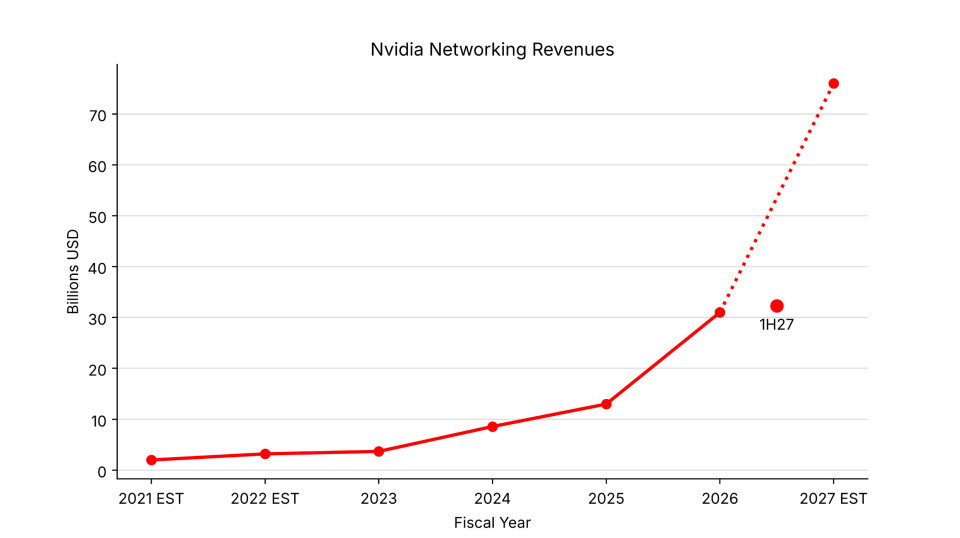
Nvidia's networking revenues have grown steadily since the Mellanox acquisition. At two moments, its revenue shot up suddenly.
The first came in the 2023 calendar year (FY24) after OpenAI kicked off the AI gold rush with the launch of ChatGPT.
The second spread across 2024 and 2025, when Nvidia started selling Blackwell-generation GPUs and then started to ship them in large quantities.
"I see two major inflection points, both coinciding with the Blackwell platform ramp: the introduction of NVLink switches and the accelerating adoption of Spectrum-X Ethernet switches for AI back-end networks, driven by growing deployments of Nvidia GPU clusters and increased attach rates of Nvidia switches, NICs, optics, and cables," Boujelbene said.
It was around this time that users started deploy to Ethernet switches in large volume across Nvidia clusters. Elon Musk's Colossus supercomputer was one of the earliest examples.
As we reported at the time, the first half of the 200,000-chip H100 and H200-based cluster came online in 2024 and, at the time, was among the largest ever clusters deployed using Nvidia's Spectrum-X Ethernet switches.
Meta has also made extensive use of Nvidia's Spectrum switches in its own training clusters, including at its million-GPU Prometheus site in New Albany, Ohio.
There are a couple reasons Nvidia's Spectrum-X offering is doing so well.
First, through a combination of Spectrum Ethernet switches, superNICs, and some clever software optimizations, Nvidia was able to replicate many of the qualities that made InfiniBand so attractive while also benefiting from significantly higher radix and interoperability.
Ethernet switches, including Nvidia's own, have historically offered more ports. The higher the radix, the fewer switches are necessary to support a cluster at a given port speed.
This often gets misconstrued to mean that InfiniBand can't scale beyond clusters of a certain size, which isn't necessarily the case. But for clusters exceeding a certain number of GPUs, Ethernet is often more economical because it requires less equipment while achieving similar utilization.
That said, Nvidia's Spectrum-X isn't exactly unique. Broadcom, Cisco, AMD and others have managed to achieve utilization similar to InfiniBand through various investments in smartNICs and switches.
Nvidia's main differentiator, as Mabey and Boujelbene noted earlier, is the level of integration between the compute and networking.
The next frontier
Then Blackwell hit the market, enabling much greater scale and creating a surge in Nvidia's networking revenue.
Prior to Blackwell, Nvidia's NVLink and NVSwitch interconnect tech had largely been limited to single systems with up to eight GPUs. With the launch of the GB200 NVL72, these NVSwitches were broken out into dedicated appliances. (And yes, we remember GH200 NVL256 and NVL32, but from what we can tell these were never shipped in any meaningful volume, if at all.)
For every NVL72 rack system sold, Nvidia also sold nine NVSwitch trays, which enabled the system's six dozen GPUs to function as a single enormous GPU. This effectively guaranteed steady networking revenue growth: even if customers didn't buy Nvidia's scale-out switches, if they wanted NVL72 racks, they were automatically buying NVSwitch.
"We estimate that NVSwitch now accounts for roughly one-third of Nvidia’s networking revenue, up from virtually zero less than two years ago," Boujelbene told . "This underscores how quickly NVLink switching has become a major growth engine for Nvidia’s networking business."
Nvidia is now moving to grow its networking business even further with a new licensing program.
Until recently, Nvidia's NVSwitch tech was limited to its own accelerators. However, with the introduction of NVLink Fusion early last year, Nvidia opened the interconnect tech up to third parties to license.
Many chip designers, including Marvell, Qualcomm, Arm, Fujitsu, MediaTek, and d-Matrix, have announced plans to develop CPUs and XPUs using NVLink Fusion. The adoption of the interconnect opens the door to additional NVSwitch sales, as the chips using NVLink Fusion still rely on them for chip-to-chip communications, and there's no other place to get them, as Nvidia has yet to license out NVSwitch.
"NVLink Fusion allows Nvidia to extend its networking footprint beyond its own GPUs into the rapidly growing custom accelerator market. I see it as a strategic move to capture a larger share of AI networking spending, even in clusters that do not use Nvidia GPUs," Boujelbene said.
Nvidia's networking ambitions don't stop there.
"Nvidia continues to pursue opportunities in emerging networking domains as network requirements evolve to keep pace with increasingly demanding AI workloads," Boujelbene added. "The latest example is scale-in networking, designed to address the new requirements of agentic AI, while innovations such as CPO will help overcome growing bandwidth, power, and scalability challenges." ®