How do you mourn an abusive alcoholic parent? French writer Anne Pauly’s Before I Forget, translated by Dina Leifer, addresses this question in a deeply personal account of grief.
We accompany Pauly’s protagonist and narrator, Anne, as she cares for her ailing father, looking after his house and his personal grooming. Having grown up witnessing her father’s recurrent violence towards her mother, Pauly addresses some very serious topics. She expresses anger towards people who cannot understand why victims of domestic abuse don’t simply leave, saying:
I’d like to see you, on a Sunday evening, your eye black and blue and your nightshirt torn, hurriedly pack a case for a strip-lit emergency refuge. I’d like to see you, bombarded by insults and threats, find the energy to run to the station with your children and get on a train, not knowing whether you can ever come back.
In the present, this giant who would chase Anne’s mother around the kitchen table or lock his family out of their home in a drunken rage has been reduced to a sunken form in a wheelchair. These two versions of him co-exist in the narrative.
We are invited to listen to her father’s recollection of Anne’s childhood – which was a “different time” when misogyny was rife. We hear his refusal to see his failings even in retrospect and his dismissal of his alcoholism as nothing excessive. Though this could be construed as a form of mitigation, it allows – even explicitly encourages – Pauly’s readers to reach their own judgment of her father, rather than directing how we should respond.
Before I Forget is an uncomfortable read at times. Anne says that her parents hurt each other deeply, but the reality Pauly describes is that of a violent alcoholic and his abused wife. This generosity towards her father is perhaps Anne’s way of processing her grief, enabling her to continue caring for him as she strives to find the humanity inside a monster.
In writing about trauma Pauly is also acerbically funny and no-one is spared from her arch humour. From a doddery priest and an inebriated funeral home director to an overbearing nurse and overly enthusiastic LGBTQ+ activists, she brings to life a quirky cast of secondary characters who variously support and frustrate Anne’s attempts to honour her father during his end-of-life care and after his death.
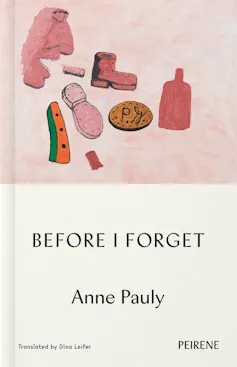
Translator Dina Leifer succeeds in conveying the humour and the pathos of the author’s self-reflection, and grapples admirably with a striking number of culturally specific references. In the first few pages alone there are mentions of the French electrical goods store Darty, the supermarket chain Leclerc, a jingle for the BN biscuit brand, and a range of Parisian suburbs (not to mention coffin styles named after French historical figures). Leifer also conveys the complexity of the relationship at the core of the novel, encapsulated in Anne’s acknowledgement that “I always ended up hugging, kissing and caring for that body whose madness and violence I’d feared for so long”.
When death comes, it drives a wedge between Anne and her brother. Jean-François is scandalised by the cost of coffins, disinterested in sorting through their father’s things, and unwilling to engage with Anne’s grief. Anne sinks deeper into a sense of inadequacy as she feels she could have done more for her father. She wrestles with the tension between the memory of her mother and the instinct to love her father.
It is hard to comprehend fully how such a bully can be so beloved by a victim of his rage, especially when he never truly acknowledged his failings in his lifetime or asked for forgiveness. Yet, it is surprisingly poignant when Anne discovers her father’s scoring system for battery lives, showing a rare humanity in his attention to the mundane, and there is a further emotional curveball when she receives a revelatory letter from her father’s teenage sweetheart.
Throughout, Anne emerges as profoundly human in her frank exposure of the grief she cannot contain. Revealing to us the things she feels unable to say to those around her, Pauly establishes herself as a strikingly sardonic new voice in French literature, and Liefer as a talented translator attuned to the complexity of human grief.
This article features references to books that have been included for editorial reasons, and may contain links to bookshop.org. If you click on one of the links and go on to buy something, The Conversation UK may earn a commission.