Oil companies say federal law should block state climate deception claims.
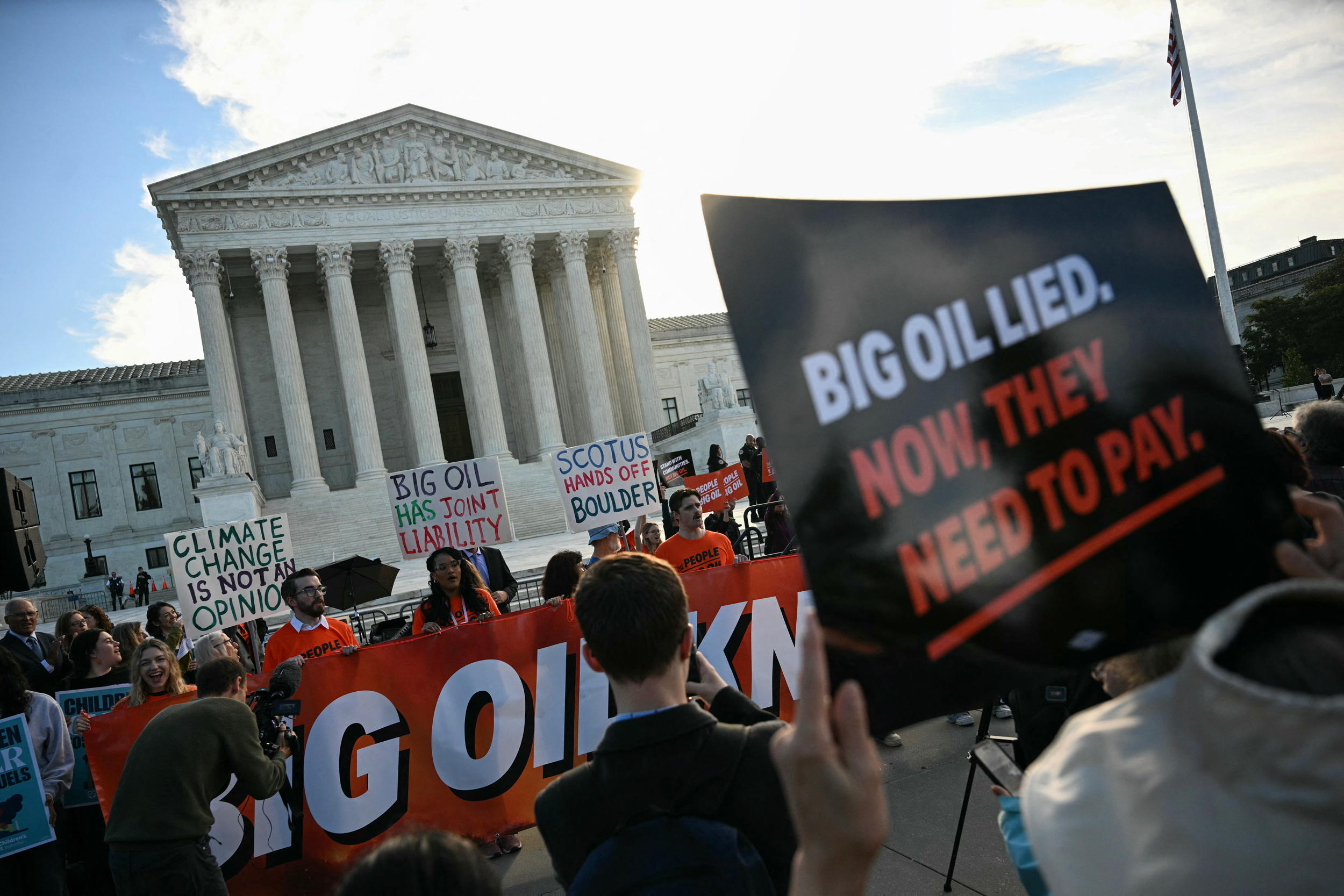
The US Supreme Court heard arguments from oil companies on Monday that could help decide the fate of more than two dozen lawsuits accusing the industry of deceiving the public about climate change. The claims seek potentially billions of dollars in damages to help pay the costs imposed by climate-related extreme weather.
Yet the questions before the court did not focus on the merits of these claims but instead on technical legal matters over whether they should proceed at all.
The case being argued was brought in 2018 by the city and county of Boulder against ExxonMobil and Suncor Energy in Colorado state court. While the case and dozens like it have survived multiple appeals in state and federal courts, the oil companies are asking the Supreme Court to declare that federal law preempts state and local governments from bringing such claims.
“This case represents an unprecedented effort to use state law to regulate global conduct,” said Kannon Shanmugam, arguing for Exxon and Suncor. In effect, Shanmugam said, Boulder is attempting to use state law to regulate oil company activity around the world. “If Boulder’s claims are allowed to go forward, some 90,000 municipalities across the country would have the ability to make national and international energy policy by asking juries to impose catastrophic damages on selected fossil fuel producers.”
But Boulder and dozens of other plaintiffs have argued their claims do not attempt to impose any limits on oil companies at all—the Boulder case seeks damages, not an injunction on any activity.
“This case is not about emissions,” said Kevin Russell, who argued the case for Boulder. “It’s about deception.”
Oil companies and conservative groups have been ramping up a campaign to block the lawsuits from proceeding as they inch closer to trial. Some states have enacted laws barring such lawsuits, and Republicans have introduced federal legislation that would shield oil companies from climate liability claims. The Trump administration has also intervened in several state cases, including Boulder’s, to try to block them from moving forward. Many scientists whose work is being cited in the cases have been the subject of more than 100 public records requests from conservative groups seeking information about their work and funders, according to Politico.
The first question that arose at Monday’s hearing, posed by Justice Clarence Thomas, is whether the court has jurisdiction to hear the case at this stage because no ruling has been issued.
The oil companies contend that the proliferating lawsuits are already causing sufficient harm and that the court should decide now whether the cases should proceed. Several justices suggested they thought it might be too early to intervene.
“I think Boulder’s best shot is on the jurisdictional question, whether this case is too early,” Michael Gerrard, faculty director at the Sabin Center for Climate Change Law at Columbia University, said in an interview.
The justices also probed the arguments of whether federal law preempts a state claim about climate change and emissions, either through the Clean Air Act or the Constitution.
Several of the conservative justices seemed inclined to agree that federal law preempts at least some of Boulder’s claims, Gerrard said.
The oil companies’ lawyers have argued that the Clean Air Act preempts any claims against oil companies tied to climate pollution. They also argue that the Constitution itself gives the federal government exclusive control over interstate pollution.
Russell argued that Boulder’s claim does not seek to limit pollution, and that there is nothing in the Clean Air Act or the Constitution that would bar states from taking actions that have a secondary effect of reducing pollution, such as imposing a gas tax or, in this case, seeking damages from oil companies.
Justice Samuel Alito was not at the hearing after recusing himself last week. While Alito gave no explanation for the decision, he had been under pressure to do so because he owns stock in oil companies that are party to other lawsuits that would be affected by the court’s decision.
Alito’s absence leaves open the possibility of a tie vote, which would allow the case to move forward.
Supporters of the case held rallies outside the court, calling on the justices to let it proceed.
“Boulder, like other cities and counties across the country, is confronting realities associated with climate change every day, from wildfires and floods to drought, extreme heat, and growing pressures on our water and infrastructure,” said Boulder’s city manager, Nuria Rivera-Vandermyde, in a statement after the hearing. “The legal question before the court is whether taxpayers must bear these costs alone or must the defendants also pay their fair share for the harms they have caused.”
Boulder won supportive briefs from not only climate advocacy groups and Democrats but also many academics and former Environmental Protection Agency officials, including some appointed by Republican presidents.
Many of the cases brought by states and local governments have been paused pending the outcome of the Supreme Court’s ruling in the Boulder case. The decision, expected by the end of the court’s term in June, could bring those claims to an abrupt halt or set the stage for trials to finally begin.
Nicholas Kusnetz is a reporter for Inside Climate News. Before joining ICN, he worked at the Center for Public Integrity and ProPublica. His work has won numerous awards and citations, including from the Society of Professional Journalists, the Society of Environmental Journalists, the Overseas Press Club, the Society of American Business Editors and Writers, and others. His articles have appeared in more than a dozen publications, including Wired, The Washington Post, Businessweek, The Nation, and The New York Times. Nicholas can be reached on Signal at nkusnetz.15.
This story originally appeared on Inside Climate News.