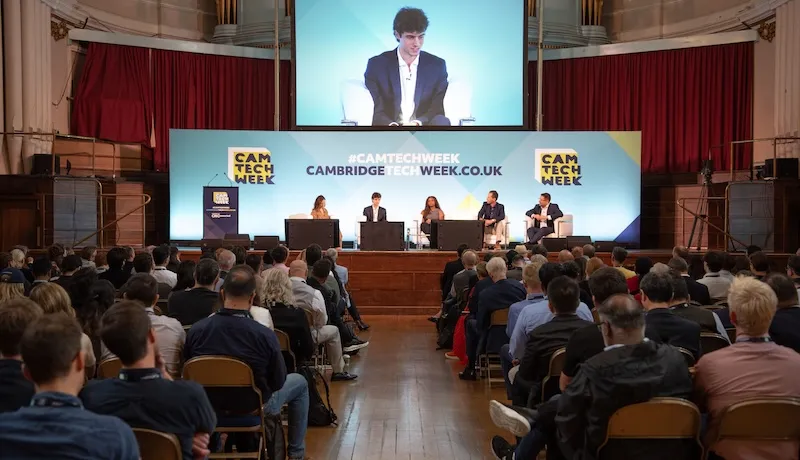
More than 1,700 delegates from 52 countries attended Cambridge Tech Week this year, a 15% increase on 2025, as the event placed a growing emphasis on turning deep-tech research into commercial businesses.
The five-day event, held from 14 to 18 September, brought together founders, investors, researchers, policymakers and technology companies for discussions spanning artificial intelligence, quantum computing, healthtech, energy, infrastructure and security.
Held under the theme How Deep Tech Changes the World, much of this year’s programme focused on the challenges involved in moving emerging technologies beyond research and into commercial applications.
Commercialisation, access to investment and collaboration between researchers and industry featured prominently, alongside discussions about the infrastructure needed to support technologies including AI and quantum computing.
More than 80 emerging companies and scaleups exhibited at Innovation Alley at Cambridge Guildhall, while the event’s pitch competition showcased a group of early-stage technology companies.
won the 2026 Cambridge Tech Week Pitch Competition for its wearable neurostimulation technology, which is being developed to help stroke patients regain movement.
The startup was founded by chief executive Sam Kamali, whose motivation for developing the technology followed his cousin suffering a stroke aged 11 after a bleeding brain tumour caused by previously undiagnosed leukaemia.
Agritech startup was named the People’s Choice winner. The company is developing advanced photonic materials designed for use in greenhouse agriculture.
The two companies shared a £7,500 prize.
The event also attracted a significant international presence, with delegations attending from countries including Finland, Romania, Estonia and Serbia.
The British-Serbian Chamber of Commerce brought more than 20 companies to Cambridge, with eight Serbian businesses exhibiting across areas including AI, telecommunications, cybersecurity, agritech, healthtech and biotechnology.
Other parts of the programme focused on some of the infrastructure and policy challenges associated with the next generation of technology.
Sessions examined the growing energy demands associated with AI, sovereign computing capabilities and the increasing crossover between civilian and defence technologies.
The Big Tech Debate focused on dual-use technology and the changing boundary between civilian and defence innovation, while separate sessions examined the development and commercialisation of AI, quantum and health technologies.
Speakers during the week included BenevolentAI founder Kenneth Mulvany, author Calum Chace, CMR Surgical co-founder Mark Slack, Balderton Capital general partner Suranga Chandratillake and LinkGevity founder Dr Carina Kern.
Michaela Eschbach, CEO of CWConnected, which organises Cambridge Tech Week, said: “Cambridge Tech Week was a powerful demonstration of Cambridge’s global leadership in deep tech.
“Across five extraordinary days, we brought together the people, ideas and technologies with the potential to change the world, creating connections and conversations that will continue long beyond the event itself.”