The new film Whalefall, released on 16 October, takes viewers into the belly of the beast — quite literally. The survival thriller, based on Daniel Kraus’s 2023 novel, follows university student Jay Gardiner (played by Austin Abrams) as he is accidentally swallowed by a sperm whale while scuba diving. Viewers watch with apprehension as Jay treks through the whale’s multi-chambered stomach, looking desperately for a way out — all while reckoning with the anniversary of his father’s death.
The making of both the novel and its subsequent film relied heavily on collaboration with scientific advisors. One of them — Joy Reidenberg, a comparative anatomist at the Icahn School of Medicine at Mount Sinai in New York City — says she and the storytellers discussed everything from what whale species would work best for the “modern-day Jonah” story to what damage Jay might incur while inside various stomach chambers.
Here, Nature speaks to Reidenberg and Ilias Foskolos, who researches deep-diving toothed whales at both Aarhus University in Denmark and Stanford University in California, to help separate science from fiction.
Jay dives offshore in California and gets mixed up with a giant squid and accidentally swallowed. Is that possible for a sperm whale?
Foskolos: There are a few problems with this. Sperm whales are usually not in coastal areas. They’re oceanic predators. They won’t feed on something that is at shallow depths. Most evidence from sperm whale stomach contents suggests that they consume quite small prey. They consume mostly squid of about 30 to 40 centimetres long — so nothing even close to a person’s size. Sometimes they go for bigger squid, but that’s not very common.
Reidenberg: Sperm whales don’t have much of a mouth to carry anything. But the throat passageway is actually quite large. And if it’s a very large sperm whale, which is the premise for this movie and for the book, then it’s physically possible. Behaviourally, could this ever happen?
You have to realize that the premise of the whole thing is that this sperm whale is pulling [Jay] in accidentally [with a squid]. If you were eating a gummy bear, and someone put a pebble next to it and you put the pebble in your mouth with the gummy bear, you'd probably spit everything back out again because that’s not really what you want to eat. So how likely is it for a sperm whale to ingest a human? About as likely as you are to ingest a rock.
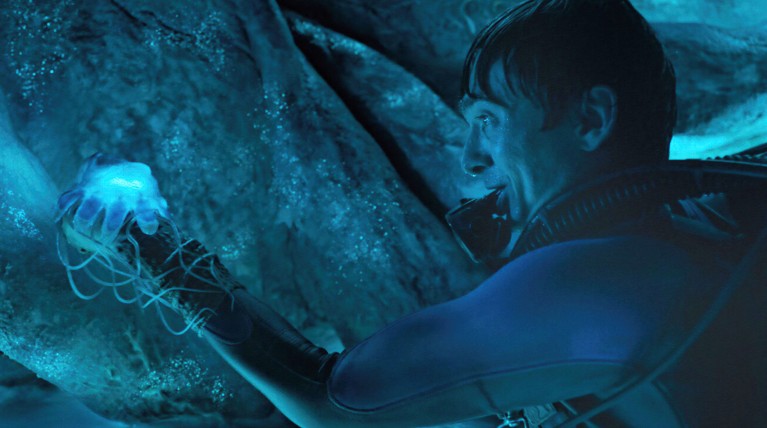
Could a human survive inside a whale’s stomach chambers?
Reidenberg: I think so, if they had enough of the right protection.
The first chamber is supposed to be a mechanical mushing chamber. What that stomach is trying to do is break [Jay] into smaller digestible units. If you’ve got something that’s punching the walls against the person, or constricting like a boa constrictor might around someone’s chest, would it stop that person’s heart? Usually, these muscles are trying to mash up something that doesn't have bones. Humans have bones. So now we’re dealing with a form of resistance that this whale’s not used to encountering. And then add the scuba tank, which is pretty incompressible. It’d be pretty unlikely that the stomach would constrict all of the chest, because you still have that area where the ribs meet the tank.
If the scuba diver has a dry suit on, then stomach acids [in the second chamber] are unlikely to get into that dry suit. Only the areas that are exposed are the areas that would start to burn. And you don’t necessarily die from burns, but that would not be a pleasant experience.
What does the term ‘whale fall’ mean to scientists?
Foskolos: What we call whale fall is just the remains of a dead whale along the sea bottom, which creates entire ecosystems, because they can at times fuel different communities of animals depending on the state of decomposition of the whale, which is amazing.
Reidenberg: There isn’t anything else really growing down there that can provide nutrients. There are lots of scavengers around waiting for something. And when a whale fall comes down, it's like manna from heaven. Everything comes from miles around to feed on this carcass, and it develops its own community.
Enjoying our latest content?
Log in or create an account to continue
- Access the most recent journalism from Nature's award-winning team
- Explore the latest features & opinion covering groundbreaking research