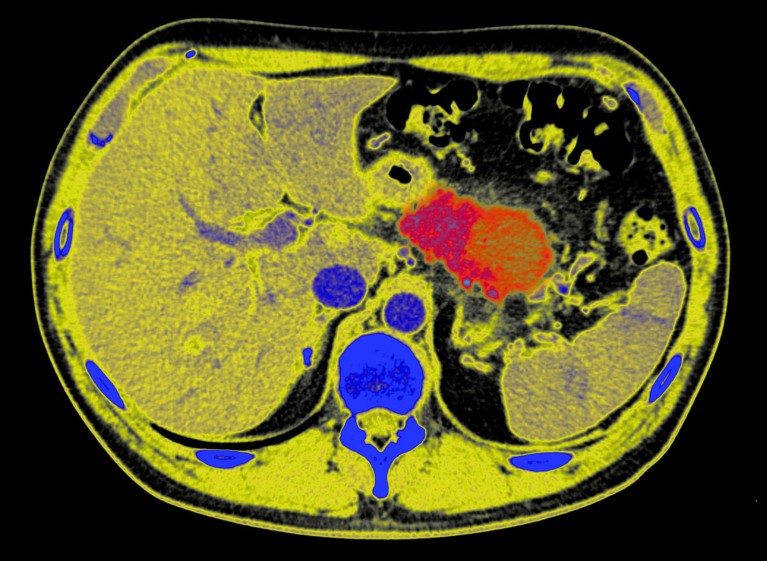
In this approach, tissues that are growing abnormally are treated to keep them from turning cancerous and spreading. Interception is already being trialled for breast and skin cancers, among others. But now the success of a new drug that quashes pancreatic tumours is raising scientists’ hopes that interception could succeed even for this recalcitrant cancer.
CRISPR makes enhanced cancer-fighting immune cells inside mice
Cancer interception was one of the main themes at last week’s American Association for Cancer Research Conference (AACR) on Pancreatic Cancer in San Diego, California — the first such meeting since the US Food and Drug Administration approved the landmark pancreatic-cancer drug daraxonrasib (Rasonque) in August. Its success has renewed optimism that researchers can combine it or other emerging therapies with early-detection methods to revolutionize how pancreatic tumours are treated.
A combination of early-detection techniques and interception is “going to be the breakthrough strategy that really changes survival”, says Diane Simeone, director of the Moores Cancer Center at University of California San Diego Health. At the AACR meeting, Simeone argued that such an approach could more than triple the proportion of people who survive for five years after being diagnosed with pancreatic cancer, from 13.7% to 50%.
It’s a lofty aspiration, but other researchers are also eyeing interception. “We’re so excited that we are at this juncture now to even be considering this,” says Anirban Maitra, director of the Perlmutter Cancer Center at New York University Langone Health in New York City. “This wasn’t possible even a few years ago.”
Precautionary principle
Pancreatic tumours are notoriously wily: they are often highly invasive, impervious to most treatments and can wrap themselves around major arteries and veins, making the growths difficult to remove.
Even so, five-year survival rates can top 80% when such tumours are caught early, Simeone says. But the symptoms of pancreatic cancer are vague, and people often do not seek medical attention right away. More than half of pancreatic cancers are not diagnosed until after the disease has spread to other organs — a statistic that has remained mostly unchanged since Simeone first opened her cancer research laboratory 30 years ago.
Cancer-fighting antibodies with a one-two punch take aim at tumours
To improve early detection, she and her colleagues have launched a clinical study called PRECEDE, which aims to enrol 20,000 people who have a family history of pancreatic cancer, certain abnormal growths on their pancreas or a genetic profile that elevates their risk of the disease. The goal is to see whether — and by how much — frequent monitoring for pancreatic cancer will improve survival. So far, the team has enrolled a little more than 12,000 people, Simeone said at the conference. More than 50 participants have been diagnosed with pancreatic cancer — many of them at the earliest stages of the disease1.
The PRECEDE team plans to use samples from the study to evaluate experimental blood tests for early cancer detection, and to explore artificial-intelligence methods to detect abnormalities on the participants’ scans before they become visible to the naked eye.
In addition, Simeone says the PRECEDE consortium might test whether therapies such as daraxonrasib can boost survival rates when given immediately after surgery to remove pre-cancerous growths or early-stage tumours. Currently, daraxonrasib is only approved for advanced cancers.
Testing tolerance
Researchers at the AACR meeting heard about studies in mice that suggest the approach could work. Ben Stanger, a cancer researcher at the University of Pennsylvania in Philadelphia, and his team studied mice bearing mutations in a gene called Kras; these mutations produce proteins that can cause cancer. When the mice developed tiny, precancerous pancreatic growths, the researchers administered a drug that, like daraxonrasib, disarms KRAS and related cancer-promoting proteins. The treatment improved the animals’ survival2. “It is super exciting,” Stanger says, but adds that it could take years to determine how best to deploy the technique in people.
Enjoying our latest content?
Log in or create an account to continue
- Access the most recent journalism from Nature's award-winning team
- Explore the latest features & opinion covering groundbreaking research