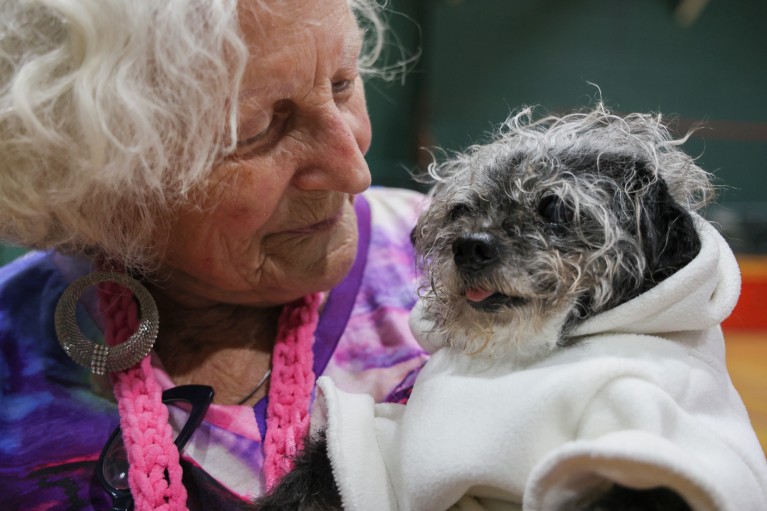
Vera Gorbunova has attended many a longevity conference over her decades of studying ageing. But never one quite like this.
Earlier this month, Gorbunova, a researcher at Rochester University in New York, joined scientists from industry and academia — and a fair few of their dogs — for the Animal Longevity Summit in Toronto, Canada. Given it was the inaugural summit, it was small. But it highlighted a growing interest in the science of extending the lifespan of pets.
On the agenda were presentations by academic researchers such as Gorbunova, who studies ageing in various animal species. Others presented projects about understanding cancer in dogs, regeneration in axolotls and the genetics of mammals that thrive in extreme environments. Alongside the university scientists were researchers at companies pursuing gene therapies for dogs, probiotic kibble for cats, and cryopreservation of pets.

Big dogs age faster than little ones — rogue ‘jumping genes’ might be to blame
“It was maybe a somewhat different crowd of people than you see at the typical ageing conferences,” Gorbunova says.
The conference reflected a market reality: as the pursuit of increasing human longevity and healthspan has grown, fuelled by hefty investment, it only stands to reason that some of that interest would spill over to pets, says Cameron Hurlburt, a senior analyst at Ani VC, a venture-capital firm in Miami, Florida. The US pet- and animal-health market is estimated to be worth US$150 billion and could grow as more people in the United States purchase pet health insurance, he says.
Muscle for moggies
Most of the current efforts to promote longer pet healthspans focus on improving animal diets, including probiotic formulations, Hurlburt says. And when it comes to therapies, many companies are looking to repurpose drugs that are already approved for humans, rather than starting from scratch.
But not everyone is taking that approach. The Cat Health Company in Bucharest presented its strategy for identifying new drugs for ageing-associated diseases in cats, including a muscle-wasting condition called sarcopenia, and kidney disease. The company has two compounds in clinical trials now, with others on the way, says Alex Băciţa, co-founder and chief operating officer of the company.

How ageing changes our genes — huge epigenetic atlas gives clearest picture yet
Others are venturing into gene therapies. Rejuvenate Bio, a biotechnology company in San Diego, California, is working on one to treat mitral valve disease, the most common heart condition in dogs. But co-founder and chief scientific officer Noah Davidsohn hopes that this will be just the first use for the therapy, and that the same treatment will eventually be used to treat metabolic syndromes and improve longevity. Rejuvenate has worked to decrease the cost of manufacturing gene therapies, which are complex treatments, to a level that would be compatible with the pet market.
Another company, called Genflow Biosciences, is pursuing a gene therapy to enhance longevity and reduce sarcopenia in dogs. If the drug shows success, the company hopes to sell it to a larger animal-health company, and then use the proceeds to help to fund studies of the same approach in humans, says Eric Leire, founder and chief executive of the firm in Brussels.
Academic researchers also stand to gain by interacting with the latest companies to spring up, said Noah Snyder-Mackler, a comparative geroscientist at Arizona State University in Tempe, before the meeting. Government grants for studying dogs often focus on applying the results to human health, rather than canine health. That means that academic researchers might need to collaborate with industry to conduct studies that lead to treatments for dogs.
“We don’t have the resources to follow up with dog-centric interventions,” says Snyder-Mackler, a researcher on the Dog Aging Project, a large collaboration to study ageing in pooches. Gorbunova says she enjoyed the meeting. “It was a revelation to me to see how interested people are in extending the life of their pets,” she says.
Enjoying our latest content?
Log in or create an account to continue
- Access the most recent journalism from Nature's award-winning team
- Explore the latest features & opinion covering groundbreaking research