It’s no secret the technology sector has a serious waste problem. Around 62 million tonnes of e-waste was produced globally in 2022 alone, which is equivalent to around 7.8kg per person per year, according to the Global E-Waste Monitor 2024.
Yet, with Gartner projecting worldwide IT spending to total $6.37 trillion in 2026, the AI boom is continuing to drive major infrastructure development. According to Gartner, data centre systems and IaaS in particular have seen significant growth, at 62.5% and 29.3% respectively. This has sent component prices skyrocketing for all users as suppliers struggle to keep up with unprecedented demand.
For many businesses already tightening their purse strings due to wider macroeconomic challenges, these soaring costs may be putting new hardware purchases out of reach.
Instead, businesses are beginning to reevaluate pre-owned technology. According to a 2024 Bitkom study, 15% of companies it surveyed said they were already using refurbished technology, with a further 15% saying they would consider using it in the future. More than half (61%) said more companies should consider the use of refurbished devices.
This growing confidence in refurbished enterprise hardware, combined with sustainability targets and the desire to cut costs, means extending the life of existing equipment makes increasingly good business sense.
Newer isn’t always necessary
Although the AI boom is bringing forward unprecedented demand for compute, it doesn’t make a circular economy in IT impossible.
“Technology has always been circular,” says Matt Harris, SVP and managing director for UKIMEA at HPE. “AI is just today's latest technology accelerator.”
Sign up today and you will receive a free copy of our Future Focus 2026 report - the leading resource for IT decision-maker insight on priorities and investment areas in AI, security and more.
Harris tells that while there may be an argument that AI is developing at speeds much greater than other technology cycles seen before, we now have a greater understanding of what those life cycles look like.
“In 2026, our understanding and knowledge of the life cycle is far greater than other technology waves we've experienced,” he explains. “How you source materials, what you do at the end of life of those materials, what the usage of those materials is, how you increase the utilization of those assets – they are designed in mind to be more cyclical in nature.”
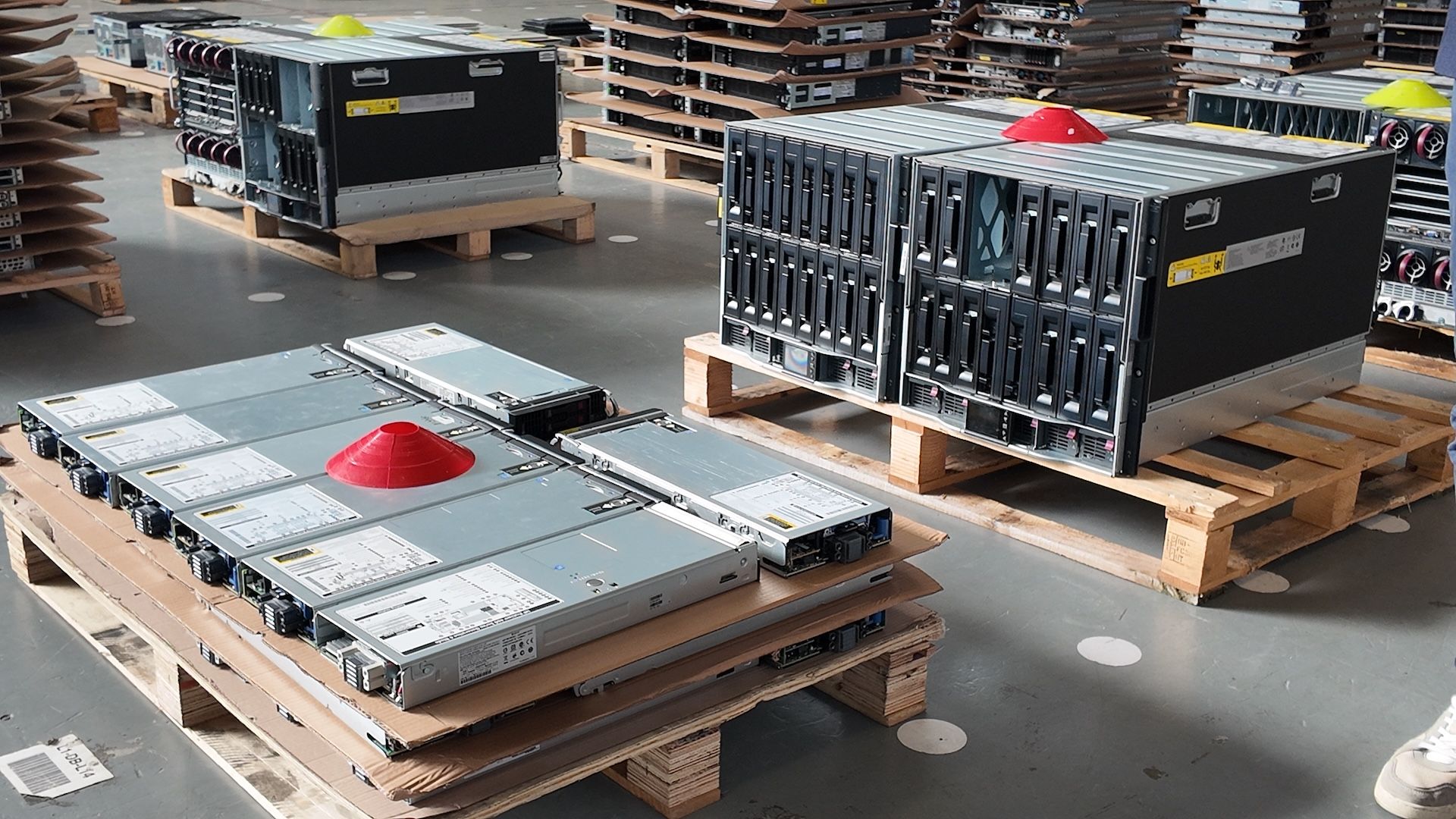
Harris adds that there are also great ways of reusing and recycling assets now, with HPE itself estimating that over 8,400 tonnes of waste has been kept from landfill thanks to its technology renewal centers (TRCs), where enterprise technology gets a new lease of life.
Indeed, the volume of assets coming into HPE’s Erskine TRC has remained “very consistent” according to the facility’s operations manager, Jackie Rafferty. “The flow of material into Erskine is coming, and is still coming,” he tells ITPro.
Rafferty says the facility currently receives around between 8,000 and 9,000 assets every single day – and sells the same amount. “It's very consistent in terms of what we process on a monthly basis. There's not really been much deviation at all, I would say, for the last 15 years.”
Supplying the mid-tier demand
As neocloud providers and hyperscalers alike race to build out AI infrastructure for wider services, the demand for high-performance components is putting pressure on global supplies. Rising costs of processors, memory, and storage are being felt across the board, making new technology more expensive for businesses of all sizes.
Not every organization needs the most cutting-edge hardware, though and, for those that don’t, buying refurbished could be a better way to meet their computing needs without paying the premium.
“The requirement for AI is going to be incredibly vast and most of the customers that we are going to serve now and into the future will not need the latest, highest-speed, most dense infrastructure,” says Harris.
“There's the thirst for new technology, but there's also the economics of IT technology now.”
While the new market is scrambling to keep up with the AI neo-cloud providers, he says HPE is thinking about “the other businesses and public sector bodies that we serve who, because things are more expensive, because of memory costs going up, are actually keeping assets for longer.”
Using pre-owned equipment can also help organizations make measurable progress towards their sustainability targets. Upgrading existing hardware can help companies make impactful energy savings, which in turn helps reduce emissions associated with their operations. Stepping away from newly manufactured components also helps reduce scope three emissions – those associated with a company’s wider supply chain. With the UK and Europe putting more emphasis on reporting and measuring these emissions, more companies are considering the impact on their own footprints.
Harris says he’s pleased to see customers and governments requesting HPE’s own scope of emissions as part of these efforts. “If you tie together both the economic efficiency of doing that alongside the sustainability goals and the emission scope that people are trying to reduce, it's a great thing that customers should be leveraging more,” he explains.
The business-case for pre-owned
Convincing businesses to embrace pre-owned technology also comes down to trust. “If a customer is buying a new piece of technology from HPE, they will want to make sure a few things have happened,” says Harris. “They want to make sure that it's manufactured well, that it operates, that we are also being very clear and considerate about conditions for workers in factories.”
Indeed, HPE’s Erskine TRC leverages the facility's rich history as a former Compaq and HP manufacturing site, adopting testing methods once used to maintain quality along its own manufacturing line. The facility’s 200-strong workforce is also Ministry of Defence-cleared to handle all the data cleaning aspects, ensuring security is sustained throughout the renewal process.
“We use HPE test infrastructure, so the supply chain is using the same test infrastructure that we are using,” says Rafferty. “Our quality standards are very high and, actually, the quality of product from pre-owned is extremely high.”
“I would say the market has actually increased considerably for pre-owned products,” he adds. “When you think about it, a server has maybe been running solid for three years, [that means] someone's tested it for three years and it still has an awful lot of life left in it.”
A human touch
Delivering that assurance requires considerable expertise. For Rafferty, that means retaining a human touch in a process that would be difficult to fully automate.
“You can't build that experience into a robot. It's the diversity of products that we see on a day-to-day basis,” he says. “To automate that, you'd be changing things every five minutes. I think you need the skills, you need that attitude of that individual to make it successful here.”
The Erskine facility handles an enormous variety of equipment, different customer requirements, and data hygiene considerations, making it a far more complex operation than a conventional manufacturing line.
“When you are running something so bespoke as that, I think that is incredibly hard to automate,” says Harris. “I don't think any AI engine would really be able to go and solve that”.
With AI continuing to reshape enterprise IT, the pressure to invest in new infrastructure isn’t going to go away – but neither is the need to make existing technology work harder.
As the market for refurbished hardware grows, businesses are increasingly recognizing that getting more life out of their IT assets is a tangible way to manage costs, maintain performance, and make technology investments go further.