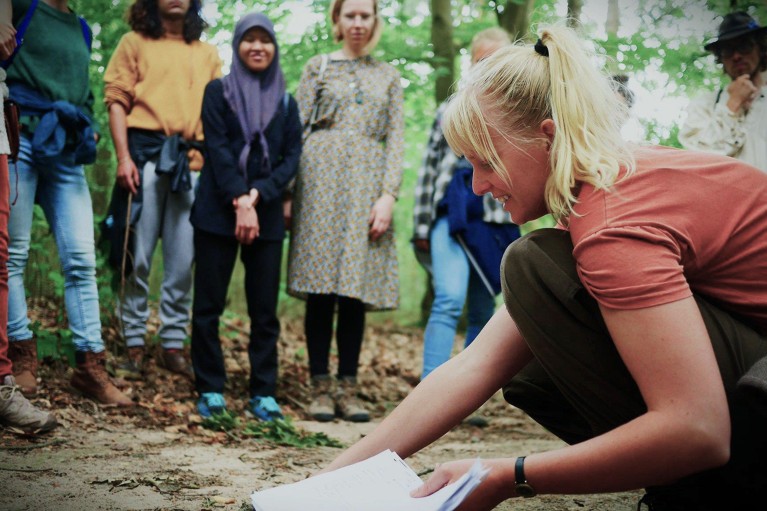
Pedro Maria Abreu Ferreira spends a lot of time outside. It’s part of his job: he conducts long-term ecological studies at the Pró-Mata Nature Research and Conservation Center in the Serra Gaúcha region, Brazil. He also spends a lot of time outdoors when teaching classes, both at the centre and as a biologist at the Pontifical Catholic University of Rio Grande do Sul in Porto Alegre, Brazil.
Although it can be breezy, being outside with students is not always a breeze. When it comes to fieldwork, transportation issues are pretty common — on the way back from a palaeoecology trip Ferreira and his team were delayed because of damage to their bus’ suspension. During a botany visit to the Pró-Mata reserve, he and his students experienced a strong, cold snap of weather known as a polar air mass. He even had to call off a trip to a mangrove forest once because of the sheer number of mosquitoes and horseflies. “It was absolutely impossible to teach or even think straight despite all the repellent and protective clothing we had on,” he remembers.
But, despite these hiccups, Ferreira thinks that the outdoor classroom is a must for teaching biology, and especially ecology. “Teaching outside is kind of mandatory, because you have to show the students what’s out there,” he says. “It’s more of a complete student experience.”
Although some regions are more conducive for al fresco teaching than others, it still provides a way to mix things up when working with students. Nature spoke to lecturers and outdoor-education coordinators about why it can be beneficial and how to prepare your students — and yourself — for the elements.
Taking class outdoors
There are many ways to implement outdoor education in academia, explains Janne Fengler, who studies educational sciences and teacher training at the University of Luxembourg in Esch-sur-Alzette. As a member of the Outdoor Learning in Higher Education project, she and her colleagues are preparing a systematic analysis of outdoor education at universities and other education settings.
According to Fengler, there have been studies on the use of outdoor education in preschools, primary schools and secondary schools. But there has been less research on outdoor learning in higher education.

There’s more research to work with now. During the COVID-19 pandemic, many universities turned to outdoor learning as a way to mitigate the spread of the virus, while still providing crucial in-person instruction.
“Outdoor classrooms became more important when COVID came,” says Jean-Philippe Ayotte-Beaudet, a science and outdoor-education researcher at the University of Sherbrooke in Canada, who was tasked with designing outdoor classrooms for his university at the peak of the pandemic. “We tried to be creative, and we thought about some spaces we could use to welcome them outdoors.”
In September 2020, before COVID-19 vaccines were rolled out, and as worldwide cases of the virus surpassed 28 million, Lisa Bonner, a chemist at Eckerd College in St. Petersburg, Florida, had to learn to teach outside, conducting her class from a set of picnic benches under a canopy with a periodic table poster affixed to a nearby wall. “It was important for student retention and for some sort of normalcy,” she recalls. Despite the Florida sunshine, there were days when it rained, and everyone had to huddle under the canopies and try to tune out the distracting sound of the pouring rain.
The Sunshine State’s humidity was also an issue: whiteboards were stored in air-conditioned buildings and as soon as they were taken outside they would become damp with condensation because of the hot Florida air. The soaking wet boards were useless, so “I would have to go an hour before class and wheel them out to make sure they got to temperature”, she says.
Enjoying our latest content?
Log in or create an account to continue
- Access the most recent journalism from Nature's award-winning team
- Explore the latest features & opinion covering groundbreaking research