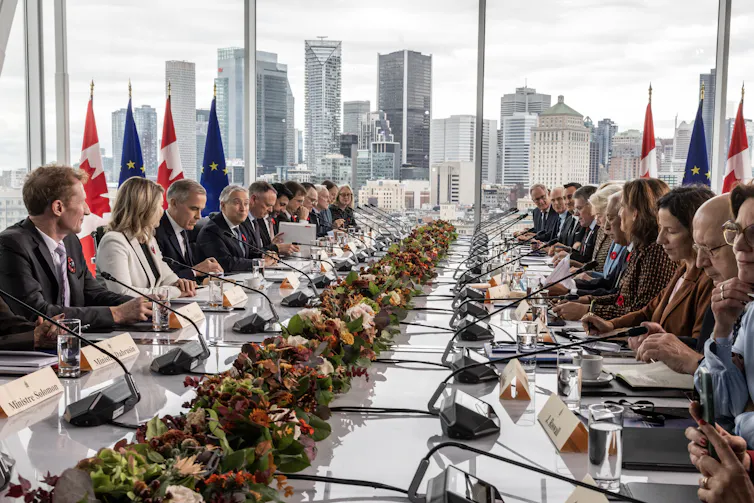
The dream of a Canada-EU “middle-power bloc” has hit its first serious obstacle. At the Montreal summit, Brussels failed to deliver on the promise of associate membership for Canada, despite the enthusiastic backing of European Commission president, Ursula von der Leyen.
Instead, the EU offered the hollow consolation of “an ever-closer association”, raising an uncomfortable question about whether the middle powers can overcome their own divisions to become a serious geopolitical force.
The two-day EU-Canada summit culminated on October 30 with the launch of a so-called “Alliance for the Future”. That compromise formula of association, rather than associate membership – which specifically ruled out full membership – was necessary because of internal disagreements in the EU.
In September, Von der Leyen, offered Canada the chance to become the EU’s first “associate member”. But Germany, backed by Greece and others, objected to the term, worried about legal uncertainty and the expectations it might raise in other countries.
The Canadian prime minister, Mark Carney, used it anyway at the Montreal summit’s closing press conference: “Today we move toward associate membership for Canada and we launch a new alliance for the future.”
Carney has been unusually explicit about what he believes. In his view, the future belongs to purpose-built coalitions organised around specific interests, and the successful ones among them will grow by attracting new members.
The Montreal summit fits that description. Ottawa’s official account presents the EU-Canada Alliance for the Future as drawing on “a variable geometry of like-minded nations”. According to an EU official, other countries have already expressed interest.
Earlier middle-power coalitions, such as the 1997 Ottawa Convention banning anti-personnel landmines, which 194 countries have ratified, have shown that middle powers can build issue-specific leverage when a clear objective, a committed coalition and an institutional strategy line up.
Can the bilateral Alliance for the Future be the nucleus around which a new middle-power coalition is built? On the one hand, a stronger Canada-EU partnership could give middle-power cooperation more resources and political weight. On the other hand, the closer Ottawa and Brussels move towards each other, the harder it may be to bring in other middle powers, such as India and Brazil.
The partnership’s ability to realise the summit’s aspirations – from digital trade to cooperation on critical resources and supercomputing – is yet to be tested.
Five tests for potential success
The track record of past efforts implies five tests to judge whether Ottawa and Brussels are likely to succeed in leading a wider coalition of middle powers into a new international order.
First, leadership costs money. In Montreal, Canada signalled its “intention to join” the EU’s €90 billion (£75 billion) Ukraine support loan. That will spread an existing burden rather than adding new money. The test is whether Ottawa and Brussels can mobilise new resources, not just share existing burdens.
Second, any middle-power coalition will need to build defence capabilities that can be sustained. Canada is the first non-European participant in Security Action for Europe (Safe), the EU’s defence procurement scheme, and Canadian firms have won contracts to supply radios to Poland and helmets to Latvia.
But the joint statement merely “takes note” of Carney’s proposed Defence, Security and Resilience Bank, an international financial institution which would pool funds to allow it to offer loans for defence procurement for allies. This sort of thing sounds easy at summits. It gets harder once the location of headquarters, the procurement rules and memberships are at stake.
Third, while military defence is important, economic defence increasingly matters as well. Any middle-power coalition will need to make economic coercion harder. The EU already has an Anti-Coercion Instrument to respond to economic pressure from bigger powers against itself or its member states, but it does not extend the same protection to Canada.
The closest to this in the Montreal summit statement is a joint commitment to limit the “negative effects” of each side’s economic security measures on the other. That is a promise of restraint between partners, not of joint defence against a third party – even though US president Donald Trump threatened tariffs on Europe if he judged associate membership for Canada to be a “hostile act”.
Fourth, whatever the exact vision that the EU and Canada have in mind, it needs to be built in a way that it can handle disagreement. The dispute over the “close association” versus “associate membership” did not derail the summit – but the two sides described the outcome remarkably differently.
Finally, any durable middle-power coalition will need to offer a common story, and live by it. The joint statement “deeply” regrets US sanctions on the International Criminal Court, an unusually direct rebuke of an ally. But it also leans on the language of the “rules-based international order”. Many governments in the global south treat this phrase with suspicion and prefer the broader term international law.
The difference is more than rhetorical. Defending international law would also mean upholding it when doing so conflicts with members’ own interests or those of their allies.
What to watch
Regional heavyweights such as Brazil, India and South Africa are sceptical about the idea of a new post-American world order led by Europe and Canada. So the EU-Canada summit in Montreal is unlikely to have reassured them.
Brussels and Ottawa will therefore have to make a conscious effort to build the issue-specific coalitions Carney favours. A possible platform to help these sorts of coalitions get off the ground was launched on the margins of the UN general assembly in September. Partners for Multilateralism is a network to promote open international dialogue and cooperation.
It was co-founded by Canada and the EU with Australia, Barbados, Brazil, India and Kenya five weeks before the Montreal summit. Whether this works will depend on three questions. What are governments prepared to pay for? What capabilities are they prepared to contribute? And what constraints on their own behaviour are they prepared to accept?
In Montreal, Canada and the EU began to answer the first two for each other. The third, which asks the most of them, they left open. It will need to be addressed if Carney’s middle-power vision is to be realised.