Mike Flanagan's take on Carrie brings the story to a modern audience, with an effective look at cyberbullying and how it goes beyond the school walls. But a few deviations from the book might frustrate Stephen King fans.
Reasons to buy
Reasons to avoid
Why you can trust TechRadar We spend hours testing every product or service we review, so you can be sure you're buying the best. Find out more about how we test.
Prime Video's has quickly shot to the number one spot on the streaming service, as it leads this week's streaming recommendations. The anticipated adaptation of Stephen King's novel is finally here, and there's a lot to unpack.
Series creator Mike Flanagan has impressed horror fans over the years, especially with his Netflix shows including The Haunting of Hill House and . His new version of marks his sixth adaptation of King's works, following movies including and .
With that in mind, we've all been interested to see how Flanagan handled , King's first story. I can confidently say I enjoyed the series, but there are some differences from it here that will cause division.
The eight-episode season follows Carrie White (Summer H. Howell) after her father dies in a tragic accident, prompting authorities to send her to a public school for the first time whilst her mother Margaret (Samantha Sloyan), re-enters the workforce.
Attending a new school is daunting for anyone, but Carrie knows very little of the outside world, after being raised by overbearing religious parents and schooled at home. Her struggle to adjust among other teens is the catalyst for her story, after she is baffled by everyday things such as a school shooting drill and getting her first period, both of which scare her to the point she fears as though she is about to die.
Carrie, in my opinion, is one of Stephen King's most likable protagonists. Howell portrays her brilliantly, focusing on her compassion for others and her desperate need to fit in, trying to relate to her fellow students even though she has never used a computer, nor does she have a cellphone. In the eyes of the school she is "weird", and the perfect target for bullying.
Flanagan's decision to set the story in a modern world resonated with me, and I liked this change. With technology being both wonderful and anxiety-inducing, he uses things like social media, camera phones and the internet at large to torment Carrie even more than she was in the book.
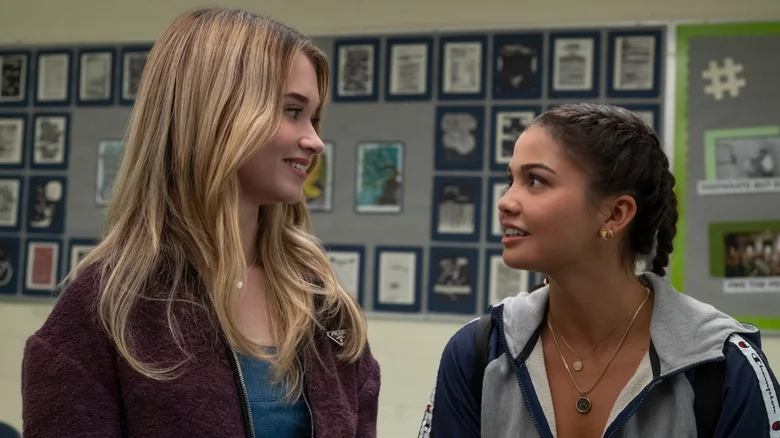
The school bullies are an important part of , and the casting works well here too. Alison Thornton's performance as Chris Hargensen, the ringleader of the bullies, is great and she makes some horrifying decisions throughout the series. But instead of turning her into a cartoonish villain, Flanagan also focuses on Chris' own issues, and the collapse of her family life at home.
Additionally, Siena Agudong's Sue Snell is shown as a complex character here, who does begin to feel remorse for Carrie's ongoing torment, whereas the group around her doesn't. I really liked Sue in this and she's one of my favorite characters as a result.
Characters in the series felt well-rounded to me, and for the most part, I was happy with the changes and the nuance. But there's one character who I was disappointed in, and that was Margaret White, who is portrayed a lot more sympathetically in the series.
In my opinion, I think Margaret should have been crueler. We do see her intense and suffocating religious beliefs, but she is more empathetic towards Carrie, and I wasn't a fan of the way her character was softened here. Margaret's resentment of Carrie in the book and the Brian De Palma film contributed to Carrie's eventual breakdown and use of her power for destruction, something I think is important.
In the original story, Carrie never found any comfort at home, but some decisions in the series felt out of character for Margaret. By supporting her daughter, I felt like it took away from the crippling isolation she is supposed to experience, resulting in the iconic, violent prom scene.
The ending is also different, which I have noted some fans may not be impressed with. I didn't mind the ending as much, but I still would have preferred if Margaret's characterization had been more faithful to the source material.
That's my only major gripe with the series, though, and I do think Mike Flanagan's is a good retelling of the story for the modern era, particularly when it comes to her fellow students and a school faculty that ultimately fails her.
So if you're keen to see a different take on , you might enjoy the Prime Video series. We've known for a while that it wasn't trying to copy the book directly, and it's certainly the most unique adaptation we've had.

Lucy is a long-time movie and television lover who is an approved critic on Rotten Tomatoes. She has written several reviews in her time, starting with a small self-ran blog called Lucy Goes to Hollywood before moving onto bigger websites such as What's on TV and What to Watch, with TechRadar being her most recent venture. Her interests primarily lie within horror and thriller, loving nothing more than a chilling story that keeps her thinking moments after the credits have rolled. Many of these creepy tales can be found on the streaming services she covers regularly.
When she’s not scaring herself half to death with the various shows and movies she watches, she likes to unwind by playing video games on Easy Mode and has no shame in admitting she’s terrible at them. She also quotes The Simpsons religiously and has a Blinky the Fish tattoo, solidifying her position as a complete nerd.