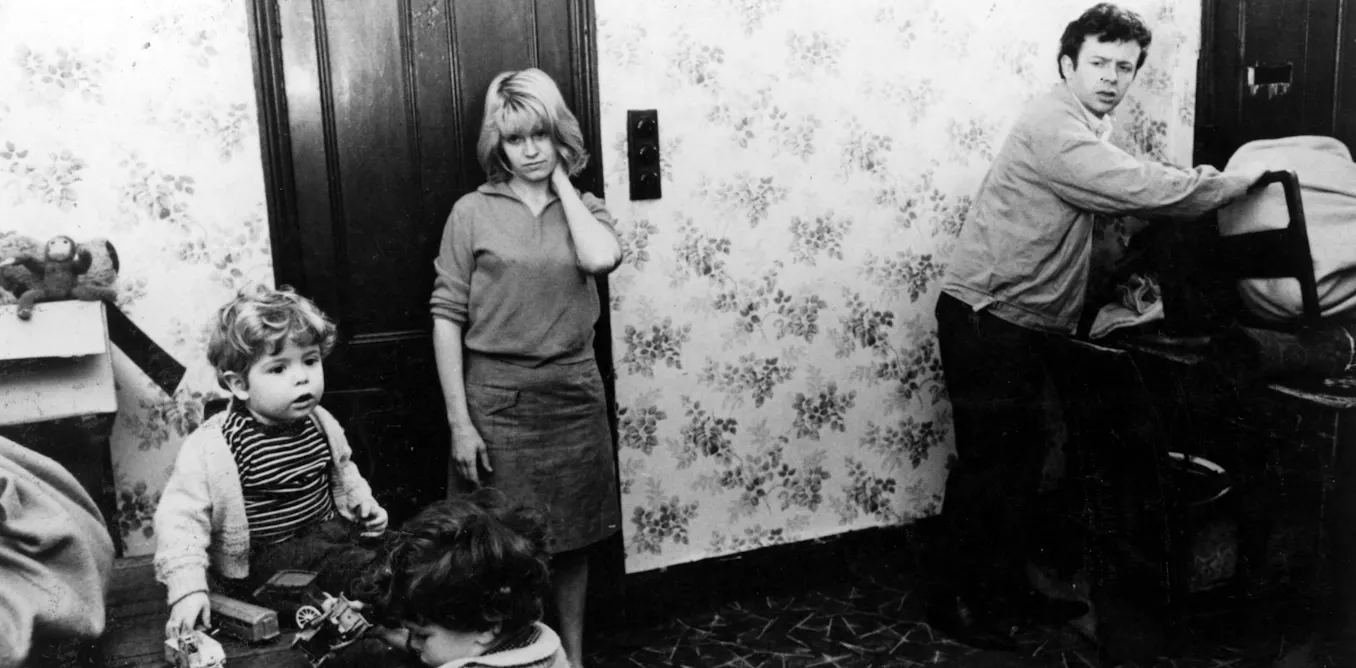
“You don’t care. You only pretend to care!” an exhausted, homeless Cathy shouts at a board of welfare officials just days before her children are taken from her. It’s a scene from Cathy Come Home, the 1966 BBC drama that remains – 60 years on – a touchstone for discussions on homelessness.
Written by Jeremy Sandford and directed by Ken Loach, the television play follows Cathy and her husband Reg, who are expecting a child when Reg loses his income through injury. The couple then lose their home, the first of many instances of this. Eventually Cathy ends up, with three children in tow, at an overcrowded government hostel that doesn’t permit husbands. Cathy finally loses her children to the care system, leaving her broken and alone on a railway platform.
Despite its age, the film is recognised even by people who were not yet born when it was first screened. As recently as 2016, it spawned a new initiative: Homes for Cathy, a network of housing associations and charities kickstarted to “end homelessness”.
Studies have highlighted controversy and debate as key to cementing the film’s cultural status. Though the main cast were actors, Loach employed groundbreaking techniques to present a composite of things that had genuinely happened to people over the preceding 18 months.
He filmed in real locations, used improvised dialogue and captured authentic encounters between the couple and gatekeepers to housing – people like landlords. A narrator also listed facts about housing poverty over the visuals. One of the most damning statistics from the time hangs as text over the closing frame: “4,000 children are separated from their parents and taken into care each year because their parents are homeless.”
For decades, media and government figures argued about the veracity of the statistics, how accurate Cathy’s experience was and whether it was right to blend fact and fiction in this way. The ordinariness of fact-based drama today (things like Mr Bates vs The Post Office from 2024) is testament to Cathy Come Home’s experimentation with the format.
The more pressing reason for its relevance is the endurance of its central theme: homelessness. Numbers of people living in temporary accommodation are unprecedented in recent times: 135,580 households in England – including 177,530 children.
Terrible conditions persist, too. Temporary accommodation is often “unfit for human habitation”, as a government housing committee recently found. This can include homes riddled with damp and mould, or with broken fixtures and fittings, or safety issues. Between 2019 and 2025, temporary accommodation was listed as a contributing factor in the deaths of 104 children.
The ongoing impact
The film’s enduring impact also rests on the belief that it changed things in British society. For months, newspapers covered their own “Cathy” stories. My recent work with the charity Justlife on temporary accommodation history shows the film wasn’t the first spotlight on these conditions; homeless families had been publicly protesting about their treatment for years. But when the BBC broadcast Cathy’s experiences to 12 million viewers, so many people called in that the switchboard was overwhelmed.
Housing campaign charity Shelter – coincidentally founded two weeks after Cathy Come Home aired – capitalised on the attention by presenting families like Cathy’s in campaign materials and involving actress Carol White in rallies. The charity had raised around £50,000 by 1967 – not all due to Cathy Come Home, but it certainly helped.
The film is also credited with the formation of homelessness charity Crisis in 1967. Politicians even spoke of the drama in parliament, and the minister of housing invited Loach, Sandford and producer Tony Garnett to meet him in Whitehall to discuss the issues it raised.
However, there was no significant change to homelessness law until the Housing (Homeless Persons) Act in 1977 – 11 years after the film. This legally defined homelessness and gave those who met priority-need criteria and were not deemed “intentionally” homeless a right to be rehoused. The law came about primarily due to civil service concerns about how councils were managing homelessness, as well as pressure from housing campaigners. Cathy Come Home was part of that wider story.
Loach and others have credited the film with ending family separation in some areas at the time. Certainly, after a series of public meetings – one of which included Loach, Sandford and homeless families – the council in Birmingham (where parts of the drama were filmed) committed to trying to end family separation within two years. Yet a 1972 Shelter report highlighted the practice continued in the city – and elsewhere. It didn’t end there: an investigation revealed that in 2022-23 at least 50 children were taken into care for the central reason of homelessness.
There were issues with the film’s representation of the period, however. It has been criticised for focusing on the experiences of white homeless people, even though Black and ethnic minority households were more likely to be homeless or living in poor-quality housing.
These concerns remain pertinent. Today, Black-led households are more likely to apply for statutory homelessness support, spend more time in temporary accommodation, and are less likely to be rehoused in social housing than their white counterparts.
Cathy’s family presented the nuclear ideal, too, when unmarried mothers or women fleeing relationship breakdown or domestic violence typically faced much higher barriers to accommodation. Similarly today, single-parent households are nearly four times more likely to be homeless than two-parent families.
Sixty years after Cathy Come Home first aired, many of the problems it depicted remain unresolved. Each anniversary offers a valuable opportunity to hold a mirror up to today and demand affordable, safe and secure housing for everyone. But to do that, we must pay attention to its silences and what it failed to achieve as much as what it depicted.