Living Threads at Whitechapel Gallery is the first major UK exhibition of eco-feminist activist contemporary artist and poet Cecilia Vicuña.
Born on the outskirts of Santiago, Chile, in 1948, Vicuña moved to London to study at the Slade School of Fine Art in 1972. While she was in London, Chile’s democratically elected president, Salvador Allende, was violently deposed during the 1973 Chilean military coup. This left Vicuña unable to return home because of the threat of violence or death.
When her UK visa expired in 1975, she went to Bogotá, Colombia, then moved to New York in 1980 where she has remained to the present. It was not until recently that Vicuña’s outstanding contributions have been commercially recognised. She received the Golden Lion for lifetime achievement award at the 59th Venice Biennale in 2022 and won the Icon Artist Gold Medal at Art Basel Miami Beach in 2025.
Her new solo exhibition Living Threads contributes to the long-overdue recognition this engaging and important artist deserves.
A gentle dance with living threads
The “living threads” of the exhibition title tell of Vicuña’s ideas around the vitality and effervescence within fibre-based art practice, as well as the invisible connections and interactions between people and plants, animals and the natural world. These ideas have occupied Vicuña’s creativity since her teenage years and are magnificently displayed at Whitechapel.
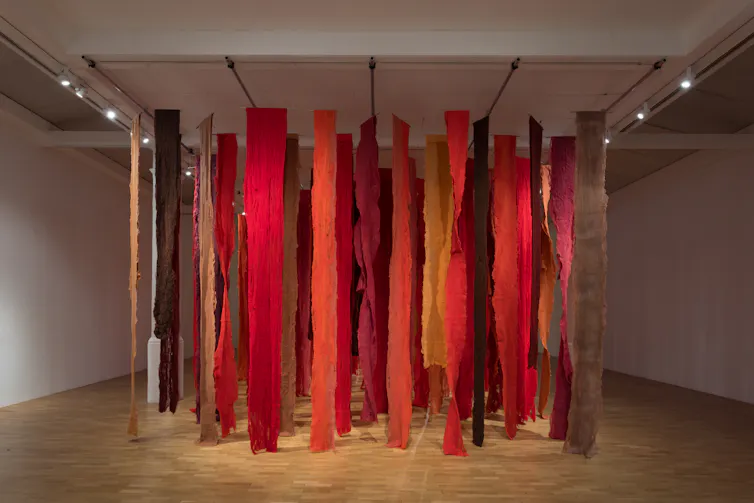
Upon entering the first gallery space, visitors are presented with a room-filling vision of Quipu Menstrual 1 (unknotted) (2006-24). Streams of raw wool in deep reds, vibrant oranges and soft pinks hang in structured rows. While some strands drape all the way to the floor, others trail off at barely a third of that length, appearing torn and frayed under their own weight. Through its monumental scale, the work directly challenges western ideals of permanence and memorialisation traditionally found in stone statues and monuments.
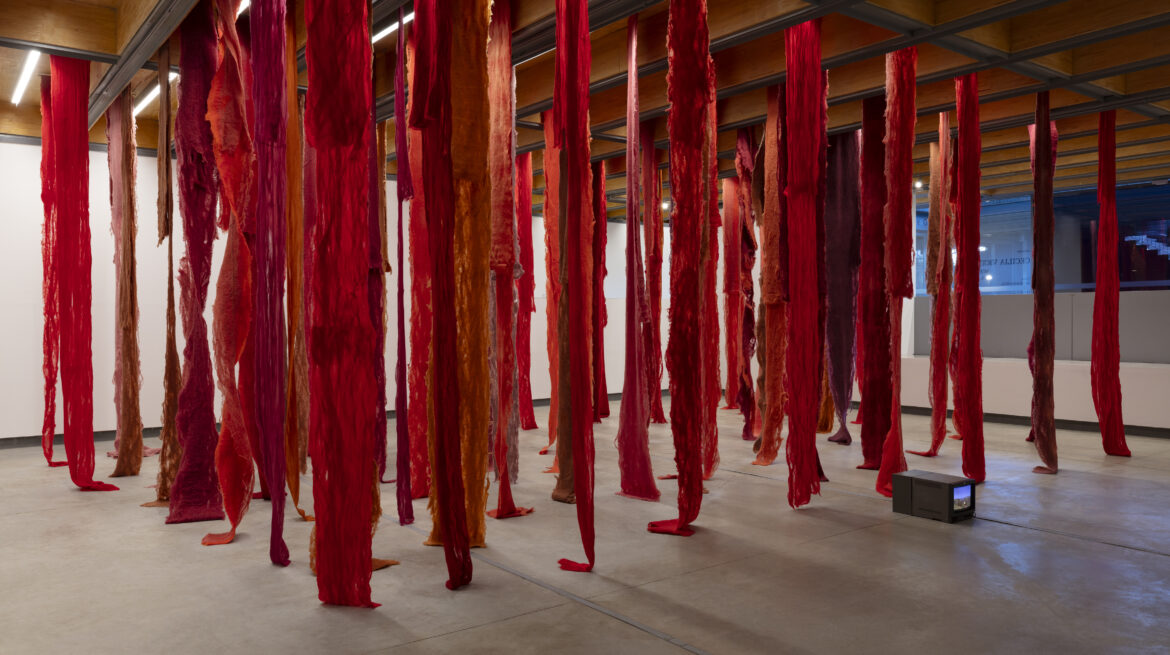
While stood immobile in front of this enormous installation, there is subtle yet constant movement where the airflow within the gallery drags across the materials. It causes a gentle sway reminiscent of branches in a breeze.
As visitors move around the vast form of Quipu Menstrual, their presence stirs the raw wool into a gentle dance. This motion creates a deep connection between the viewer and the artwork, entangling human hair and airborne fibres with the physical piece. Through these subtle interactions, the porous, shifting material transforms the viewer into an active participant. Energised by these living threads, the work appears to breathe alongside the surrounding room.

Contributing to themes of liveliness within these traditionally inert materials are Vicuña’s ideas surrounding the “not yet”. This open-ended phrase points toward notions of becoming and transformation.
Vicuña views existence as an ongoing process, rather than something fixed or finite. Swaying, mobile and fragile, her installations are literally untethered, resisting the urge to impose rigid meaning and leaving room for pure possibility. Through the “not yet” of Quipu Menstrual, Vicuña surrenders control, passing the work’s ongoing life over to the piece itself and the participating viewer.
Invisible threads of connection
Gallery three comprehensively introduces visitors to Vicuña’s vital role in Artist’s for Democracy (AFD). Vicuña was a founding member of this London-based artist group (alongside Guy Brett, John Dugger and David Medalla) which raised awareness within the arts and wider community of the plight of the Chilean people and other liberation and human rights struggles worldwide.
In existing literature, Vicuña has been cast in more of a supporting role in the formation of AFD, so it is refreshing that Whitechapel are championing her pivotal position as founding member.
There is photographic documentation of a smiling enthusiastic Vicuña in a 1974 exhibition showing her Objects for the Chilean Resistance, 1973-74. This series of objects highlights her focus on the overlooked and discarded within daily life revealing an intense desire for equality. The prolifically produced objects point towards an anxiety at being far from home during that politically unstable period of extreme and violent displays of power and forceful suppression.
The exhibition showcases the breadth of Vicuña’s multidisciplinary practice. It features a dedicated gallery for her surrealist-inflected paintings. These works are modern recreations of early canvasses lost or destroyed during her decades of exile and displacement between London, Colombia and New York.
The exhibition shows that Vicuña mourns the loss of these early paintings. But their rebirth here aligns beautifully with her belief in cyclic time and invisible threads of connections. There is a coherence here where dissolution becomes a creative catalyst rather than a destructive force.
Whitechapel completes the weaving in and out of our journey through Vicuña’s career by presenting the work Foraging Quipu (2025-26). This piece encapsulates Vicuña’s desire for communal engagement, transformation and viewer participation by requesting that the public contribute items that they have encountered within their daily routine.
Principally composed of natural and biological matter, Foraging Quipu is constantly decomposing and changing. Moving bodies around the work and the natural passage of time mean that Foraging Quipu will provide a different experience upon each look, illustrating some of Vicuña’s ideas about relationality and invisible living threads.
Cecilia Vicuña: Living Threads is at Whitechapel Gallery, London, until February 14 2027.