At a literary event at Burgh Island Hotel in south Devon recently, the novelist Catherine Newman remarked that whenever she looked down from the island’s steep cliffs while walking, she half-expected to discover a body.
It was an apt response to a place that helped inspire Agatha Christie’s crime novels, including Evil Under the Sun. In the novel, Christie makes the island’s isolation part of the mystery. When character Emily Brewster remarks, “This isn’t the sort of place you’d get a body”, the famous sleuth Hercule Poirot responds: “But why not?”
Burgh Island is more than a beautiful art deco hotel. Its cliffs, tidal causeway and isolation are geographical realities, but Christie transformed these features into elements of a fictional world. Generations of readers have since learned to see the island through her stories.
This is part of what makes literary hotels so fascinating. Some are associated with writers’ lives, others with the places where they worked. A third group has become part of the fictional worlds themselves.
From writers’ lives to fictional worlds
Years ago, shortly after moving to Lancaster, I spent a night in a hotel where Dickens once lodged. There was a certain pleasure in knowing that he had been there before me, but the connection was historical rather than literary. The hotel belonged to Dickens’s life, not to the fictional world he created.
Other hotels offer a more direct connection to the act of writing. Poet Dylan Thomas’s relationship with Brown’s Hotel in Laugharne, south-west Wales, belongs to this category. He would walk from the Boathouse where he lived and wrote, into the town, spending time at Brown’s.
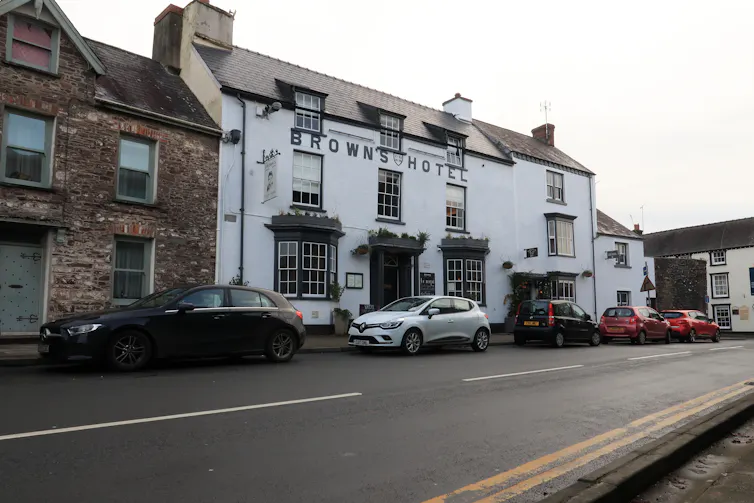
Such places offer a glimpse of the circumstances in which writers lived and worked. But a writer’s presence does not necessarily tell us how a particular story came into being. The relationship changes when a hotel enters fiction itself.
Hotels are particularly adaptable settings for fiction. They bring strangers together in temporary communities, creating opportunities for encounters, misunderstandings and suspicion. In detective fiction, they can also provide a ready-made sense of enclosure: a place where characters are brought together and escape becomes difficult.
Read more: Why the places we love in books can never quite be found in real life
Christie stayed at Burgh Island and wrote in its Beach House, drawing on its distinctive geography. In And Then There Were None, the island features an unnervingly modern house; in Evil Under the Sun, it becomes the fashionable Jolly Roger Hotel.
The island’s isolation is real, but Christie transformed it into something more. In her novels, the landscape becomes part of the machinery of suspense. Knowing the stories can therefore change how visitors experience the place itself. A tidal causeway is no longer simply a route across the water; it becomes a reminder that an island can be cut off from the outside world.
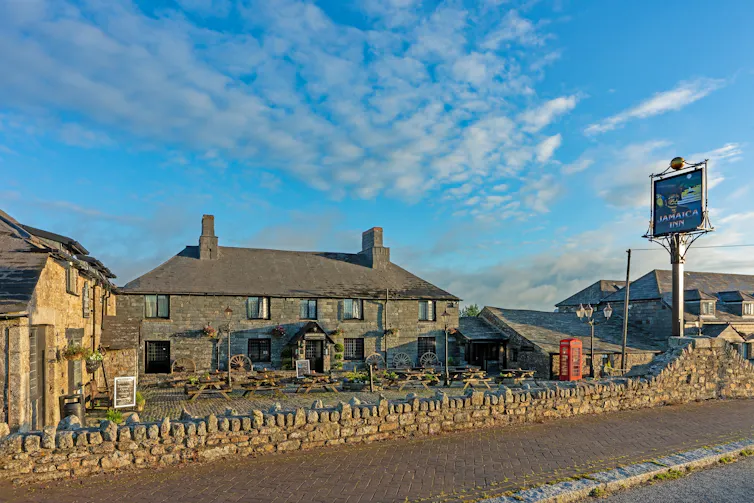
A similar phenomenon can be seen at Jamaica Inn on Bodmin Moor. Daphne du Maurier’s experiences at the inn helped inspire her 1936 novel of the same name.
During an early visit, she and her companion became lost in mist and darkness on the moor while riding, eventually finding their way back with the help of their horses. The experience of isolation and uncertainty echoes through the novel, in which the inn stands as a “grim landmark” in a desolate landscape.
In both cases, the relationship between place and fiction works in two directions. The real landscape provides material for the story, while the story gives the landscape a new identity.
A literary afterlife
The King’s Arms Hotel in Dorchester illustrates how these three categories can overlap. Novelist Thomas Hardy stayed there, wrote there and incorporated the building into The Mayor of Casterbridge as the principal hotel of Casterbridge.
The building therefore belongs both to Hardy’s biography and to his fiction. During his lifetime, the King’s Arms became part of the emerging literary geography of Wessex, attracting readers eager to connect fictional locations with real ones.
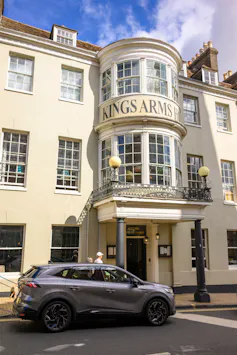
Hardy helped foster this connection by revising his novels and prefaces to emphasise Wessex, the fictional region based on real places in south-west England. The King’s Arms was no longer simply a hotel where Hardy had stayed; it had become part of the landscape his readers came to explore.
Across Britain, hotels, houses and inns continue to attract visitors through their associations with writers and books. Some offer a glimpse into an author’s life, while others allow readers to encounter places that have become inseparable from the stories told about them.
It’s an important distinction because a hotel where a writer once stayed can bring us closer to literary history. A hotel that has entered fiction offers something different: the chance to experience a place through a world we first encountered on the page.
Literary hotels make visible the relationship between literature and the world beyond it. The buildings are real, but their significance is continually reshaped by the stories attached to them and the readers who arrive in search of those stories. In this sense, visiting a literary hotel is not simply a journey into the past. It is also a way of stepping, however briefly, into a fictional world.