An analysis of 1.3 million chemical reactions listed in patents over four decades has shown that chemists still depend heavily on hazardous solvents, despite a nearly 30-year campaign to make chemistry ‘greener’ using safer, more sustainable alternatives. The survey is the largest and most comprehensive of its kind.
Solvents are workhorse liquids used to dissolve chemical substances during reactions; chemists also use them to extract and purify reaction products. Some of the most common solvents, such as dichloromethane (DCM), are known to have health risks, or are hazardous in other ways — for instance, many are flammable. Almost all of them are derived from oil or natural gas, giving them a substantial environmental footprint.
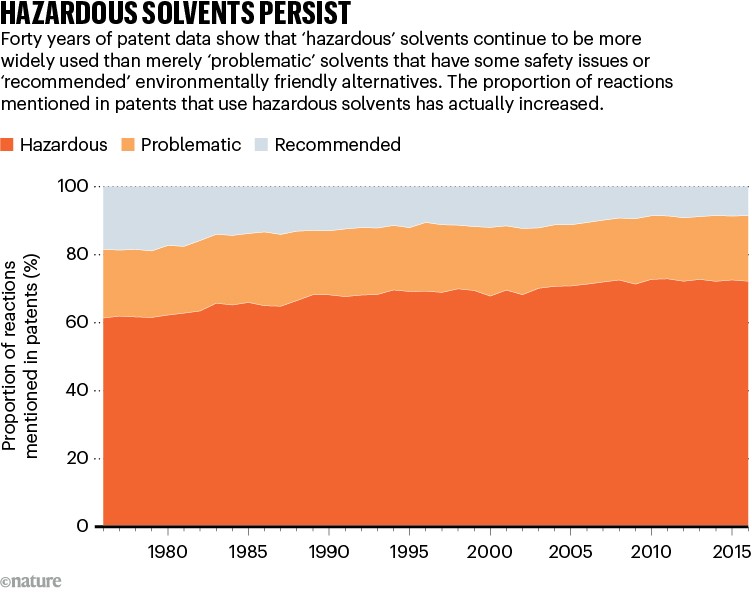
The patent survey, published this month in Angewandte Chemie1, found that solvents classed as hazardous were used in about 60% of reactions mentioned in patents in 1976, but that by 2016 that proportion had risen to above 70% (see ‘Hazardous solvents persist’). “I was disappointed, rather than surprised,” says Helen Sneddon, a sustainable-chemistry researcher at the University of York, UK, who co-authored the analysis with Maarten Dobbelaere, a researcher who applies artificial intelligence to chemistry at the Swiss Federal Institute of Technology in Lausanne.
Bruce Lipshutz, an organic chemist at the University of California, Santa Barbara, says the findings reinforce the urgent need for chemistry to move away from petrochemical-based solvents. “We have to stop,” he says.
Many of the patents relate to exploratory research early in the drug-discovery pipeline. “It feels a little bit deflating, because you’d expect we should be seeing progress,” says David Leahy, chair of the advisory board to the American Chemical Society’s Green Chemistry Institute in Washington DC. “I hope that a lot of medicinal-chemistry groups, and academic groups, look at this and think about their own choices.”
Red alert
The analysis relied on a pre-existing database, drawn from the US Patent and Trademark Office, in which chemical names and structures from patents were converted into a computer-readable format. “It’s more or less the only large, open-source repository of chemical reactions that is available for this kind of survey,” Dobbelaere says.
Dobbelaere developed an AI-based system called Rxn-INSIGHT that can digest chemical databases, and then answer queries about which reagents, catalysts and solvents chemists should use to make new molecules2. Sneddon and Dobbelaere realized that they could deploy the system to track solvent use across the more than 500 different types of chemical reaction in the annotated patent database.

Why chemists can’t quit palladium
The survey not only shows that hazardous solvents such as DCM continue to be favourites among chemists; it also finds that when government regulations restrict the use of a toxic solvent, chemists are more likely to switch to another hazardous liquid than to choose a greener or safer alternative. Furthermore, it shows a substantial rise in the use of trifluoroacetic acid (TFA), which is key to the synthesis of popular peptide drugs. By some definitions, TFA is a ‘forever chemical’, one of the many persistent per- and polyfluoroalkyl substances (PFAS) increasingly found in waterways, soils and living creatures.
Leahy says that chemists involved in early-stage drug discovery often aim to make lots of different molecules as quickly as possible, which is why they lean on literature precedent when choosing solvents. “There’s almost zero incentive for the discovery chemist to make these molecules with more environmentally friendly conditions,” says Leahy, who is vice-president of drug-substance development at Biohaven, a pharmaceutical company in New Haven, Connecticut.
Still, the analysis may not have captured some areas of progress. The database ends in 2016, so doesn’t include changes after that. Neither does it measure the quantities of solvents involved in these reactions, for example, so it’s possible that a trend towards scaling down, or miniaturizing, reaction set-ups in laboratories could be helping to drive down overall solvent usage. And whereas the patents mostly record early-stage research, scaled-up manufacturing processes often weed out hazardous solvents such as DCM, Sneddon says.
Enjoying our latest content?
Log in or create an account to continue
- Access the most recent journalism from Nature's award-winning team
- Explore the latest features & opinion covering groundbreaking research