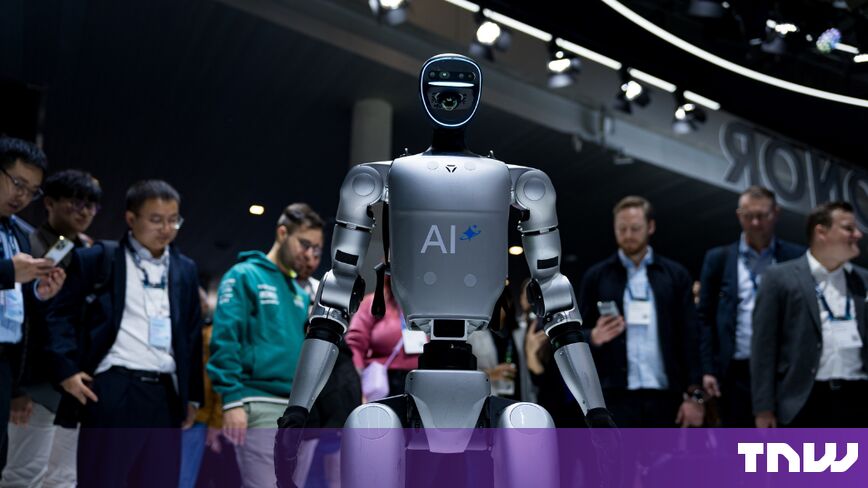
China’s securities regulator has begun steering humanoid robot companies away from the public markets until they can show recurring revenue and a credible path to narrowing losses, The Information reported on 9 September.
The direction is being given as window guidance, the informal and unpublished channel the China Securities Regulatory Commission uses when it wants an outcome without writing a rule.
Reuters reported today that at least six Chinese humanoid firms preparing for listings are now waiting, and that private-market valuations have been cut by 30% to 50%.
Neither figure appears in a public filing, the CSRC has published nothing, and TNW has not independently verified either claim.
Unitree Robotics listed on Shanghai’s STAR Market on 19 August at 150.80 yuan per share, raising 6.1bn yuan, or about $904m, at a valuation of nearly $9bn.
It then rose by as much as 460% in a session, briefly reaching a market capitalization of roughly 445bn yuan and a price-to-earnings ratio above 1,300, compared with a STAR Market average closer to 124.
The slide began within days. Unitree was down about 45% from its peak by 25 August, and roughly 55% off it by the time the regulator’s caution surfaced.
Mech-Mind Robotics, which was listed in Hong Kong on 1 September, has fallen back around 20% from its debut-day high.
Underneath the share price sits a revenue question the exchange had already raised. In the first nine months of 2025, only about 9% of Unitree’s revenue came from industrial sales, while 73.6% came from research and education customers, according to review materials filed with the Shanghai Stock Exchange. A robot sold to a university laboratory is a sale, not a market.
Shao Tianlan, chief executive of Mech-Mind, put it more bluntly, telling Reuters that some of the sector’s revenue arrives through “data collection centers, related-party deals and other unsustainable arrangements”.
Stripping those out could cut some valuations by 60% to 70%, Reuters reported, a calculation no other outlet has corroborated.
Ruiying Zhao of S&P Global described the shift to Reuters as a move from “blanket euphoria to selective rationality”, which is a polite way of saying the window has narrowed rather than closed.
Mainland share sales reached $148.9bn to date in 2026, up 59% year on year, with technology accounting for 41% of the total.
The queue behind Unitree is real enough. LimX raised $200m in July on an explicitly pre-IPO footing, and XPENG’s robotics arm took more than $900m in August ahead of its first production run.
Chinese manufacturers accounted for more than 90% of global humanoid shipments in the first half of 2026.
None of which tells us when the listings resume. The guidance is unwritten, the regulator has said nothing publicly, and the six companies said to be waiting have not been named by anyone.