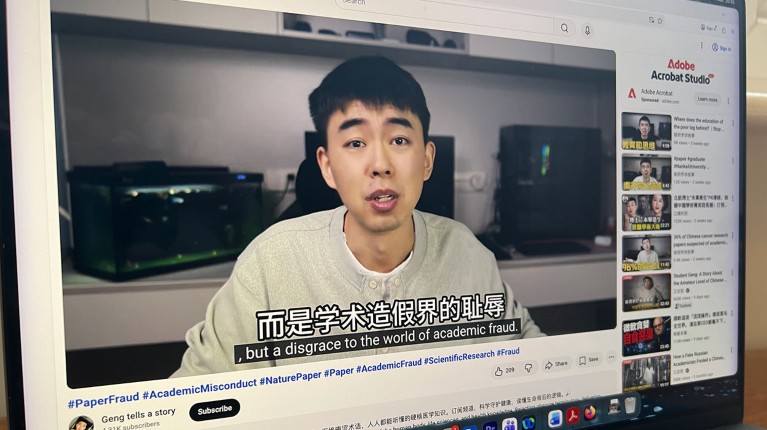
China’s national funding agency has reprimanded and penalized four senior academics and their colleagues after a sleuth flagged data anomalies in their published papers.
The National Natural Science Foundation of China (NSFC) found violations ranging from data fabrication to data tampering in four papers, according to an announcement from the agency on 28 August.
The academics and their colleagues were banned from applying for funding from the NSFC, either as individuals or members of teams, for between three and seven years. The agency also cancelled funded research projects related to three of the four papers and recovered the money that it had already distributed to them.
Geng Hongwei, the sleuth and video blogger who called out the papers, known online as Student Geng, says that the severity of the punishments is in line with his expectations. He also says that he feels “a little proud” that his efforts, highlighted in a series of viral videos, have led to an official response.
‘Student Geng’ ignites research-integrity scandal in China after calling out senior academics
The penalties were part of a wider crackdown on research misconduct by the NSFC, with 31 research groups and institutes identified in the agency’s statement. Some of the other offences addressed include buying and selling data, plagiarism and misuse of research funds.
Although the NSFC’s statement does not provide the titles of the papers in question, Nature journalists have verified that all four of them were published in Nature or Nature-branded journals. Two were retracted on 29 July and the others now contain editor’s notes acknowledging concerns about their data. Geng said that a key reason that all of the papers he raised concerns about were published in Nature-branded journals is that these journals require researchers to publish their raw data, making his investigations possible.
Nature’s careers and news teams are independent of the journal’s research section and its publisher, Springer Nature. When contacted for comment, Erika Pastrana, vice-president of the Nature research and reviews journals, said that “all papers flagged to us will be investigated”. The journals “will provide updates on papers with editor’s notes once investigations are complete”.
Social-media sleuth
Geng scrutinized the four academics and their papers in videos that went viral in April and May. At that time, all four of them held senior positions at Chinese universities and had received prestigious grants from the NSFC.
The reprimanded academics are Wang Ping, former dean of the School of Life Sciences and Technology at Tongji University in Shanghai; Chen Quan, former dean of the College of Life Sciences at Nankai University in Tianjin; Kuang Dongming, former deputy dean of the School of Life Sciences at Sun Yat-sen University in Guangzhou; and Su Jiacan, former dean of the Institute of Translational Medicine at Shanghai University. Before the NSFC’s announcement, these academics had already been investigated and disciplined by their universities, including having their deanships removed.
Nature journalists contacted the scientists for comment but had not received any replies at the time of publication.
In the NSFC’s announcement, the agency did not say whether the penalties were a response to Geng’s videos. But Geng says that he filed formal requests with the NSFC for each of the four papers to be investigated, and notes that the agency informed him personally of the results of its investigations (Nature could not independently verify this). Geng’s videos provoked public outcry in China and attracted attention from international media. The videos criticizing the four papers have garnered nearly nine million clicks on Bilibili, a Chinese video-sharing platform.
‘Stamp out paper mills’ — science sleuths on how to fight fake research
The NSFC’s punishments are “very severe”, says Futao Huang, a researcher of higher-education policy at Hiroshima University in Higashihiroshima, Japan.
“For leading researchers, an NSFC funding ban can make it extremely difficult to maintain a laboratory, recruit students and staff or continue major research projects,” he says. “The reputational consequences may be even more damaging.”
For Sun Ping, editor-in-chief of the International Research Collaboration Information Platform, a Beijing-based website that provides information about research-integrity policies and best practice, such punishments aren’t necessarily career-ending for penalized researchers, especially early-career scientists accused of only minor offences. These academics can still participate in research as a team member rather than as a lab leader, he notes.
Geng has called out various other prominent scholars on social media since April, alleging that their papers also included falsified data. Some of those papers now include correction notices, but have not been retracted. It is unclear whether the other scientists called out by Geng will face official investigation by their universities or the NSFC.
Enjoying our latest content?
Log in or create an account to continue
- Access the most recent journalism from Nature's award-winning team
- Explore the latest features & opinion covering groundbreaking research