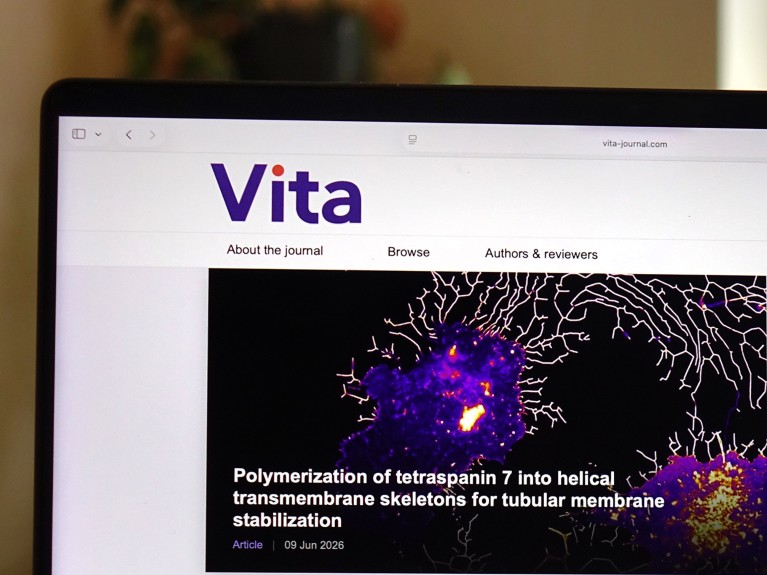
A new Chinese-owned journal has set its sights on rivalling the world’s oldest and most influential academic titles. Vita is one of several English-language journals that have launched in China in the past couple of years. They represent the country’s latest effort to create prestigious global journals, as part of the government’s Journal Excellence Action Plan, which began in 2019.
Until recently, institutes and universities in China have often worked with international publishing companies to run English journals. “What sets Vita apart is that it is a completely Chinese journal, launched by Chinese scientists and published by a Chinese publisher,” says Ning Zhang, founder of TopEdit, a company based in Gaithersburg, Maryland, that helps Chinese journals to build global presence.
China is a global leader in scientific research, but only a small portion of that research is published in Chinese-owned journals.
China views establishing its own journals as a way to raise its presence in the global scientific community, says Chen Fuyou, director of XinRui Journal Ranking, an independent journal evaluation website, based in Beijing. “This means China would get to define what is a high-quality paper and what is high-quality research, based on its own measures and selection processes. It would also get to decide what papers to publish,” Chen says.
Free publishing
Vita is jointly funded by the Higher Education Press, a subsidiary of China’s Ministry of Education based in Beijing, and Westlake University in Hangzhou, its editorial team says. It publishes papers in biological sciences. Its first print issue came out in July.
As an open-access journal, Vita waives article-processing charges (APCs), a fee charged by many publishers to authors to make their work open access. In August, Li Dangsheng, Vita’s co-editor-in-chief, told Jiefang Daily — a state-run newspaper in China — that this allows the journal to focus on assessing papers on the basis of quality. It will also help to attract high-quality papers from overseas authors, he added.
The surging APCs paid by researchers in China to international publishers is another reason why China wants to establish its own journals. In 2024, scholars in China spent US$909 million on APCs collectively, nearly 30% of the total APCs earned by global academic publishers that year, according to the Chinese Academy of Sciences (CAS). Since March, CAS has stopped funding the APCs of 30 of the most expensive open-access journals.
Vita’s model is “clearly going to be appealing” to authors, says James Butcher, a former publisher at Nature-branded journals and The Lancet, who now runs a consultancy firm called Journalology near Liverpool, UK. But he warns that keeping the model running in the long term will be a challenge for the journal and its funders because “publishing is expensive”. Publishers who charge APCs say that the money helps to pay the salaries of in-house editors and production staff, as well as printing and server costs.
But whether Vita’s funders will be willing to foot the APC bills for foreign authors is an open question, says Butcher. “If there are 20% or 30% of papers coming from the United States, for example, is that something they would be happy to bankroll?”
Vita says that it is committed to not charging APCs to international researchers.
Big financial support
As part of its plan to build globally influential journals, China’s government offers generous financial support. Four-hundred and fifty journals have been categorized into different tiers, which will receive various amounts of money each year for five years. For example, an English-language journal that makes it into the ‘leading journals’ category will receive up to 1.5 million yuan (roughly $223,000) per year.
The plan also supports 13 Chinese academic publishers. “The government’s goal is to help these companies to grow into major academic publishing groups, like Springer Nature. This is deemed a more efficient way than cultivating individual journals,” Zhang says. Publishers will receive various levels of grants, up to 10 million yuan (roughly $1.5 million) per project, for five years.
Going global
Enjoying our latest content?
Log in or create an account to continue
- Access the most recent journalism from Nature's award-winning team
- Explore the latest features & opinion covering groundbreaking research