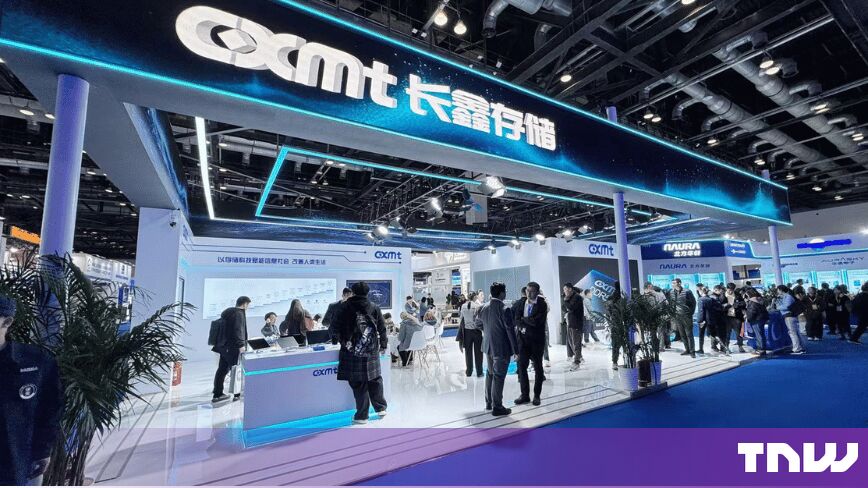
Our process capability is now on par with the most advanced mass-produced nodes out there in the industry.
Luo Xiaodong, vice president of ChangXin Memory Technologies and head of its marketing centre, said that at the World Manufacturing Convention in Hefei, in remarks reported by Reuters. China’s largest maker of DRAM had just announced that its fifth-generation technology platform had entered mass production.
The CXMT DRAM numbers
The company set out the detail on its own site on Sunday. It puts the active area half-pitch at 11.95 nanometres, the storage capacitor aspect ratio at 45 to 1, and says it reached those dimensions using four-exposure patterning. The platform yields at least 50% more dies per wafer than its fourth generation, measured on an eight-gigabit baseline.
Two products already run on it. Both are 24-gigabit LPDDR5X, the low-power memory used in smartphones and portable electronics, and both hold 50% more data than the equivalent chips CXMT made before. They come in 496-ball and 245-ball packages, aimed at mid-range and high-end handsets.
DRAM is the short-term working memory a phone or computer uses to run whatever is open. Reuters reported that the new platform is designed to make more powerful chips at lower cost and with less power draw, and that CXMT is pitching it to electronics makers as an additional source of supply. That last phrase is the commercial point. It aims squarely at buyers who currently choose between three suppliers, all of them outside China.
CXMT called the platform a milestone breakthrough in its announcement, and said it would give the global memory industry solution choices that are more innovative and more resilient in the supply chain. That second phrase does the political work. Resilience, in this context, means a source that Washington cannot switch off.
What the 50% figure does not say
Reuters was careful with that number, and the care matters. Gross dies per wafer counts the chips a wafer could yield before testing removes the defective ones. It is a ceiling, not the share that survives. Yield is where memory makers win or lose money, and CXMT has published nothing about it.
The parity claim is the company’s own too. Nobody outside Hefei has measured these parts against Samsung, SK Hynix or Micron. CXMT says it developed the platform using computer simulation and joint work with Chinese chip-equipment makers, which is its answer to a problem Washington created: US export controls have restricted China’s access to advanced chipmaking equipment since 2022. The company listed on Shanghai’s STAR Market this year.
The equipment problem underneath
Everything CXMT claims here, it claims without the tools its rivals use. Washington has restricted China’s access to advanced chipmaking equipment since 2022. Four-exposure patterning is the workaround: rather than printing fine features in one pass with a machine China cannot buy, the process repeats coarser steps until the pattern is fine enough. It costs throughput and it costs money. It also does not require anyone’s export licence.
Why the timing lands
The memory crunch has been repricing consumer hardware all year, and TNW has followed it down the chain. Roku raised streaming device prices by up to 60%. AMD put Radeon GPUs up by at least 10%. It reached phone contracts when T-Mobile stretched its financing to 36 months. GoPro warned it might not survive, and Insta360 spent $298m on memory chips in six months.
Chinese DRAM has already been arriving quietly in Western products. Corsair began using CXMT memory in its DDR5 kits in May. That was the fourth-generation platform. This is the one the company says draws level.
Acer’s chief executive got there a day early
On 19 September, a day before CXMT’s announcement, Acer chief executive Jason Chen told Taiwan’s Economic Daily News that DDR4 and DDR5 are not especially scarce at the moment, and that CPUs are not either, beyond some mid-range and entry-level parts. He expects PC prices to rise by 5% to 20% in the fourth quarter, and average selling prices to peak in the middle of 2027, with a possible decline late that year.
Asked about forecasts that the shortage runs to the end of the decade, he pointed at Chinese capacity coming online.
It is impossible for the shortage to last until 2030.
Chen put a limit on his own optimism in the same remarks. Component prices remain high, he said, and the supply and demand balance still favours the chip suppliers over the companies buying from them. His forecast is a peak followed by relief, not relief now.
Two cautions belong with those quotes. Chen runs a PC maker rather than a memory maker, so he is describing the market he buys in. And his remarks reached English-language readers through translation from the Chinese, which is why the Economic Daily News report, not any English write-up of it, is the source cited here.
What would settle it
Three things, none of them announced yet. The first is yield: gross dies per wafer is a ceiling, and CXMT has not said how close it gets. The second is price, because a supply alternative only loosens a shortage if it undercuts one. The third is who buys. Chinese handset makers have an obvious incentive, and Corsair has shown a Western brand will take the parts when the price is right.
The wider question is whether governments outside China let their manufacturers do the same at scale. That has been the pattern with Chinese components in telecoms equipment for a decade, and memory is now sitting in the same argument. CXMT has given the market a second source and a claim of parity. The industry has not yet tested either.