In October I was sitting on a bench by the Thames, having just watched Clarissa at the BFI Southbank. It had been shown on the same screen where I once watched Mandabi (1968), the first feature-length film produced in west Africa. I thought to myself: here is a new version of African cinema.
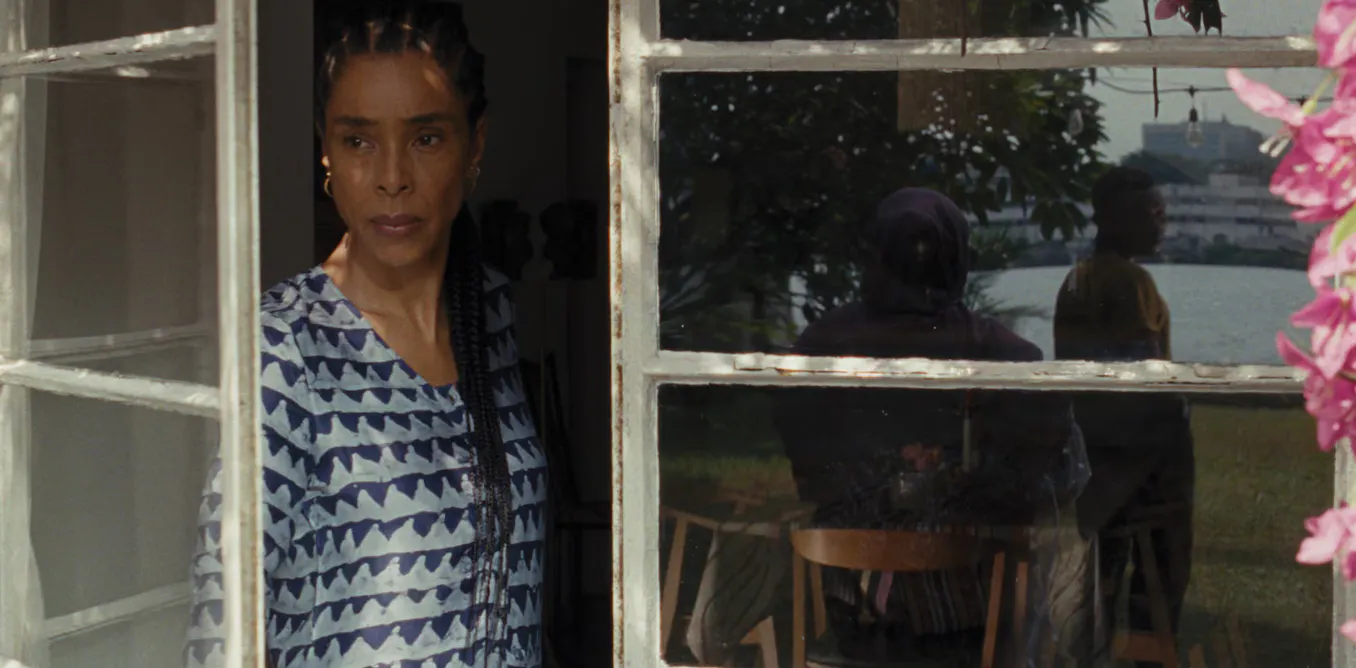
Clarissa is written and directed by brothers Arie and Chuko Esiri. The film is a retelling of Virginia Woolf’s novel Mrs Dalloway (1925) that relocates the novel’s post-war London setting to contemporary Lagos, Nigeria.
It follows Clarissa (Sophie Okonedo) as she prepares to host a party and finds herself revisiting the choices that have shaped her life. The premise is familiar; Woolf’s story is now over 100 years old, but the film feels remarkably at home in its new setting. Lagos pours into every open space and fills the screen in much the same way that Woolf’s London fills the pages of her novel.
Read more: Mrs Dalloway at 100: Virginia Woolf’s timeless novel is a work of pandemic fiction
In an interview with Afrocritik, Chuko Esiri described the transposition as emerging naturally from his relationship with the book. He sees the novel’s themes manifesting in both Clarissa’s private reckoning with her life and the parallel story of Nigeria’s own history of independence, its great promise and the question of what has become of it.
“We all put our great futures behind us and settle,” Clarissa says. It is a line that belongs to the film’s particular meditation on ageing and the distance between the lives we imagined and the ones we inhabit. But it also speaks to the nation in which this story now unfolds. What does it mean to grow older, individually or collectively and to look back at the futures Nigerians once believed were theirs?
In Woolf’s novel, the London of 1923 is a city of imperial wealth and inherited privilege. The social world of the upper classes exists alongside the suffering of those it barely sees.
One of the book’s main characters, Peter Walsh, returns from India and finds London newly enchanting, its “civilisation” thrown into relief by comparison. The word carries the weight of an imperial worldview in which, inevitably, Britain is positioned as the measure against which other places are judged.
To transplant this story to Lagos is to unsettle that perspective. Instead of London, the film offers viewers the grandeur of Victoria Island (an affluent, upscale enclave in Lagos known for its wealth and luxury), the lushness of Clarissa’s home and the carefully managed elegance of her social circle. This, too, is a world of wealth and inherited status, a bubble in which guests can arrive at a party and ask whether there is food, only for Clarissa to assure them that “there are canapés floating around”.
This is not an owambe (a traditional lavish west African party). There is no great spread of rice, no amala woman (cook serving hot yam-flour swallow, a traditional, dough-like West African food) in the corner. The detail about the canapés is funny, but it also tells us something about the world these characters inhabit: a particular, cosmopolitan Lagos that draws on British social codes while remaining distinctly its own.
Elsewhere, the city is louder, more precarious, its rhythms spilling out of danfo buses (Lagos’s iconic yellow commercial minibuses) and into the lives of those beyond Clarissa’s circle. The film allows privilege and hardship to occupy the same city, as they do in reality.
After watching Clarissa, I keep returning to Woolf’s language in her essay A Room of One’s Own, where she describes the supposed advantage of being a woman as being able to “pass even a very fine negress without wishing to make an Englishwoman of her”. The sentence exposes the limits of Woolf’s own racial imagination, the colonial gaze through which a Black woman can be observed without being granted the fullness of her personhood.
In the hands of a Nigerian filmmaker, this British literary classic acquires a different centre of gravity, one shaped by Black lives, desires and contradictions.
This is part of what makes Clarissa feel so assured in its retelling. In an interview, Okonedo describes the Esiri brothers as bold, singular in their vision and unburdened by the working-class insecurities that have shaped her own experience. There is something fitting about this confidence: a Nigerian film taking a story so deeply rooted in British literary culture and making it entirely its own, without asking permission or pausing to explain itself.
The joyful song Happy Day by Victor Uwaifo carries through the last moment with the characters as old friends dance together. These are people who have lived, who have made choices, who imagine they have left their great futures behind them. Yet there is joy here, too, and the possibility of being surprised by life again. Perhaps this is what retelling makes possible.
This article features references to books that have been included for editorial reasons, and may contain links to bookshop.org. If you click on one of the links and go on to buy something, The Conversation UK may earn a commission.