Authoritarian regimes have a history of keeping information about escalating disasters secret, even when it could harm their own citizens.
With more weather-related disasters caused by climate change predicted, the issue of whether governments are willing to act faster to share information with neighbouring nations is an increasing concern.
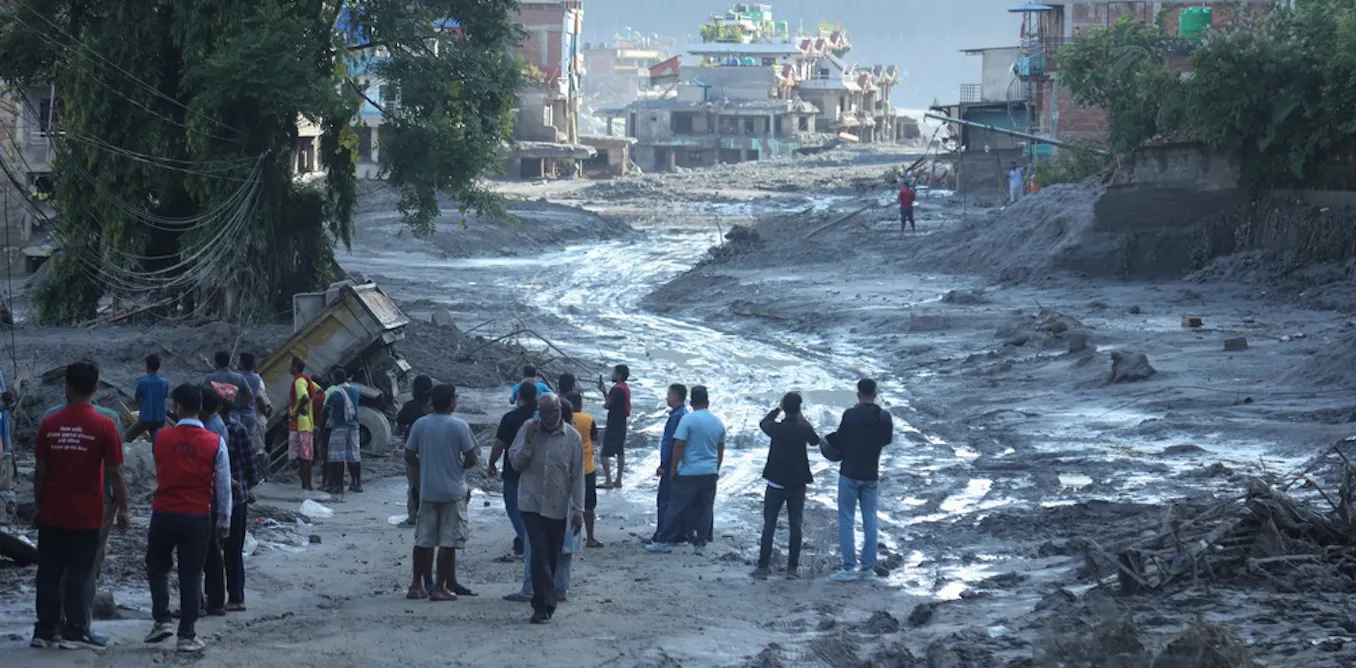
The signs are not positive. After the recent massive floods on the Nepal-Tibet border, Chinese state media tightly controlled reporting with a focus on rescue attempts, rather than devastation. It also heavily censored unofficial accounts.
Handheld and security camera footage that showed the destruction at the border appears to have vanished from Chinese media platforms.
On this occasion and in the past, Nepal has accused China of not sharing information quickly about escalating dangers. But Beijing denied there was any disinformation, and said information was released in a “timely” way in this recent incident.
A new report says the Himalayas are approaching a tipping point in terms of the speed and risks of glacier melting and lack of monitoring – with millions of lives and livelihoods at risk. So this issue could not be more urgent.
The recent behaviour of another world power, Russia, cast doubt on its willingness to be transparent during a disaster. When floods caused Siberia’s Ishim River to overflow in 2025, local officials hid much of the damage.
The severe consequences of such secrecy is apparent throughout recent history. In 1984, Ethiopian military dictator Mengistu Haile Mariam concealed and downplayed the catastrophic drought which led to a famine, in order to protect the country’s image. A strict media blackout was enforced, as Mengistu’s government refused to share data regarding the scale of the crisis or even acknowledge there was one.
Read more: Nepal-Tibet disaster linked to climate change – a glaciologist explains
Instead, he prioritised spending over US$100 million (£87 million) on celebrations to commemorate the 10th anniversary of Ethiopia’s Marxist revolution.
Mengistu ignored the ongoing mass starvation crisis in speeches. He also blocked international aid workers and journalists from entering the starving regions. An estimated one million people died due to this lack of action.
Another potential issue is the impact on shared water sources. If autocracies hide prolonged droughts, they may secretly over-extract shared resources, potentially drying out neighbouring territories.
Chernobyl’s cover-up
History shows that lack of warnings about escalating dangers caused by a disaster can have devastating effects in nearby countries.
The nuclear power plant disaster in Chernobyl in the former Soviet Union in 1986 was also covered up. KGB archives revealed that classified information on the extent of the radiation and contamination were kept secret.
Critical information was not released to the Ukrainian people and inhabitants of western Europe until months, and even years, later. Advocacy group Greenpeace estimated that there were potentially between 100,000 and 250,000 additional deaths – mostly due to radiation in Belarus, Ukraine and Russia – because of this lack of transparency.
Myanmar’s quasi-military government has regularly hidden valuable information from journalists, aid workers and other countries after each disaster in that country.
A 7.7-magnitude earthquake that hit central Myanmar in April 2025 killed thousands of people, causing bodies to pile up. Rather than facilitate the support of aid workers, supplies were blocked and confiscated by the military.
Not allowing humanitarian aid to come through in a timely fashion can also accelerate a refugee crisis, as desperate populations may flee in search of help.
Censorship and repression
Autocracies are more likely to censor and monitor media platforms than democracies. For instance, China recently stopped non-official content being shared about the August 2026 floods.
Some autocracies also restrict access for international aid workers, independent scientists and observers.
There’s another example from 2019. When Zimbabwe was hit by tropical cyclone Idai, its government restricted the involvement of international aid workers, which reduced recovery efforts.
Research has also shown that authoritarian regimes can escalate repression against their own citizens during disasters.
Greater levels of secrecy has implications for disease. Natural disasters frequently lead to infectious disease outbreaks. A government’s refusal to report a climate-driven outbreak could prevent neighbouring states from taking protective measures.
Authoritarian regimes also frequently suppress or delay data regarding extreme weather, glacial melts or industrial accidents to protect the regime’s image. This can compromise the safety, stability and economy of their own citizens and, potentially, neighbouring countries too.
Ecosystems and disasters do not respect political borders. Information censorship and the suppression of data will make us all more vulnerable as climate change-driven incidents escalate.