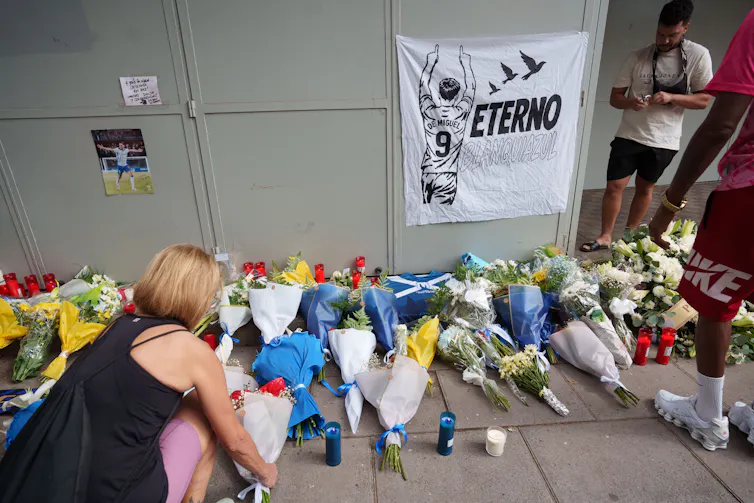
A recent incident during a Spanish Segunda División match between CD Tenerife and FC Andorra resulted in the tragic death of Tenerife player Jesús de Miguel. Although no official statement has confirmed the cause of his death, some reports suggest it could have been commotio cordis. This is a rare but well-known medical condition that can cause sudden cardiac arrest after a blow to the chest.
Commotio cordis means “agitation of the heart”. It was first described by doctors in the 1850s. In 1932, researchers in Germany identified three factors that help explain how it happens: the type of impact, its speed and where it strikes the chest. A sudden, sharp blow is particularly dangerous.
The heart sits inside the chest, protected by the ribs and the sternum, the flat bone at the front of the chest. Its lower tip points towards the left side of the body.
Unlike other muscles, the heart contains specialised muscle cells that generate their own electrical signals, allowing it to beat without conscious effort. It contracts thousands of times a day to keep blood circulating around the body, adjusting its activity to meet changing demands.
Heart muscle also does not tire in the same way as the muscles we use to walk, run or lift things. It can keep working throughout our lives because it relaxes between beats, giving itself time to recover.
This relaxation depends on a carefully timed electrical process. During part of each heartbeat, the heart’s cells reset their electrical charge so they are ready to contract again. This stage is known as the T-wave and can be seen on an electrocardiogram (ECG), which records the heart’s electrical activity.
During this brief period, the cells are normally less likely to respond to another electrical signal. But a powerful blow to the chest can send energy through the body’s tissues and disturb the electrical activity of the heart.
For commotio cordis to occur, the impact must happen at a very specific moment in the heartbeat. The vulnerable part of the T-wave lasts for roughly 30 milliseconds – just three hundredths of a second. A blow during this tiny window can interfere with the heart’s normal electrical rhythm.
The result can be ventricular fibrillation, one of the most serious heart rhythm disorders. Instead of contracting in a coordinated way to pump blood around the body, the heart’s lower chambers, called the ventricles, begin to quiver chaotically.
Blood can no longer circulate effectively to vital organs, including the brain. This causes cardiac arrest, in which the heart stops pumping blood properly and the person loses consciousness.
Heart appears normal
One unusual feature of commotio cordis is that the heart and surrounding tissues can appear completely normal afterwards. There may be no structural damage to the heart muscle, coronary arteries, ribs or sternum. This distinguishes it from cardiac arrest caused by injuries that physically damage the heart or chest.
The condition is rare but life-threatening. It is most commonly reported in children and teenagers aged four to 18. Most recorded cases involve males, who account for 94% of sporting cases and 93% of non-sporting cases.
Younger people may be more vulnerable because their chest bones and muscles are still developing. Their chest may offer less protection against the force of an impact reaching the heart. Women account for a larger proportion of non-sporting cases, at around 13%.
Football has seen deaths linked to commotio cordis before. A study examining sudden deaths in football worldwide between 2014 and 2018 recorded 617 player deaths. Among players aged 35 and younger who died suddenly while playing, 9% had, or were thought likely to have had, commotio cordis. In 11 cases, the impact came from a football hitting the chest. In three, it came from an opponent’s fist or elbow.
The condition has been reported more frequently in other contact sports. Baseball is often cited as the sport with the highest number of cases. Ice hockey, American football and lacrosse have also recorded more deaths than football.
One of the best-known recent cases involved NFL player Damar Hamlin, who suffered commotio cordis during a televised match. Medical staff responded immediately and saved his life. He returned to playing nine months after his cardiac arrest.
The speed of treatment is crucial to survival. Research suggests that when emergency treatment begins within three minutes, survival is more than 70%. If treatment takes three to five minutes, the chances fall to around 50%. After five minutes, they drop to approximately 25%.
Outside sport, commotio cordis can happen during assaults or road traffic collisions. Survival in these situations depends partly on whether someone nearby recognises what has happened, starts emergency treatment and has access to equipment such as a defibrillator.
Researchers believe commotio cordis deaths are probably underreported. This may be because it can be difficult to distinguish the condition from other causes of cardiac arrest, particularly when nobody witnesses the original impact.
Greater awareness of commotio cordis beyond cardiology, alongside the development of a national registry, is helping researchers understand the condition better. These efforts, combined with faster emergency treatment and improved access to defibrillators, could increase the chances of survival for people who experience it.