Birds’ compact nervous system seems to help them handle tasks very quickly.
Much of what we know about how a brain makes decisions comes from studying monkeys watching dots. In a task known as a random-dot-motion task, a cloud of flickering specks drifts weakly in one direction while the subject tries to determine whether—and in which direction— it’s moving. The task has shown that in the primate neocortex, neurons gather visual evidence over time, with their firing rates climbing until they cross a threshold, when the animal commits to a decision.
But avian brains don’t have a neocortex, so it wasn’t obvious how they made similar decisions.
“This was the big question,” said Andreas Nieder, a neurobiologist at the University of Tübingen. “How [would] a differently organized avian brain encode decisions?”
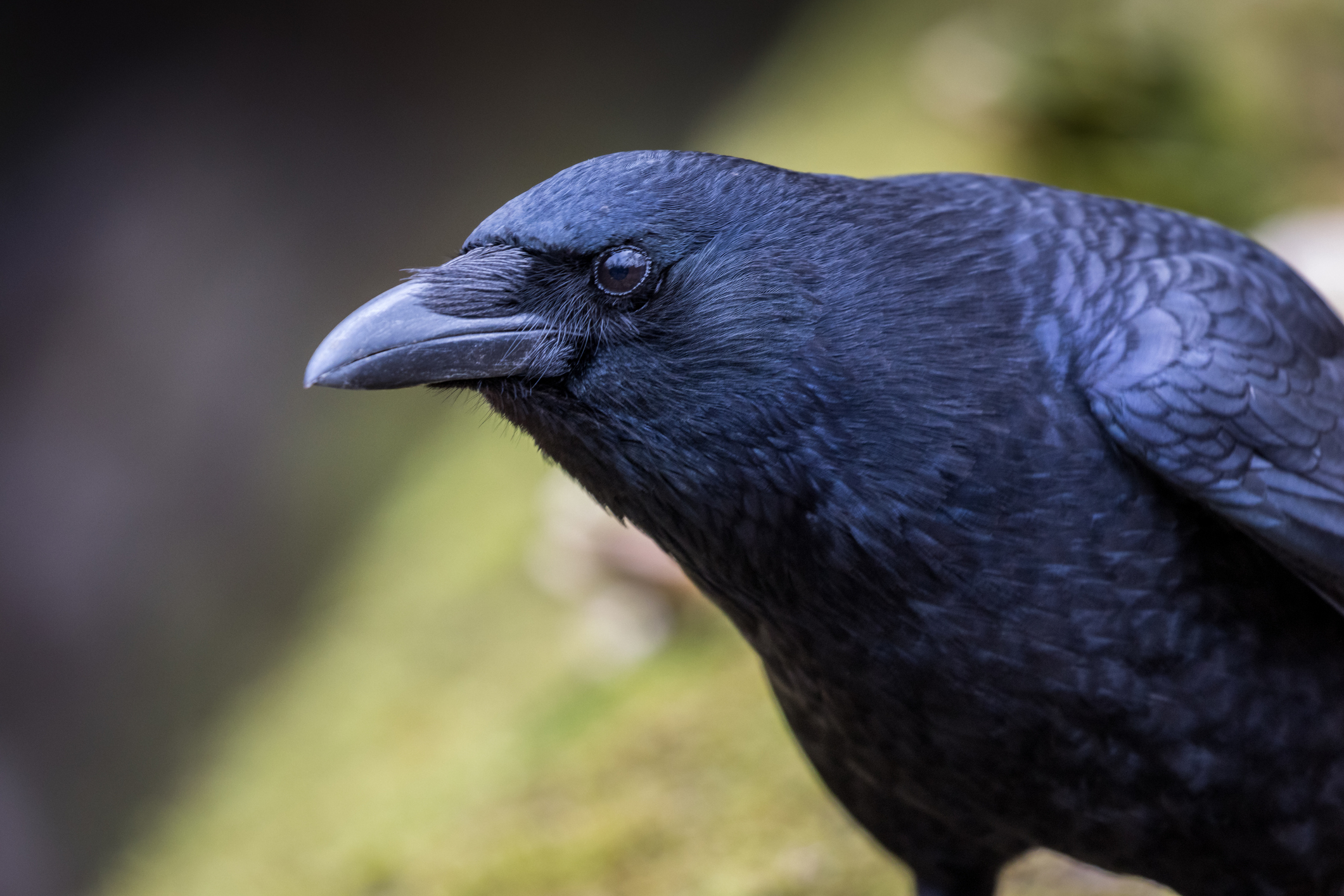
To find out, Nieder and his colleague Philipp Schmidbauer put two carrion crows through the same task the monkeys faced, recording their brain activity along the way. The crows solved the task the same way primates do, using the same mathematical logic despite having a very different brain structure. And they did it two times faster.
A brain built different
Nieder and Schmidbauer put two hand-raised crows in front of a touch-sensitive monitor showing a cloud of white dots on black, with some fraction of them drifting coherently left or right or up or down. The birds’ job was to report the overall direction by pecking one of the targets that flanked the display. Correct answers earned them a mealworm.
“We intentionally wanted to have exactly the same random-dot motion task,” Nieder said. “The only difference was that the crows had to peck to indicate their decision, whereas monkeys were indicating by making an eye movement.”
The researchers varied how many dots moved together, ranging from 81 percent of the dots coherently moving together, which is trivially easy to determine, down to 3 percent, which is barely distinguishable from noise. They also included a zero percent condition, in which there was no correct answer.
Both birds scored better than chance, even when only three percent of the dots were moving.
While the crows worked at the task, the team recorded from 248 neurons in the NCL (nidopallium caudolaterale)—a region at the top of the avian processing hierarchy that is widely regarded as the functional counterpart of the primate prefrontal cortex, despite being built differently.
Birds and mammals parted evolutionary ways more than 360 million years ago, and bird brains evolved a different architecture. The mammalian cortex is arranged as stacked sheets of cells, while the equivalent tissue in a bird is organized into dense clusters, with no layering at all. This alternative architecture, Nieder’s study found, proved faster.
Measured from the moment that the dots appeared to the moment the bird’s head started turning to peck at the button, the crows averaged 235 milliseconds. In closely matched versions of the task, monkeys took roughly 410, 490, and 600 milliseconds in three studies. The obvious question was whether the birds simply sacrificed accuracy for speed, but it turned out they did not.
Hunting for shortcuts
“This would be a simple explanation, that they are very fast at the cost of precision. But that’s not what’s happening,” Nieder said. Crows were as good as monkeys or humans in the same task.
“We’ve never forced the crows to be as quick as possible,” Nieder explained. “We just gave them a self-paced decision. And even in this situation, they were twice as fast compared to any monkey or human that I’m aware of.”
One possible reason for the crows’ speed was that their’ brains were working on a fixed deadline, and the data initially seemed to support that. In primates, difficulty has a large effect on how long a decision takes. In the crows, reaction times ran from 220 milliseconds at the easiest task to just 254 at the hardest, a difference of only 34 milliseconds. But Nieder doesn’t think this means an avian brain is just wired to produce answers on a timer.
“If you zoom in, there is a statistical increase in the reaction time when the coherence is going down,” Nieder said. “They show the same effect as mammals. It’s just much less pronounced, because everything happens much faster.”
There are no shortcuts, he explained, as the crows had to look at the direction of dots’ movement and process this information—they didn’t have any other cues. “That’s why I think they do accumulate evidence. They have to,” Nieder said.
Catching the evidence
The recordings of neuronal activity show the evidence accumulation in action. Just under a quarter of the neurons sampled, 58 of 248, fired differently depending on which direction the bird would eventually choose, and these neurons started registering that decision incredibly early—about 70 milliseconds after the dots appeared and roughly 170 milliseconds before the bird’s head moved. “The neurons were accumulating sensory evidence, which is very reminiscent of what monkey neurons would do in the neocortex,” Nieder said.
This kind of signal in the brain is called a decision variable, a running tally of evidence that can climb toward a commitment. “It turns out that what we find in the crow brain looks basically the same,” Nieder said. “And that’s interesting considering their brains have evolved very distinctly, as if evolution has found the same physiological mechanism twice, independently.”
So far, the team can’t attribute the crows’ speed to any one particularly fast process. Nieder’s leading explanation is that nearly every biological process runs faster in birds than in mammals.
Life in the fast lane
“We cannot really point our finger to one specific process that is totally faster. It is probably a cascade of different processes that are faster,” Nieder explained. This cascade, he said, begins with vision, since avian visual systems are exquisitely movement-sensitive. It continues through the decision itself and extends to the motor response. Nieder argues there are likely two physiological aspects that make this possible.
The first is simply size. Flight imposes strict weight limits, so birds pack enormous numbers of very small neurons into very small brains. Their axons, the long cable-like fibers that transmit electrical and chemical signals between cells, are shorter.
“Long lines take time. Short lines speed everything up,” Nieder said.
The second factor is temperature. Humans’ body temperature is about 36.6° Celsius, while birds go up to 41, or even 42°. This higher body temperature speeds up all chemical processes in birds’ bodies.
“Every ion channel would open and close faster. Every transmitter would move through the synaptic cleft faster,” Nieder explained. “Evolution really took their bodies to the limit. This is life in the fast lane, not only in the brain, but also respiration, the cardiovascular system—everything is going toward the limit in birds.”
But calling crows (or birds in general) decision-making speed demons comes with a few caveats.
Picking the smartest
First, the study included only two birds, a rather small sample. “On the one hand, that’s a valid constraint,” Nieder said. “On the other hand, when you look at monkey studies, that’s the standard number of animals that we have for these very complex types of studies, combining behavior and electrophysiology.”
Also, the decision-making time of 235 milliseconds in crows and above 400 milliseconds in primates is not an absolute limit. These times apply to the random dot-motion task, which inherently requires waiting to see which way things are drifting.
Finally, it might be hard to learn whether the results extend beyond corvids or crows specifically. “The problem with many other birds is that they are not as smart as corvids and crows and you need a smart bird in order to train it to do exactly this task,” Nieder said.
So far, he admitted, we can’t be sure whether excellent decision-making skills of crows in his lab are due to birds’ brains being speedy in general or to crows simply being smarter than other avians. “Among birds, the corvids are renowned to be extremely intelligent, so maybe there’s something special about them,” Nieder said.
Science, 2026. DOI: 10.1126/science.aed6459