Hello Nature readers, would you like to get this Briefing in your inbox free every day? Sign up here.
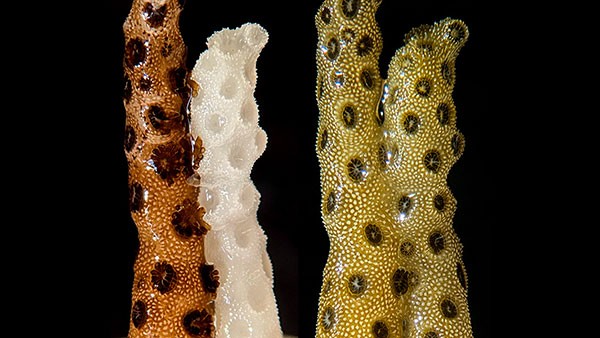
Bleached coral revived by healthy touch
Scientists have successfully restored bleached coral in the lab by placing it in contact with a healthy fragment. Researchers found that when a healthy piece of Pocillopora damicornis coral rested against a bleached piece, the two fused together to create a bridge across which algal symbionts can spread. This transfer fully restored the bleached coral within eight weeks, even if the healthy piece was removed after a week. The result “can inspire solutions that eventually may be scalable” to reverse widespread coral decline, says marine ecologist and study co-author Fiorenza Micheli.
arXiv tries to close AI floodgates
The preprint server arXiv has introduced a cap of two papers per month for each submitting researcher in a bid to clampdown on a deluge of submissions, many generated by artificial intelligence. The limit is the latest measure to prevent its voluntary moderators from being overwhelmed by submissions, says astrophysicist Steinn Sigurðsson, scientific director of arXiv. Some researchers support the cap; others counter that it doesn’t solve the root problem. AI slop will “simply go somewhere else and become someone else’s problem”, says Natalie Khalil, the founder of AI-assisted peer-review platform Reviewer3.
Brown fat comes with big benefits
A study of more than 100,000 people has revealed some surprising benefits of brown fat — a type that burns calories to generate heat. Researchers found that people with ‘active’ brown fat are less affected by health issues — such as type 2 diabetes, depression and anxiety — than those without it. The risk of these conditions decreased the more active brown fat a person had. The study is retrospective, so can’t confirm that brown fat is causing these benefits, but “it’s still a very interesting and surprising study”, says molecular biologist Irfan Lodhi.
Bouba–Kiki effect holds true in dogs
When presented with two shapes, one with spikes and one rounded, and asked to designate them ‘bouba’ and ‘kiki’, people tend to agree that kiki is the spiky one — and so do dogs. Researchers found that when presented with images of these shapes, domestic dogs (Canis familiaris) more often looked at and moved toward the round shape when the word ‘bouba’ was played from a speaker, and vice versa. The results could suggest that dogs make similar connections between visual information and sounds to humans.
Reference: Proceedings of the Royal Society B paper
Four science stories to brighten your day
Nature’s latest collection of stories selected to bring readers joy includes the newest penguin species described by science, and news that the island nation of Mauritius has become the first country in the world to reduce its number of people with type 2 diabetes — an impressive feat with diabetes rates rising globally, researchers say.
Many microorganisms; one test
A technique called metagenomic testing can screen for every microorganism that might be present in a sample, rather than searching for one in particular. Now hospitals are trialling ways of using these tests to quickly identify whether acute illnesses that cause neurological symptoms are bacterial, viral or autoimmune in origin to inform more effective treatment. Interpreting the results of metagenomic tests — which pick up pathogens, harmless microbes and contamination alike — can be a rate-limiting step, but advances in AI have enabled a faster sort of useful data from noise.
How to be an American scientist
The US National Academies of Sciences, Engineering, and Medicine has updated On Being a Scientist, its bible for graduate students and early career researchers first published in 1989. Things have changed since the last edition, in 2009, note engineer Mitul Luhar, chemist and dean Emily Pentzer and psychologist Alan Leshner, who was formerly head of the American Association for the Advancement of Science. “Shifts in research priorities and funding place new expectations and pressures on scientists,” they write. “Early-career researchers feel the consequences most acutely.”
Issues in Science and Technology | 9 min read
Reference: On Being a Scientist: A Guide to the Responsible and Ethical Conduct of Research
Quote of the day
“The beautiful part is the in-between.”
After a student asked him ‘what’s the point of doing mathematics if an AI can do it better?’, mathematician Steven Strogatz ponders why we bother with being creative and doing what is meaningful in the short time between the cradle and the grave. (The New York Times Daily podcast | 36 min listen or 2:20 video excerpt)