Hello Nature readers, would you like to get this Briefing in your inbox free every day? Sign up here.
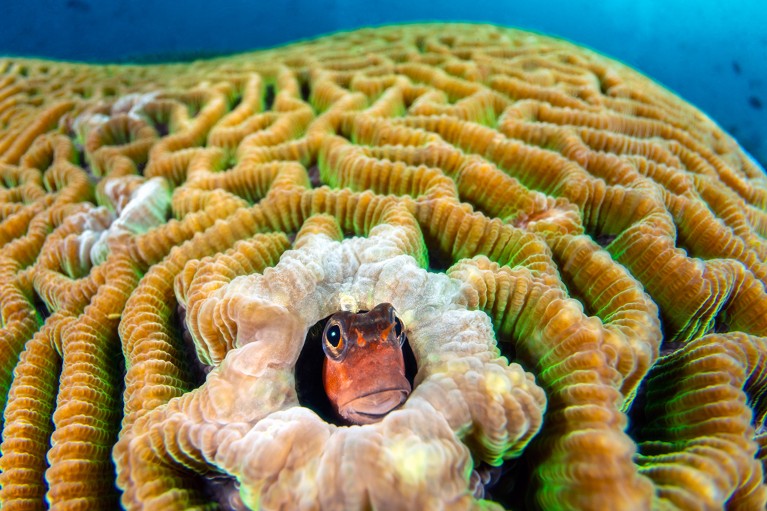
The race to save coral reefs from El Niño
Scientists warn we’re headed for a mass coral bleaching event around the globe, just a few years after the last coral crisis. Researchers working on coral restoration are doing what they can to help reefs survive and recover from record ocean temperatures. Approaches include breeding corals with improved tolerance to heat and acidity; treating corals with microbial cocktails and micronutrients; and luring coral larvae by playing the underwater sounds of a healthy reef. But these small-scale wins can only succeed alongside reductions in greenhouse-gas emissions, overfishing and pollution.

Ukraine academy responds to deadly attack
Ukraine’s National Academy of Sciences has called for the global community to continue to shun Russian state scientific and educational institutions after Russia destroyed the society’s building in central Kyiv, killing two people, on Monday. “There can be no ‘science is above politics’ when science is under armed attacks,” the academy said.
Times Higher Education | 5 min read (free reg required) & Science | 6 min read
Reference: National Academy of Sciences of Ukraine statement
The OpenAI Foundation — the charity arm of the artificial-intelligence behemoth — is on track to become one of the wealthiest non-profit organizations on the planet. It has so far funded Alzheimer’s disease research, cancer vaccines and a pilot project to repurpose data from bankrupt biotechnology companies. “Part of the reason that we’re starting in the life sciences and health is that we think that’s one of the areas where AI can have the most benefit,” says Jacob Trefethen, who leads life sciences at the foundation.
T. rex was no cold-blooded killer
The fearsome Tyrannosaurus rex might have had an internal body temperature similar to that of modern-day elephants — and not too dissimilar to humans. By examining the arrangement of isotopes in the enamel of fossilized T. rex teeth, researchers estimate that the dinosaur’s internal temperature was approximately 36 °C. Narrowing down the creature’s body temperature can hint at what kind of diet it needed to sustain its homeostasis, and where it was able to roam.
Monkeys show hints of good grammar
The vocalizations of the common marmoset (Callithrix jacchus), the olive colobus monkey (Procolobus verus) and the bonobo (Pan paniscus) all appear to contain patterns that resemble complex elements of human grammar. Researchers used mathematical models to analyse clips of these monkey’s communications and identified some elements similar to supra-regular recursion — a grammatical structure that requires a listener to process a word or statement nested within a wider sentence without context. This level of complexity was thought to be unique to humans.
Reference: bioRxiv preprint (not peer reviewed)
You decide: time to zip small talk?
A scientist with no appetite for small talk asks: is it OK to arrive late to meetings to avoid it, and to cut it off quickly when they’re the one in charge? A panel of Nature readers gave their judgement — read on to see if you agree.
Quote of the day
“Before helping students to acclimatize themselves to killing, we should ask whether becoming more resilient is the right solution.”
Three researchers respond to a Nature Careers advice column about a PhD student who was distressed by killing research animals. They argue that, rather than offering coping mechanisms, the article could have suggested discussing possible adjustments with supervisors and considering responsible dissent. (Nature | 3 min read)