Hello Nature readers, would you like to get this Briefing in your inbox free every day? Sign up here.

Psychiatry: this time it’s personal
Researchers are hoping to reduce the trial and error involved in finding the right treatments and doses for people with mental-health conditions, in an approach called precision psychiatry. The idea involves dividing broad, often vague diagnoses into more-useful subgroups and matching treatments to individuals using a data-driven approach. Some psychiatrists are busy investigating how to incorporate genetics, biometric data and socioeconomic factors into this personalized package. But others say the approach has yet to prove its benefits.
Brain flickers hint at drivers of awareness
In a visual-perception test, researchers showed macaques (Macaca mulatta) two images — each only visible with one eye — that elicited known patterns of neural activity. They found that the animals’ brain activity flickered between the two patterns 15 times per second — one corresponding to the image the macaque was consciously processing, and the other to the one that was not being perceived. The team says the findings could be a small step towards determining how brains give rise to consciousness, or the subjective experience of being aware.
Reference: bioRxiv preprint (not peer reviewed)
DMD gene therapy showed little efficacy
Results from the first human trial of an experimental gene-editing therapy for Duchenne muscular dystrophy (DMD), in which a young boy died after a catastrophic immune reaction, have been published. The therapy used an adeno-associated virus to deliver a base editor — a form of CRISPR gene-editing technology — to muscles to correct the mutation that causes DMD. The findings show that the treatment did edit some target genes, but that its therapeutic effect was limited. The boy who died was one of four trial participants.
35 minutes
The average loss of sleep per night among people in rural communities in Argentina after they gained access to electricity, which allowed them access to the Internet and smartphones. (Nature Research Highlight | 3 min read)
Funders back preprint-led publishing
Science funders and research organizations in Europe are joining a European Commission initiative to expand open-access publishing and make the peer-review process more transparent. The programme will run on an expanded version of the Open Research Europe (ORE) platform that the commission plans to roll out in early November. The platform uses a model in which preprints are reviewed openly by identifiable reviewers. “This is a collective effort to build a more transparent, sustainable publishing system that serves the research community and society as a whole,” says Karla Anaya-Carlsson, who chairs the ORE Funders Group.
Infographic of the week
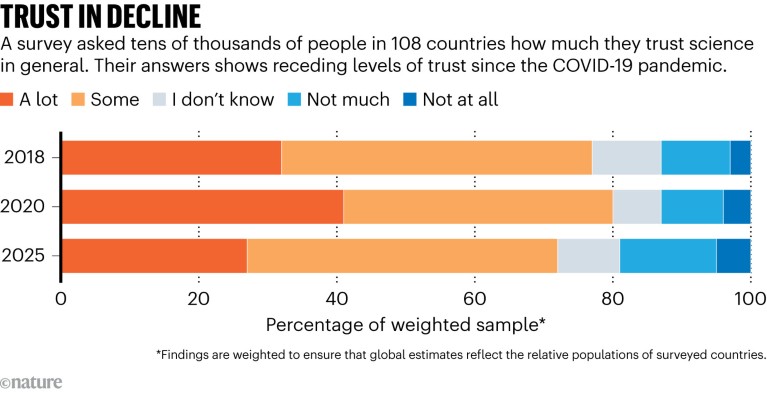
This year’s results of the largest public survey of confidence in science show that trust in research has declined since the COVID-19 pandemic. The questionnaire explores how people feel about science and health — including vaccines, pandemic preparedness, clean energy and, for the first time, artificial intelligence. Despite the dip, scientists were still ranked as more trustworthy than government officials and neighbours. (Nature | 3 min read)
The search for firesafe frog homes
In southern California, researchers are racing to conserve the mountain yellow-legged frog (Rana mucosa). Invasive species, habitat loss and an infectious fungus drove the once-thriving population of these frogs to near extinction in the 2000s. Thanks to captive breeding programmes, thousands of yellow-legged frogs have since been released back into the wild. But the increasing intensity of wildfires in the region has forced scientists to repeatedly seek out new places to safely rehome the amphibians — and they could be running out of viable options.
Should I care what my students think of me?
Marketing communications specialist Lan Nguyen Chaplin asks: is it OK that I no longer care about student evaluations? “What matters is that I challenge them — not whether they like me or not,” she says of her students. A panel of Nature readers gave their judgement — read on to see if you agree.
Quote of the day
“We’re super proud of the legacy that Swift leaves behind.”
After almost 22 years in orbit, NASA’s Neil Gehrels Swift Observatory will plummet to a fiery demise in Earth’s atmosphere next week. Astronomers are mourning the spacecraft, but grateful for the massive archive of data it leaves for scientists to explore, says Caryl Gronwall, who led Swift’s science operations team. (Nature | 4 min read)