Hello Nature readers, would you like to get this Briefing in your inbox free every day? Sign up here.
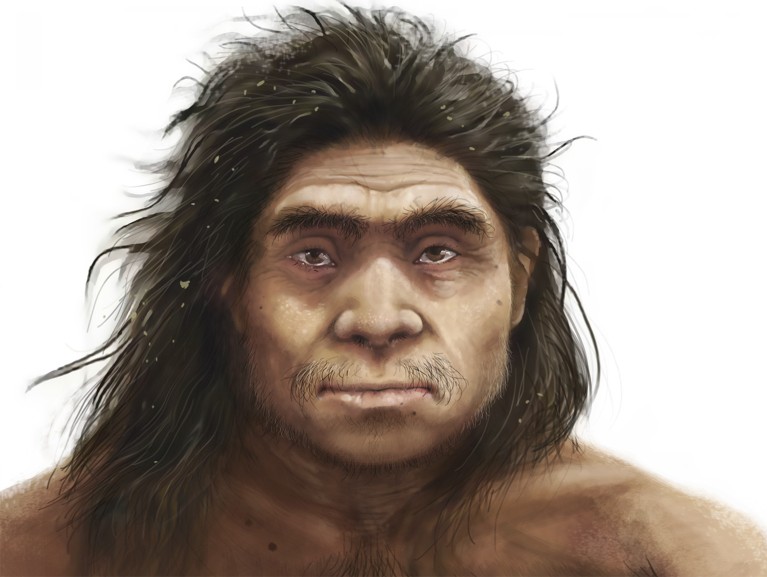
The portrait of a Denisovan
A low, sloping forehead, a massive brow ridge, rectangle-like eye sockets, flat cheeks, and a moderately elevated bridge of the nose were probably the hallmark features of Denisovans — a mysterious ancient-human species. Using fossilized skull fragments, teeth and jaws, researchers identified some visual features that would have set Denisovans apart from other early-human species, such as the flattened, elongated skull shape. A knowledge of these unique features could help researchers classify other fossils that couldn’t previously be identified as Denisovan.
Brain progress could affect mental health
The emergence of mental-health conditions in teenagers could be forecast by the speed at which certain regions of their brain develop. A study of nearly 12,000 young people in the United States suggests that vulnerability to conditions such as depression in adolescents could involve disruption of the brain’s developmental timeline and could be set in motion by genes that are active before birth. The findings reveal small population-level patterns, says systems neuroscientist Avram Holmes, but can’t be used to track the trajectory of an individual child.
Reference: bioRxiv preprint (not peer reviewed)
Egypt’s first female on the throne
A new analysis of ancient artifacts suggests that a woman named Meretneith, who was buried in a lavish tomb around 5,000 years ago, might have been Egypt’s first female ruler. Egyptologists Sue Kelly and Crystal Miller analysed digitally enhanced photographs of serekhs — hieroglyphs that indicate a person ruled at the time of their death — that named the king Djer, and possibly Meretneith, that were found on objects in a separate tomb. They found that one features the goddess Neith, "a symbol no male ruler ever used”, Kelly says, which hints that Meretneith held true royal authority, not that of a consort or regent.
Reference: Prague Egyptological Studies paper
A look inside the insula
Scientists have mapped the mysterious insula in the human brain in unprecedented detail. The results detail how this region is organized to support the brain’s processing of bodily sensation: one region is responsible for the feeling of pain in some body parts, a second generates sensations such as nausea felt by internal organs and a third ‘talks’ to other brain areas involved in emotion and cognition. The latter area allows for the insula to work with the cortex — the seat of higher-order cognition — to affect how the brain interprets various sensations.
‘Hope’ vaccine aims to slow Ebola outbreak
A phase II/III trial of a vaccine against Ebola could see its first doses administered as soon as this week in the Democratic Republic of the Congo (DRC), where there have been more than 9,500 known cases and more than 4,600 deaths, reports Science. The trial, named Tumaini — Swahili for “hope” — will first use a vaccine called Ervebo that targets a ‘mismatched’ ebolavirus species, ‘Zaire’ — the outbreak in DRC involves the Bundibugyo species. The goal is to add vaccine candidates developed specifically to target Bundibugyo — such as ChAdOx1, developed by a University of Oxford group in the United Kingdom — after they graduate from phase I clinical trials.
Science | 8 min read & Nature | 7 min read (from July)
Robert (Bob) Williamson was a geneticist who dedicated his career to the identification of disease-linked genes and the diagnosis and treatment of single-gene disorders, such as cystic fibrosis (CF) and Duchenne muscular dystrophy (DMD). “He had almost limitless energy and was an inspiring and generous leader,” writes geneticist Kay Davies, who worked alongside Williamson to narrow down the location of the gene responsible for DMD. Williamson then applied this approach to locate the gene that causes CF, and was an early proponent of gene therapy. He has died, aged 88.
What we should see in climate graphics
“Making climate change visible is only the first step” for a great graphic, argues digital communications researcher Monika Frątczak. Alongside whether a graph or chart is accurate, “we should also ask who is represented, who is missing and whose experience the data allows us to see”, she writes. By tapping into people’s connection to their own land and community, visualizations can inspire deeper engagement — and an emotional response that can lead to real action.
Quote of the day
“A city writes its values into the timing of its lights, whether or not it ever says so aloud.”
The timings of traffic lights at busy junctions are often decided by algorithms on the basis of the number of vehicles on the road. But who to prioritize isn’t a purely technical decision, and should instead be debated as a matter of public interest, argues computer scientist Xiaowen Tao (陶晓文). (Nature Cities | 5 min read)