It's been nearly half a century since the Voyager probes launched from Earth on a mission to explore the outer solar system, and they're still running.
You can listen to the latest episode of The Kettle on this page, Spotify, Apple Podcasts, or YouTube. You can also subscribe on those platforms to be notified when a new episode goes live.
You're probably familiar with some of Voyager's iconic images, like the Pale Blue Dot and and its portraits of the outer planets.
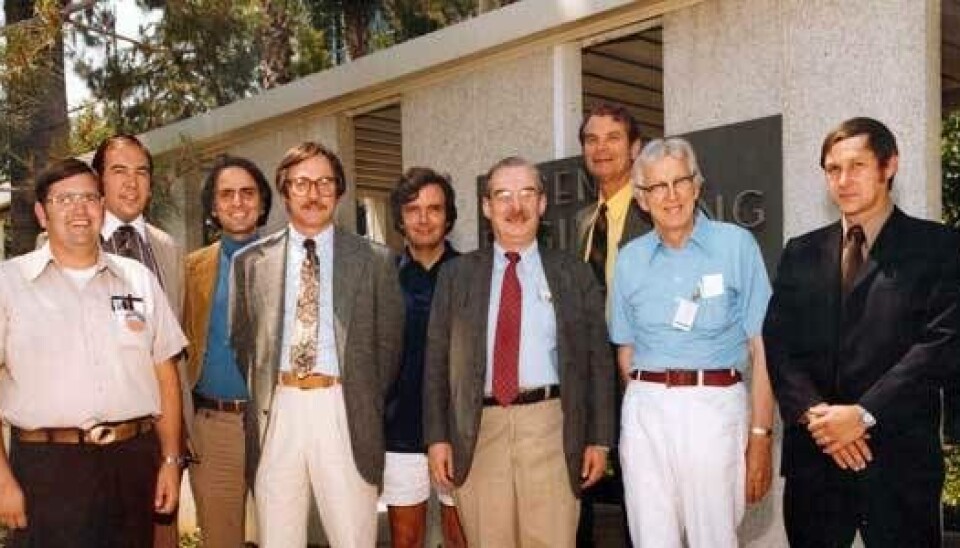
Those photos and observations wouldn't have been possible without Voyager's imaging team, eight members of which were selected from scientists from around the world. The UK's sole representative, Dr. Garry Hunt, joins us on this episode of to discuss his role in the Voyager program, the future of the mission, and the state of science in the UK, US, and beyond.
A lightly edited transcript is included below:
Hi everyone, and welcome to another episode of ’s Kettle Podcast. I'm your host, Brandon Vigliarolo, and we have a very special episode for you this week. We're gonna step away from the doom and gloom of AI and the silliness of Silicon Valley to talk about something and to someone of considerably more historic importance. The Voyager space missions will mark fifty years of exploring the solar system and beyond next year. With us to talk about this is Reg Reporter Richard Speed and our very special guest, British astrophysicist Dr. Gary Hunt who was a member of the original Voyager imaging team.
Thank you so much, Dr. Hunt, for coming on. And I'm gonna turn this over to Richard today, since you two have such a history together working on stories for , and I'm excited to hear about what he's going to pick your brain about. So Richard, take it away.
Well Dr. Hunt, we've spoken a lot about the Voyager project over the years, but for anyone who's not aware of it, I wonder if you could summarize the mission, which is, I know, a big ask, and also what your role in it is and was.
Well indeed, it's a unique mission in the sense that every 176 years the major planets Jupiter, Saturn, Uranus, Neptune, line up virtually in a straight line. And we wanted to explore the outer planets 'cause we've never been there before. I'm talking in the 1970s, late 1960s, '70s. So this is an unknown world. We thought that the major planets were keys to understanding the origin of the solar system, indeed the origin of life, so sending space missions there was a priority.
But it needed to be done in a very economical way. With the planets lined up, that meant we could get there in the quickest way, requiring less fuel, and it would be the best way of going about it. So the opportunity came and NASA funded a mission to send two spacecraft at this unique time, which was in the mid '70s, 1977, to the major planets.
NASA sent out an invitation to tender. They selected the ten instruments. Imaging had as an instrument in concept had been suggested, but they wanted a team of real scientists, not astronomers, not basic astronomers. They understood this is a chance to do real detailed science, real physics, real chemistry, the whole understanding of what went on. So they were looking for an interdisciplinary group of people. They selected eight people from invitations and I gather there were about nearly a thousand people proposed and of those eight I was chosen.
Wow.
So I decided I suddenly found myself in this incredible position. I'm there to represent atmospheric physics. I want to understand the physics, the meteorology of the major planets. So here is an opportunity to explore the outer planets to learn about why we wanted to go to Jupiter, Saturn, Uranus, and Neptune. However, funding was tight. The president at the time was Nixon, and we only had funding as far as Jupiter and Saturn. So we were treading new territory. At the time the mission was sort of decided, we had not been through the asteroid belt. So the first question was: would the spacecraft even get that far? And of course the pioneers had just been launched at the beginning of the '70s and they managed to get through and raised a lot of questions. So I was part of the imaging team, this amazing set of what I will call prima donnas, because we all were. They were from Carl Sagan to Vern Suomi, who was a meteorologist, to Brad Smith, a whole collection of people. And we had to design the imaging system, the cameras, and be part of the organization that developed the choice of trajectories and all the other facets of this mission.
In other words, we had to understand the risks as well as the potential rewards that came from it. So it was a big responsibility. And to put the whole thing in real context, I learnt in December '72 from NASA that I'd been selected. We had our first mission meetings in February of '73, and we had until the summer of 1977 to get the spacecraft launched. And the window for launching was ten days. So this was really a big precision job. So large responsibility and had many opportunities, not only to do the science, but the work that I was doing when I took the data back to the UK was to actually serve as a trigger for planetary research within the UK. So this really was a major major part of a new world, new understanding. And as we have learned over the years, we have made history and just about all the observations we've made.
Okay, great, thank you. So, I mean, as you said, it's been coming out for half a century, 50 years since the spacecraft were launched on their mission and they've been, as you say, Jupiter, Saturn, Uranus, Neptune, and so on. I was just wondering, why do you think they've lasted for so long? Because it's just incredible, really if you think about it.
Well, firstly I will put my hand up and say that the engineers of JPL are exceptional. We've had a few hitches and they've overcome it. First of all, we also said we want a spacecraft. It's going to unknown territories. We don't know how long it's going to last. Reliability was the key. So it was built around the mariners, which have been the bedrock of the earlier missions to around Mars and flying by Venus. So that was the first thing.
And so many of the aspects of it were built from equipment from the mid-sixties. So the issue is even more exciting to think that here we are 50 years after launch flying a spacecraft with equipment which was already 10 years old by the time we got it there. So this really is an example of reliability, which is the bottleneck. And of course, the other aspect of it we built in redundancy as well. So we knew that, if things went wrong, we had to find a way of easily overcoming it. As it's drifting away at the speed of thirty thousand miles an hour, you can't just sort of go out and repair it. You've got to be able to do things while the spacecraft is in motion. So there's a certain amount of redundancy, built in reliability, incredibly good careful planning, absolutely brilliant engineers who to this day are doing the most incredible things.
Well, yes, I have to say, I agree, having spoken to the current Voyager team, they are a bunch of very impressive individuals. And they seem to keep eking out more and more life from the spacecraft. I know it's powered by RTGs, which will eventually expire and there won't be enough power to keep it going. But it seems they'll be able to continue well into the 2030s, maybe even beyond. I mean, what do you think is going to end the mission because I mean it must be coming up. Do you think it'll be a hardware failure? We have had some spacecraft failures over the years or do you think it's going to be more prosaic? Perhaps it'll be just a lack of funding.
Well, if you go back to our elementary school physics, we know that as it moves away the signal strength disappears like one over the square of the distance, so it's getting pretty weak. It's incredibly weak. The brilliance of the deep space network, Goldstone, Madrid, Canberra, that's key. Furthermore the power on board and we have our own nuclear power plant on board, which is decaying plutonium, which is the key aspect of the spacecraft. That's getting less and less. We're losing several watts per year. There will come a time when the signal is literally so weak we can't pick it up. So that is one thing that we predicted about 2035. Could it become out of touch before then? Well, that's then politics versus science and engineering.
And yes, it costs money to keep this thing running, but the way in which science budgets are being hacked at every moment, we are worried that once we pass our our big date of fifty years next summer, that perhaps that the politicians will say: You've had your time, enough is enough.
I really hope that's not the case. Personally I hope that there's some development in deep space monitoring over the next few years that would enable us to keep picking it up beyond that. Or do you think it's simply a matter of distance and background noise that it would be unreachable?
The signal is incredibly weak. and there'd be insufficient power in the spacecraft to actually power it. They've got to have some form of heating. It's pretty cold out there. or virtually everything has been turned off. They've just done a major activity with the onboard power system. They literally have done everything they can. We reckon to 2035 we will still be able – that'll be about the time it'll be too weak for anything on Earth to be able to pick it up. So that literally is the time we were anticipating the end would come, if we can keep the politicians out of the way.
Well, absolutely and I mean I I think as we spoke recently it's approaching a one light day to kind of get a feeling of how far away these things are now where it takes an entire day to send a command to spacecraft a light day for the command to come back.
Well, I think the issue is it's one light day in distance. Now if I'm sending you a message, suppose I'm speaking to you and you're on Voyager. I start talking to you now, it's 24 hours before you get my message, then it's 24 hours before we send it back again. Can you imagine operating like that? This is a very significant factor. This is the furthest anything it has ever got that we've been able to record. Voyager 2 will not get there until about 2030, I think it is. Because it's on a different path. But these are immense distances. So it's never happened before. It actually occurs, if you want UK time, on the 18th of November at 10.06 in the morning [0206 Pacific Time, 0506 EST]. So look at your watch when that time comes up and say, that's where Voyager 1 is.
I must admit, speaking to the JPL team, and again, we work in technology, the thought of the fact you would send a command to the spacecraft, you won't even know if it's worked until the following day or a day or so later, at which point it could have done something awful to the spacecraft and it's too late to fix it. I just can't get my head around that kind of risk analysis and risk assessment, which you must do.
Well, we've we've had that situation occur because you probably remember several months ago, they wasn't replying to signals and they discovered that the dish was actually pointing slightly away so it could not be picked up in Goldstone, but managed to find a way of turning it around so it could actually recommunicate. But there was another problem. All the codes for the very, very poor computer which actually has less power in it than I have in my Apple Watch I'm wearing. They were written in assembler code. Well those people who go back to the early days of computing, that is one of the very basic codes. There was nobody in JPL who had that experience. Somebody had retired and was willing to come back and find them. Everything was written down on pieces of paper. So it was a whole new ballgame. But they used that expertise and the excellent documentation and to actually resurrect that particular problem.
Now that's wonderful. Dr. Hunter, I wonder if you can cast your mind back to your time when the mission was obviously doing the, when the imaging portion of the mission was still running. I mean, what was a particular highlight for you?
Well, if you want to know what was the greatest picture ever taken, this will shock you, it's the little blue dot. But I think that one looking back at the family of all the planets when we were in the orbit of Neptune, and then focusing on and finding that little tiny speck, that's the Earth. That's us. We were insignificant, we were just a speck amongst the stars. So that was particularly incredible. But going back into the more physics side of it we've got situations like we found Jupiter had a ring. We discovered that Io had volcanoes. We weren't expecting it. We go to Saturn and we find the structure of the rings. We had a chance to look at Titan for the first time and then we get to Uranus and then we find the structure - good grief – the magnetic field is peculiar, it's off center. And we look we look at Miranda [a moon of Uranus], which it's clear is a reassembled satellite with cliffs which are fifteen meters high. And then go one step further to Neptune and find that's got weather systems, the fastest winds in the solar system, and active nitrogen geysers on one of its satellites. Everything was a puzzle. And one of the things I find quite incredible, every book I pick up with the solar system and the planets, it comes to the Voyager observations, we made history. This is almost like the Bayou tapestry, I guess, of a planetary exploration.
Mm-hmm.
Absolutely, it's very exciting. It must have been very exciting that almost every day, month or year there was a new discovery, something which no one else had seen before you. I can't imagine how exciting that must have been, or still is, because I gather they're still looking, they're still finding things in the data now.
Well I gather they are, because we had eighty thousand images and if you do a count of the number of satellites now, we only had a few ten or so around Saturn at the time of Voyager's launch. We're now in the hundreds. So the objects are still being found. And this is one of the other things which is so nice, is that citizen science means that everybody can have access to this data and work with it. You can process the data, you can analyze the pictures in a way we could only do with our sophisticated equipment.
Excellent. Speaking of a quick shipment and the instruments on board, the Voyager probes, a question is always asked. It's asked of me a lot. I mean, what would happen if you could turn the cameras back on? What would they see now? Nothing at all. Blankness. I mean, they were designed for certain contrasts. Could they be turned on and what would you see?
No, they couldn't do anything. They couldn't even do a selfie.
Ha ha ha.
So that was a sad thing that they turned off, but it was a marvelous job. But you just think of all the trade-offs we had to do. I wanted to see atmospheric features, the geologists wanted to look at the surface features, other people wanted elements of the power systems as well. So it was a mission of trade-offs, it was a mission of using incredible talent, but one of the most important things that came out of Voyager was this doing what we're doing now, sharing the results. We had terrifically good press conferences every morning. We met regularly with the press and we did television, all regularly, just so people kept up to date. I always thought that the taxpayer who had paid for this mission and it cost 800 million dollars, well eight cents per American per year, which is pretty good in value for money. We should share the results with them. And to this day I go around giving talks to people, people ask me fundamental questions and I'm delighted to be able to share the results with them.
That's great.
Yeah.
Now looking at the current situation, NASA and the US space program in general, I know obviously you've been out of that for quite some time, but it seems to be much more focused on the commercial sector these days. It's commercial providers, commercial vendors. mean, one, do you think something like Voyager would even be possible now, would even be a thing that NASA would attempt? And what do you make of the impact that commercial vendors are having?
Well, the commercial world has changed it dramatically. We've gone from exploration to exploitation.
And also the way in which money is spent by governments has changed from doing scientific analysis and really deep exploratory activities to saying, okay, we've got to focus on defence, we've got to focus on other elements to do with the economies. And most nations' economies are struggling. So science spending is a bit of a delicate issue at the present time. So the commercial side wants return. If I'm in, and NASA's budget is being cut back, and therefore money for space activities has got to come from people with deep pockets, investors. And now if you're an investor, you'll want a return on your money quickly and have some idea of a reliable expectation. Would you invest on a mission where you wouldn't get your return for fifty years? I doubt it.
So it will be some form of science exploration with a small amount of funding. Would you get a mission like Voyager again? Well, I hope so, but things have got to improve. We've got to have better power systems, we've got to have a whole variety of ways of doing things differently. But take it in mind, we're talking here about a mission launched fifty years ago, which went to Uranus and Neptune, over forty years ago. Nothing else has been there since. If you've had a glimpse of these objects once, that was one snapshot. Is that a real indication of what takes place? Have we seen things properly? Yes, we're getting good pictures from the James Webb telescope and they're giving us a new picture of it, but that's not enough. So we've got to have missions out there, but they won't necessarily come from the US or indeed Europe, they could well come from China.
Which has already publicly said: we're planning to go to Uranus. So who knows what's going to do it. But the balance between commercial and science has changed dramatically. Yeah, there wasn't much commercial work in the past. And the scientific side depends on the way governments fund it. And to be absolutely honest, at the present time it's pretty appalling.
What do you guys think?
Yeah, and it even makes me think about how the Voyager mission felt like an expectation to the taxpayers, right? You need to share this information. The nation has paid for it. And I feel like maybe even if there was good science being done, it might not be as publicly discussed or as much of a sort of national thing if it's being part of a private industry that expects personal returns.
I think that's a very good point because the average person is really interested. Look how much science really gets covered in the media. Very little. And this is one of the sad things, but there is so much we've got still got to learn. And we've got to be inquisitive. That is how the human race has made progress and to cut it off and to take away these opportunities is crazy.
Look about going to Mars and Mars sample return. Lying on Mars at the moment are all the rocks that America has so delicately collected, ready to be picked up by a future mission, which NASA is not funding. So the Chinese will not likely pick it up, bring it back and say, We've got these, we think they're yours, we'll analyze them for you. That could well happen.
I mean funding is a very important question, particularly around science. I mean looking closer to home and the UK, I mean and also the US perhaps, what do you make of the status of science in this nation, in these nations to date versus the perception maybe 30, 40 years ago?
I think it's pretty terrible, to be absolutely honest. I think that some shocking mistakes have been made.
We had stuck our toes in the water and set up a space agency. So what do we do? We were the UK government, they sucked it into a government department, which I immediately said, and so did everybody else, that's a barmy thing to do. Because you know that you've you've actually immediately said by sucking it into a government department, it's at the mercy of the way they juggle around with government and if they close down or reshape a government department, that could disappear, or its funding could be drastically rerouted. And that's exactly what's happening. We have no real control over it. So I think science, quite honestly, in this country and indeed in the United States is not being funded properly. The kickback in the US is pretty serious because as soon as people start drifting away from science, industry starts drifting away from science.
And the way your research, your PhDs are funded, it has a big industrial component and that's being affected. So for a world which is highly technical, we are not focusing and not using it and not developing it in a way that I think is appropriate.
In the 1970s, there was, I read about concerns about a brain drain from the UK to other countries like the US. I mean, do you think that's kind of reversed now in that we're seeing a brain drain going the other direction? Instead of going to the US, it's now Europe or further east that is attracting all the skills and brains, really.
Well I think it is a very interesting question. I actually did 'brain drain,' you know, I just plucked out of Oxford and went to California. And the UK is you know, when you've got universities giving up physics departments, cutting back on major projects, cutting about the science program, what's the attraction? So the question is what is science in the future? And it's not the sort of science in a way that my career necessarily developed, It is changed because of the more automated technical ways of operating. For Europe, and if you take ESA, which has got terrific ideas, but its budget depends on what each country can provide as their contribution. And the issue we have to put our eyes on and think about very carefully is: defence is a major component we've all got to think about.
We're talking about space and how space is being developed. We talked about commercial, we we talked about scientific research, but we didn't talk about scientific defence. And it's the defence side where the largest slab of money will be going in the future. Where already, UK satellites have been affected by Russian satellites. The Russians and the Chinese already have the ability to shoot down satellites in orbit.
The Chinese are the only ones able to refuel in orbit. So there are a lot of very, very serious issues to do with defence and we've got to worry a great deal about a rogue satellite getting up there.
Well, yes, I mean, you mentioned defense. Obviously, in recent weeks, there was confirmation of what we've long suspected, which is that the US confirmed that it had, I don't know if one would say weapons in orbit, that they have, you know, aggressive satellites in orbit. Yeah.
Mm-hmm. Yeah, they were pretty non specific. Yeah.
And I think it is in that we can go one stage further and say we've talked about going to the Moon and such like, all of which is pretty debatable and raises questions. But already people are talking about l let's put a nuclear power station up into space, we can, you know, use that as part of our space structure in orbit. Let's put a nuclear power plant on the moon. You think of the defence implications of what that actually means.
Very simple.
Well yeah well the other the other point about about all the debris up there as well, as soon as Hollywood gets up there and starts making a film, this problem is serious.
Well, I've seen Space 1999. I know how that all ends.
Yeah.
Well, Dr. Hunt, I guess finally, on hopefully a more positive note, but I'm not so sure now, what advice would, based on your experiences, would you give to a person who was considering a career in science, in space exploration? It doesn't have the same, perhaps cachet it might have had 40, 50 years ago, but one, do you think it's a worthwhile career for a person to pursue? I mean, we need that pipeline of people.
That's a very good question. And the first thing I would say is I never had a career, went into space. That wasn't my intention. I will give you that I read mathematics for my first degree. I did mathematical physics. I then had a fellowship at Oxford, which linked me between a computer research lab in Harwell and took my skills from there into working in atmospheric physics in Oxford and went that way. So it says what you'd be studying, the subjects you've got to have. And I put a big red line underneath it.
You've got to be good at mathematics, without question. You've got to be good at computer science, and you've got to have a good basis in physics. They're the three things you're going to have. But what you're also going to see, and what's also fundamental, is a dramatic change in our university structures. America already has a hugely imaginative way of going about its education. Arizona State and MIT are already using AI to restructure. Why are we still teaching in silos when the work that we're talking about and any form of space exploration or otherwise is interdisciplinary? So in developing your career, shall we say, or at least having the skills to be able to be employed in it, and space can be anything between a lawyer, a medic, as well as a scientist. A whole range of disciplines are in there now. You've got a much broader approach to be involved in that type of program. But you've got to be good at maths, you've got to be good at computer science, and you've got to have a good understanding of physics.
There we go. Well, thank you very much. Dr. Hunt.
Yeah, thank you so much for coming on.
Thank you very much.
I really appreciate having a chance to talk with someone who is so, you know, important in the history of of the outer space exploration of the outer solar system. It's really fantastic, to have the chance to chat and to share it with our listeners. And to share it with our listeners at . We really hope you enjoyed this special episode. And, you know, hopefully next time we have Dr. Hunt on, we can have some more optimistic news to share about the future of the space program and science.
So be sure to tune in on a future episode of the Kettle to hear all about it. ®