First paper added to community collection is a roadmap for research.
Last year, the Trump administration did what it could to shut down work on the next US National Climate Assessment, eliminating funding for the US Global Change Research Program and booting hundreds of contributing authors. The administration even took past reports offline, forcing others to host copies so the information would still be accessible. And this all comes despite the fact that these reports are legally required.
Later in the year, the American Geophysical Union and American Meteorological Society announced an effort to give researchers a central place to compile the kind of work that would have fed the next US report, as well as potential regional and local reports. This “US Climate Collection” works differently from the US Global Change Research Program or the International Panel on Climate Change (IPCC). Rather than facilitating the writing of a giant, coordinated report, the groups are inviting teams of researchers to publish peer-reviewed papers in scientific journals, which will then be added to a centralized resource for future report-writers.
The first paper has now been added to that collection. It’s the work of 149 authors (many of whom had been working on the US report), and it is actually being published in two journals—one operated by the American Geophysical Union and one by the American Meteorological Society. That’s because this paper is intended to provide a roadmap to prioritize future contributions.
Assessment reports like those produced by the US and the IPCC serve several purposes. Primarily, their authors read thousands of public papers so you don’t have to and provide a summary of what the existing evidence can and cannot tell us about a given topic. Not only does that give non-scientists a quick way to catch up on what we know, but it also creates reference points that are heavily cited by researchers themselves as they work to extend our knowledge.
In addition to being sources of information about scientific progress, assessment reports are also intended to be directly useful for planning and policymaking at all levels. Whether you’re a major city planning infrastructure to prevent flooding or a farmer looking to separate climate trends from weather variability, these reports should be go-to resources.
This new paper highlights a number of topics where scientists might best fill the vacuum created by the White House’s report-quashing actions. That includes some of the basics you would expect in any assessment report, like comparing measured trends to climate model projections.
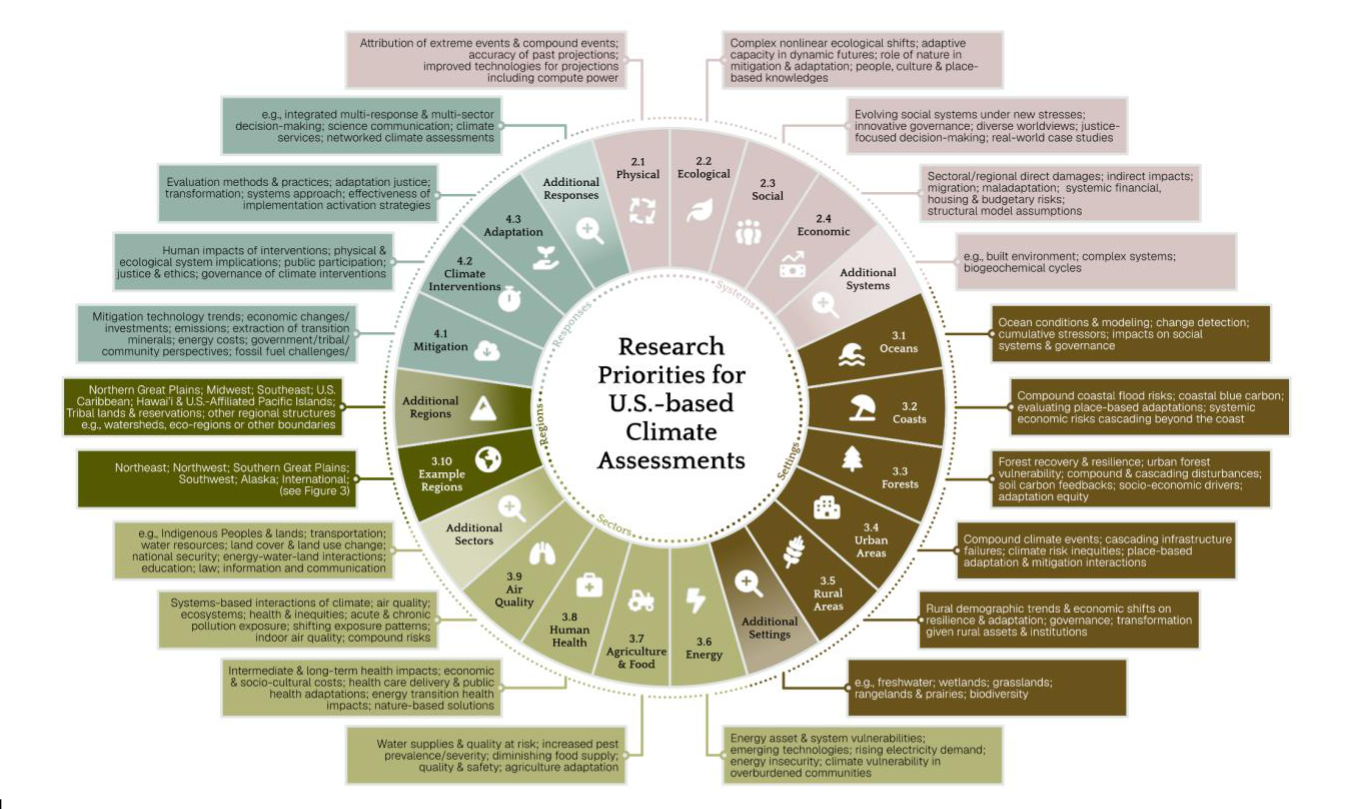
But it also calls out areas that have seen developments in the last few years. Climate modeling has dabbled in machine-learning-based simulations, for example, as well as techniques to generate simulations with finer spatial resolution.
To-do lists
There have also been plenty of changes we’ll need to catch up to on the human side. US climate policy overall has been a chaotic moving target. But on a more local scale beneath that, many climate adaptation and emissions reduction efforts are playing out. And while renewable energy continues to get cheaper and see more deployment, the AI data center rush has significantly reshaped the expectations regarding US electricity demand.
The paper also calls out ways that assessments could mirror or build on the regional focus employed by past National Climate Assessments. Zooming in on one portion of the United States is a great way to connect the dots and make the science more concrete and relatable. Using Alaska as an example, it notes that research connecting permafrost thaw and wildfires has recently explored how heavy metals like mercury can be subsequently released into surface waters.
One silver lining to working outside of a federally coordinated US National Climate Assessment would be that these analyses don’t have to stop at national borders. That could mean expanding analysis into Canada, or it could mean evaluating how trade links the US to a climate impact elsewhere in the world.
Following this publication, we’ll begin to see a variety of papers roll in covering these topics, and likely more besides. “I see this roadmap as seeding and accelerating a distributed synthesis effort rather than launching a centrally managed research program,” Melisa Kenney, a leader author on the paper, told Ars. “The goal is for papers to synthesize our current scientific understanding of key topics to support a network of climate assessment efforts occurring at state, local, sectoral, or other scales.”
Any groups working on those assessment reports will then be able to lean on the US Climate Collection in the absence of a high-quality US National Climate Assessment.
Bulletin of the American Meteorological Society, 2026. DOI: 10.1175/BAMS‐D‐26‐0305.1 and Earth’s Future, 2026. DOI: 10.1029/2025EF007336 (About DOIs).