Ernest Shackleton is one of the most well-known polar explorers in history. He’s mostly remembered for his incredible leadership following the sinking of his ship Endurance in the Weddell Sea in November 1915, which saved his life and the 27 others on board.
Yet had you known Shackleton in 1895, his future fame as an Antarctic explorer would have seemed highly unlikely. At the time, he was an unknown officer in the merchant navy, and Antarctica meant little to him. He had never even put on a pair of skis.
So how did Shackleton become such a famous polar explorer? This is one of the questions at the heart of my book The Grip of the Ice and the answer is suprising: his fame had as much to do with what he did back home as it did with his time on the ice.
Shackleton’s polar career started with the British National Antarctic Expedition, usually known as the Discovery Expedition (named after its ship). The venture was jointly organised by the Royal Geographical Society and the Royal Society and partly funded by the government. The gregarious Shackleton found a place on the expedition by befriending Cedric Longstaff, the son of one of the expedition’s major donors. On the March 15 1901, Shackleton was ordered to report to the Discovery’s commander, Robert Falcon Scott, at the expedition’s office in Mayfair. He would be the ship’s third lieutenant.
Arriving in Antarctica in January 1902, they explored the continent’s coast and then spent the winter on board their ship in McMurdo Sound. During the months of polar darkness, conditions were too harsh for further exploration. Shackleton became a vital and well-liked member of the Discovery expedition. To help keep up morale while cooped up on board the ship, he edited The South Polar Times – the first magazine ever published in Antarctica.
Shackleton soon heard exciting news: Scott had selected him, along with the expedition’s zoologist and junior medic Edward Wilson, to accompany him on a journey towards the South Pole. This would be the expedition’s first major journey.
Leaving the ship on November 2 1902, the journey started off well, with Siberian huskies helping to pull the men’s sledges. They were soon further south than any explorers before them. But things gradually began to unravel. The dogs weakened due to problems with their food, the men grew hungry on insufficient supplies and they couldn’t move their sledges forward all st once, drastically reducing their daily distances.
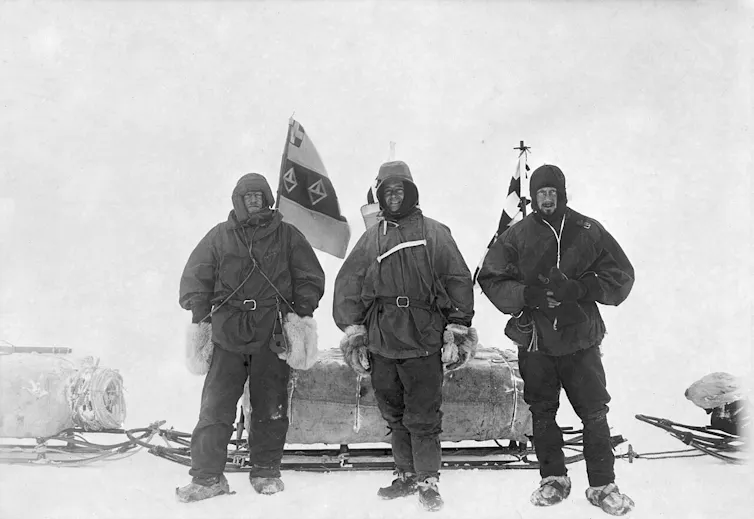
Shackleton and Scott may also have had an argument on this journey, with Albert Armitage, the expedition’s second in command, later suggesting in his letters that Scott called Shackleton a “bloody fool” during a heated argument. Even so, they patched things up and trudged southwards. Eventually, they managed to lighten their sledges by leaving supplies for the return march in a depot, improving their rate of progress. However, their dogs continued to weaken so Shackleton and Wilson killed the sickest animals and fed them to the stronger ones.
By Christmas 1902, the men were also in trouble. Wilson inspected the men’s gums and noticed signs of scurvy – a disease we now know is caused by a lack of vitamin C. Soon, they were forced to turn back, having achieved a new furthest south record of around 480 miles from the South Pole on December 31 1902.
On the march back to the ship, Shackleton’s health deteriorated rapidly. As well as suffering from scurvy, he was also coughing up blood. When the last of their dogs was killed, Scott and Wilson pulled the sledge while Shackleton made painful progress on skis.
Eventually, on February 3 1903, they got back to the ship to find that the Morning, a relief vessel, had arrived.
The Discovery was still trapped in the ice and, with winter closing in, Scott ordered that Shackleton return to New Zealand when the Morning sailed northwards on March 2 1903. Among polar historians, Scott’s decision has been controversial. Some suggest that Scott saw Shackleton as a potential rival, though there isn’t a great deal of evidence for this.
Early return and celebrity
So, Shackleton’s career as a polar explorer seemed to have got off to a bad start. While Scott sent him back with a glowing reference, he had been pronounced unfit for further Antarctic exploration. Frustratingly, he seemed “practically well” according to Gerald S Doorly, then a junior officer on the Morning, by the time he arrived in New Zealand and was in even better shape when he reached London.
Shackleton’s diaries show that he felt a mix of emotions: frustration, embarrassment and disappointment. He had been desperate to stay another winter and see the expedition through to its finish.
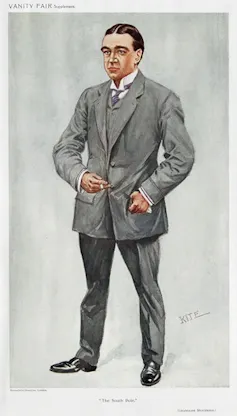
Yet studying this period, what amazed me was how Shackleton took advantage of his early return to Britain.
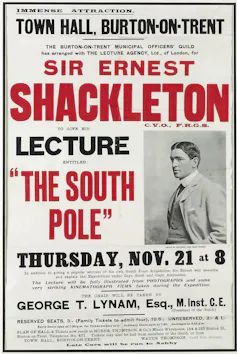
As the only officer back from Antarctica, he was in a unique position to tell the public and the media what had happened on their journey. He wrote articles for The Illustrated London News and Pearson’s Magazine and gave lectures to enthralled audiences, eager to hear about his amazing journey towards the South Pole.
Shackleton was also involved in equipping a relief vessel, the Dundee whaler Terra Nova, to help free the explorers from the ice the following year. By early 1904, he’d even managed to land a job as secretary of the Royal Scottish Geographical Society.
The Discovery expedition transformed Shackleton from an unknown officer in the Merchant Navy into one of the best-known polar explorers in Britain. He’d also built a wealth of logistical experience and connections that left him perfectly placed to launch an expedition of his own – which he did in 1907, much to Scott’s annoyance.
In his return to London, Shackleton had demonstrated his unique ability to make the very best of a disaster.
This article features references to books that have been included for editorial reasons, and may contain links to bookshop.org. If you click on one of the links and go on to buy something, The Conversation UK may earn a commission.