Mistral has released a preview of Mistral Large 4, a 1T model that the Paris-based company says is the most powerful open-weight AI system outside China.
Starting today, developers can access it via Mistral’s API. The model weights, which enable anyone to download and run it on their own servers, will be available on October 27.
The company will be spending the next three weeks testing the model under real-world conditions. Developers, cybersecurity firms, and government agencies will receive a version with fewer restrictions and more cyber features than the public API.
Large 4 is called “Le Chonk,” and the new model can process both text and images.
This time, on the label it is written”Made in Europe”
For any task, it uses only 49 billion of its trillion parameters. Moreover, the model was trained from scratch over two months using about 4,000 Nvidia Grace Blackwell GPUs in Mistral’s European data centres, which now also power the preview. The company said the training used about 10 megawatts of power.
The reinforcement learning phase, in which the model improves through trial and error and feedback, is still ongoing.
Mistral reports that gains have not begun to slow. The benchmark results are preliminary, and the company expects them to change before the weights are released.
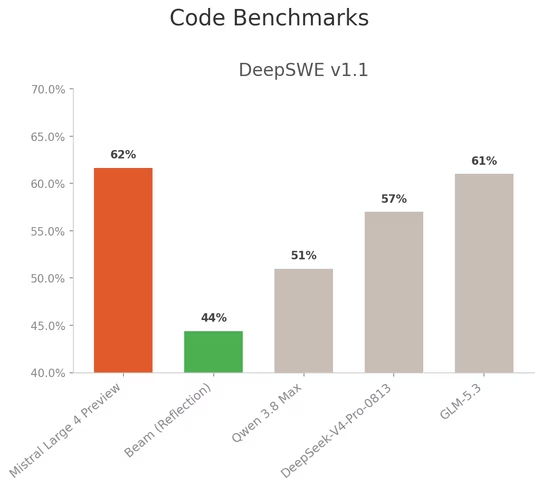
On DeepSWE, an agentic coding test in which models work through real software engineering tasks, Large 4 scored 62%.
That puts it narrowly ahead of Zhipu’s GLM-5.3 at 61% and DeepSeek-V4-Pro at 57%, and well clear of Qwen 3.8 Max at 51% and Reflection AI’s Beam at 44%.
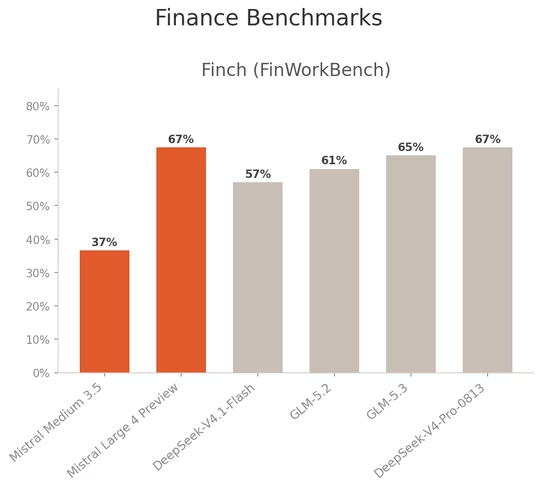
On the finance benchmark, Large 4 reached 67% on the FinWorkBench (FinWorkBench), level with DeepSeek-V4-Pro and just ahead of GLM-5.3 at 65%, and almost double Mistral’s own Medium 3.5 at 37%.
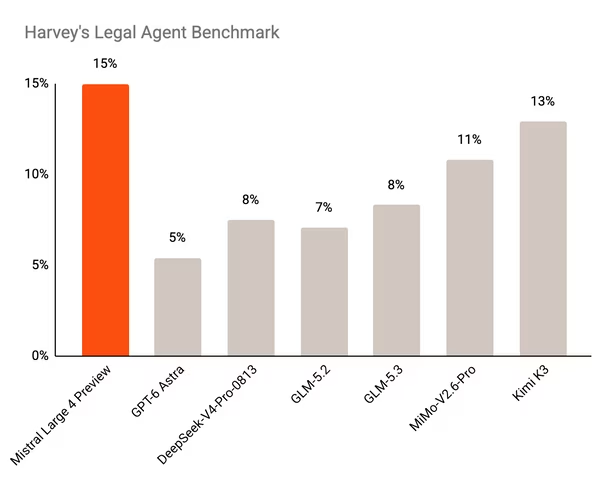
On Harvey’s Legal Agent benchmark, it scored 15%, ahead of Kimi K3 at 13% and OpenAI’s GPT-6 Astra at 5%, although the low scores across the board show how far every model still is from handling legal work on its own.
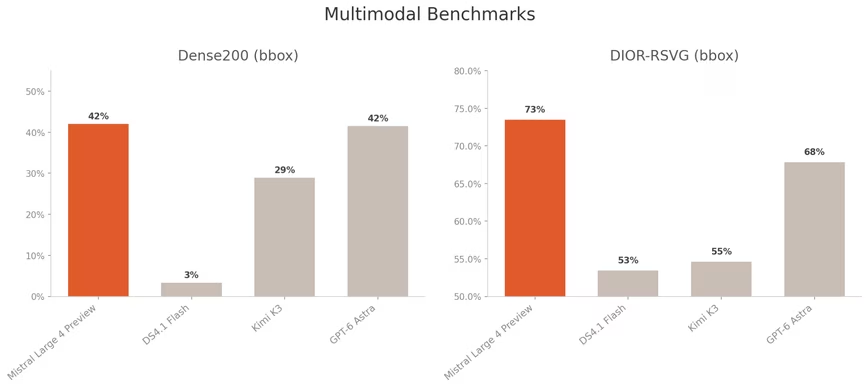
Vision is where Mistral stands out most. For grounding, which means finding specific objects in an image, Large 4 scored 73% on the DIOR-RSVG remote-sensing test, compared to 68% for GPT-6 Astra.
Both models scored 42% on Dense200. Mistral also claims its model outperforms Anthropic’s Fable 5.1 on these tasks, but it has not shared the numbers for that comparison.
The company plans to use these skills in real-world ways, such as helping insurers assess storm damage in aerial photos, utilities inspect power lines, and farms monitor crop health.
The new model, Large 4, can also convert technical drawings into CAD models, and Mistral says it performs very well on semiconductor tests, suggesting it industrial customers.
Cybersecurity sits at the centre of this model, and this is where being open matters most. The most powerful models from American labs are closed: customers can only rent them through the provider’s servers, and the provider decides what the model will and won’t do.
Once Large 4’s weights are out, a bank or a government can download the model, run it on its own machines, and use it to protect its own networks without asking anyone’s permission.
For security teams, that difference is practical. They need to scan their systems for new weaknesses every day, and closed models are often too expensive for that volume of work, too restricted, or simply refuse the request.
The company also says Large 4 beats the best open models from Kimi, DeepSeek, and Meta on cyber tasks, though it has not shared figures to back that up.
“The cyber defense capabilities will enable enterprises and governments to defend themselves against threat actors that are jailbreaking closed models to perform cyber attacks,” said Guillaume Lample, Mistral’s co-founder and chief scientist.
Yet, there is also a political perspective, as Mistral says companies and governments should not depend on a provider that could switch off their tools at any moment, and that its customers want two guarantees: that no foreign country can cut off their access, and a clear record of how the model was trained.
Sovereignty concerns will shape how Large 4 is sold. Customers can run it on their own servers or use it through Mistral’s API in a region they choose, including a European region where data is protected by EU law.
The model is also built to work well beyond English, having been trained on more than 160 languages, including every official EU language as well as languages such as Korean.
Paying for all of this is the €3 billion funding round Mistral closed in September, and Large 4 is the first model to come out of it.
The same money will buy more computing power, which is due to come online through the first half of 2027.
Mistral already works with more than 125 large businesses, including Airbus, ASML, and HSBC, and some of them helped train Large 4 using the same tools Mistral sells through its Forge platform.
Before the weights go public on October 27, Mistral says it will publish more about how the model is built, more benchmark results, how it was refined after its main training, and how it was tested for safety.
After that, the company plans to use Large 4 as the base for a new family of specialised models, so the version developers can try today is a starting point rather than the finished product.
“So the narrative that Europe cannot compete is something that is not true,” Arthur Mensch said at a conference in Abu Dhabi, before the launch of this new model.