
Artificial intelligence has unlocked incredible creative possibilities, but it has also handed bad actors a formidable tool.
According to comprehensive new research by Lithuania-based cybersecurity company , which analysed thousands of incidents across global databases including the AI Incident Database, Resemble AI, and the OECD, have rapidly escalated from a digital novelty into a multi-billion-dollar global crisis.
Here is everything you need to know about what deepfakes are, the financial scale of the threat, where they are hitting hardest and how you can protect yourself.
What are deepfakes?
Basically, deepfakes are AI-generated videos, images, or audio recordings that show people – frequently celebrities, corporate executives, or politicians – saying and doing things they never actually did.
Powered by and advanced machine learning models, modern deepfakes can manipulate facial expressions, sync cloned voices with synthetic speech, and even execute real-time video impersonations during live web calls. What started as experimental tech has become a frictionless vehicle for deception.
The scale of deepfake fraud: billions lost
The statistical trajectory of deepfake incidents and financial losses reveals a frightening upward curve:
-
Between 2020 and the third quarter of 2026, researchers tracked 2,430 deepfake-related incidents across 114 countries. Nearly 90% of these cases occurred from 2024 onwards. While 2020 saw a modest 22 incidents, cases skyrocketed to 970 in 2025, with 2026 on track to shatter that record after logging 809 incidents in just the first three quarters.
-
Global financial losses tied to deepfake fraud have reached an estimated $3.91 billion across 51 countries. Similar to incident volume, 98% of these losses accumulated from 2024 onwards. After a record $2.52 billion was lost in 2025 alone, ongoing scams added another $972 million in the first three quarters of 2026.
-
Investment scams – often using deepfakes of trusted public figures to promote fraudulent schemes – rank first, accounting for 45% ($1.75 billion) of all financial damages. Finance and banking fraud follows closely at $1.14 billion (29%), driven by voice-cloned payment requests and identity check bypasses. Corporate executive impersonation accounts for another $545 million (14%), while product promotions and romance scams make up the remainder.
-
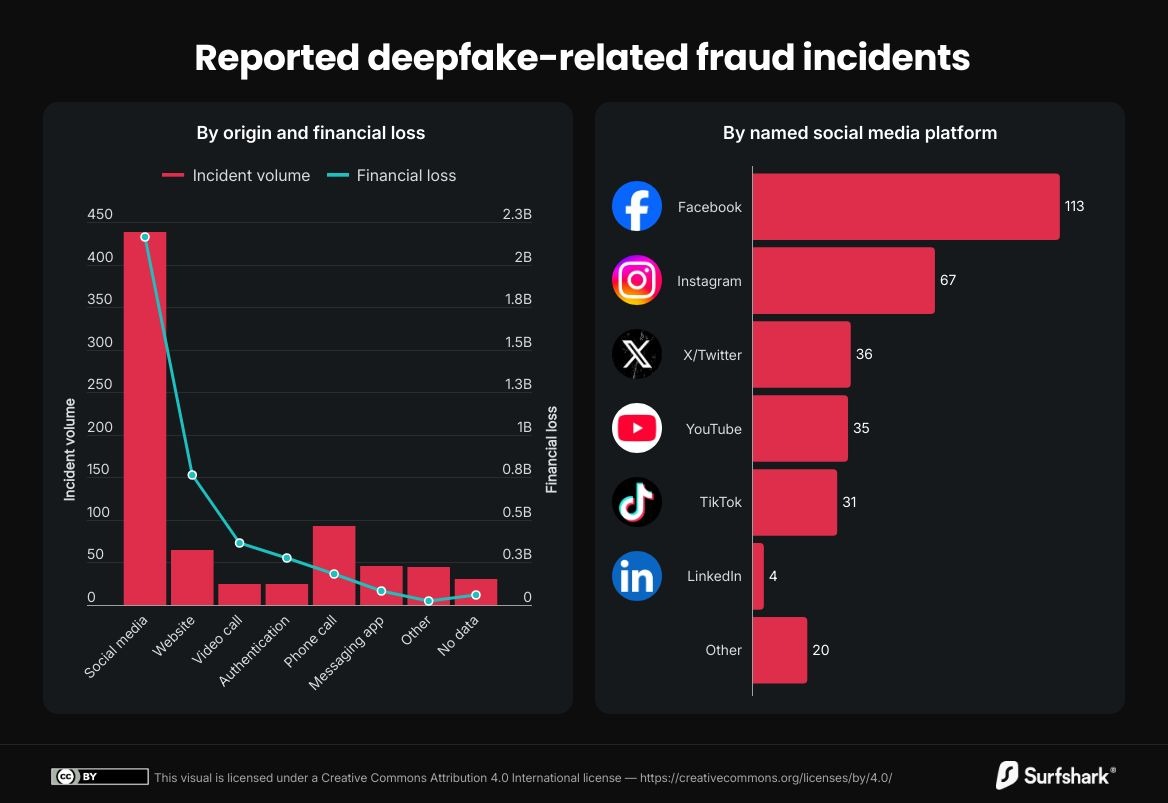
The Social Media Gateway: Social media acts as the primary launchpad for 57% of deepfake fraud incidents and 55% ($2.16 billion) of financial losses. When specific platforms are identified, Meta-dominated networks dominate. Facebook accounts for 42% of first-contact cases (and 80% of traceable social media losses), followed by Instagram at 25%.

Which countries are most affected?
Deepfake incidents are truly a global phenomenon, with recorded cases spanning every single inhabited continent. However, incident volumes and financial damages concentrate heavily in major economic hubs:
-
The United States leads the world by a wide margin with 787 incidents – more than triple second-place India (246). The United Kingdom ranks third (141), followed by China (111), Brazil (79), South Korea (76), Taiwan (62) and Australia (62). Regionally, North America (871) and Asia (853) shoulder the heaviest burdens, closely followed by Europe (620).
-
The United States also records the highest direct losses globally at $705 million. However, Southeast Asia has emerged as a massive hotspot: Indonesia ranks second globally ($615 million) and Malaysia third ($513 million), largely driven by complex banking and loan-fraud schemes. Europe’s hardest-hit nations include the United Kingdom ($177 million) and Italy ($148 million).
As deepfake technology evolves, relying on a quick glance or basic visual inspection is no longer enough. Tomas Stamulis, Chief Security Officer at Surfshark, emphasises that spotting a fake requires scrutinising minute details:
-
Look closely for , asymmetrical blinking, mismatched lighting or skin tones, distorted background elements and audio-visual desynchronization (where lip movements do not precisely match the speech).
-
Context is King: Scammers heavily rely on artificial urgency, unexpected financial requests, or unusual communication channels. Because seeing or hearing someone digitally is no longer definitive proof of identity, always pause and verify requests through an independent, trusted channel.
-
Legal and Technical Realities: While making a deepfake is not inherently illegal in most jurisdictions, deploying one to commit fraud is prosecuted under standard fraud laws. Automated detection tools can catch some synthetic media, but they constantly chase shifting AI capabilities – identity fraudsters successfully bypassed biometric verification checks to rack up $276 million in losses.
Ultimately, defending against deepfake fraud requires shifting away from blind trust in digital media : verify urgent requests, double-check unexpected communications from banks or family members, and never treat a familiar face or voice online as undeniable proof.
For latest tech stories go to TechDigest.tvDiscover more from Tech Digest
Subscribe to get the latest posts sent to your email.