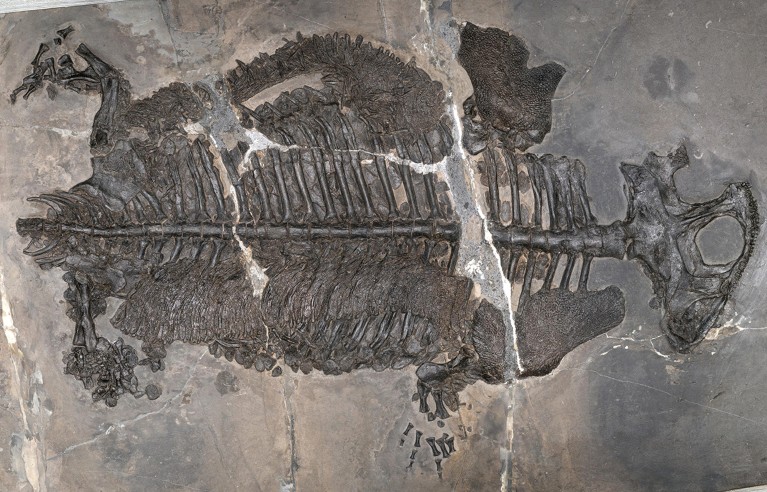
Amphibians were able to live in the sea 237 million years ago, according to research published today in Nature Ecology & Evolution1.
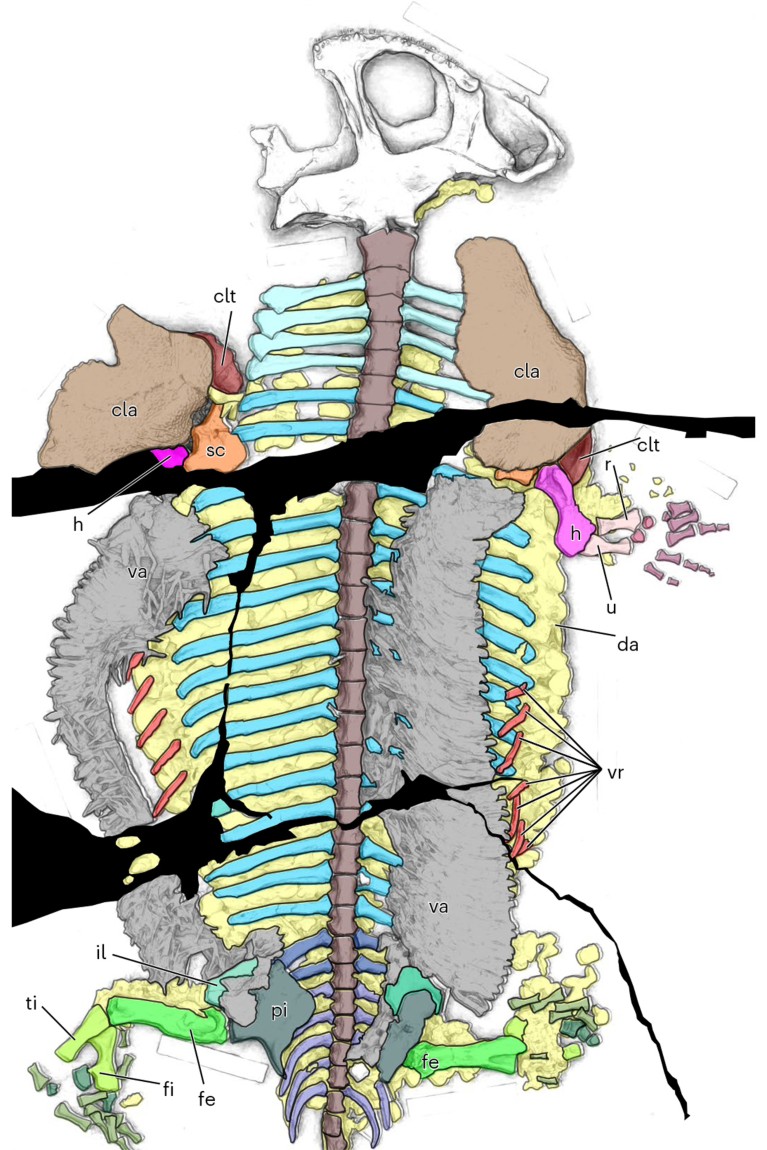
Two fossils of a type of primitive amphibian from a group called temnospondyls were found in what is now Guizhou province in China — which would have been a salty sea during the Late Triassic period. The researchers have provisionally named the species Gerrothorax maritimus. The 74-centimetre-long creatures had flattened bodies and were almost completely covered by body armour.
There are more than 8,000 species of modern amphibians, but none of them lives exclusively in a marine environment. “This is potentially a revolutionary discovery,” says Steve Brusatte, a palaeontologist and evolutionary biologist at the University of Edinburgh, UK. “If this Triassic amphibian, Gerrothorax, really was fully marine, then it is a game changer.”
Amphibians have varying levels of salt tolerance, says Ryosuke Motani, a palaeobiologist at the University of California, Davis, and a co-author of the study. But even salt-tolerant animals need to recover from excess salt in one way or another, he explains. “In most cases, they do it by drinking fresh water.”
Salt slurpers
The researchers argue that this was not an option for G. maritimus: the excellent preservation of the skeletons, so far from any land mass that existed at the time, suggests that they were not swept there by water. The team also measured isotopes of strontium, as forms of this element can help to date minerals and water in marine samples. The levels in the ancient animals’ bones matched those in the seawater at the time, which suggests that the creatures “grew up drinking the seawater”, the researchers write in the paper.
Enjoying our latest content?
Log in or create an account to continue
- Access the most recent journalism from Nature's award-winning team
- Explore the latest features & opinion covering groundbreaking research