China is reportedly mulling letting ByteDance, Alibaba buy banned Nvidia chips.
On its face, the recent summit between Donald Trump and China’s president Xi Jinping didn’t change much in the world of AI regulation. Export controls were not discussed, with neither country seemingly interested in making concessions. An already tenuous trade truce was temporarily extended for just two months, and looming US controls that could drop soon could easily end that and trigger China to retaliate by cutting off exports of rare earths, analysts expect.
However, in the background of these shaky talks, Nvidia appeared to notch a big win, as China is currently mulling relaxing controls and allowing some of its biggest AI firms to import perhaps millions more of Nvidia’s banned chips over the next year.
Sources familiar with China’s talks told The Information that China’s tech oversight arm, the Ministry of Industry and Information Technology, asked Alibaba and ByteDance to share plans to buy Nvidia’s RTX Pro 5500 chips. Although these are gaming chips, China asked firms to detail how they plan to use them, with expectations that chips could be put into servers to help power the country’s most in-demand AI models.
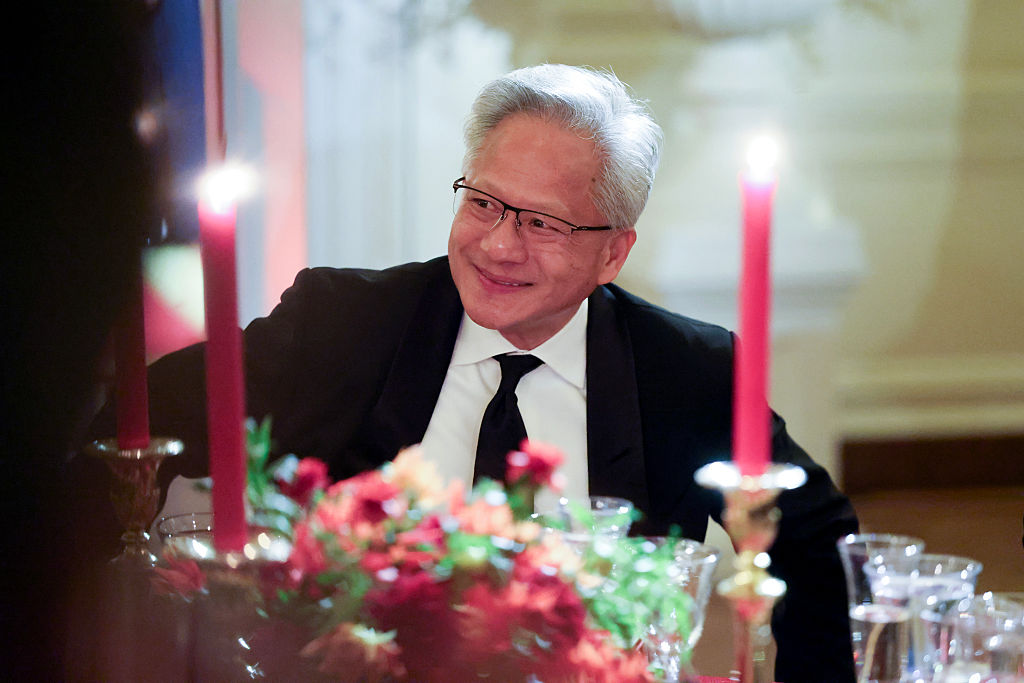
Increasingly, Trump looks to Nvidia CEO Jensen Huang for advice on AI, but not everybody agrees that what’s good for Nvidia is good for the United States.
Already the world’s most valuable company, Nvidia would obviously profit enormously in a world where risks are downplayed, and both countries’ priorities remain powering rapid developments in frontier AI without pumping the brakes. Some critics worry that Nvidia’s profit motivations may be steering Trump’s thinking at a pivotal moment when it may matter how well a president actually understands the risks of a new technology.
Trump “completely aligned” with Nvidia
For Nvidia, a big goal since Trump took office was to open up more of China’s market so that Nvidia could start selling chips that were restricted during Joe Biden’s administration. Huang has blamed US export controls for cutting Nvidia’s share of China’s advanced AI chip market from about 95 percent to zero, The Information reported.
Trump was not an instant ally. Instead, he came into office asking “What the hell is Nvidia?” and rather than loosening Biden’s export controls, he initially tightened them further, most notably by banning exports of H200 chips to China. Trump was even thinking about breaking Nvidia up, expecting that stoking more competition among chipmakers domestically was crucial to America winning the so-called “AI race” with China.
But then he met Huang over dinner at Mar-a-Lago, where Trump said he “learned the facts of life” and understood that Nvidia as a firm is an “amazing” AI leader. Ignoring warnings from lawmakers and national security experts, Trump lifted the export controls on H200 chips, which China eventually allowed to be sold to some firms. Since then, Trump and Huang have appeared together in public repeatedly, and they regularly talk by phone, according to Stephen Witt, the author of The Thinking Machine: Jensen Huang, Nvidia, And The World’s Most Coveted Microchip.
In an interview discussing Huang’s influence over Trump, Witt told NPR that Trump’s recent claims—suggesting that it’s a “hoax” that AI might destroy humanity and that instead AI will be an economic boon—are “exactly Jensen’s talking points.”
“Jensen is now the president’s most influential adviser on technology issues,” Witt said. “The two have become quite close.”
Witt spent time with “tons” of people in the AI industry who share Huang’s views, he told NPR. And like Huang, they tended to downplay risks that software developers—including Nvidia’s biggest customers like Anthropic and OpenAI—are right now urging the White House to take seriously, he found.
“Most of the hardware people, most of the people who designed the networking equipment and the microchips, feel like Jensen does,” Witt said. “They tend to have a very low sense of risk regarding this technology. They just don’t see it.”
He said this debate has been going on between the two camps for the past 10 years and “neither camp has moved at all.” With Huang growing closer to Trump, it seems likely the president will continue downplaying leading AI firms’ warnings and avoiding serious talks with China about their models’ risks. Treasury Secretary Scott Bessent confirmed ahead of Trump’s talks with Xi that “the president is completely aligned with Jensen Huang, the CEO of Nvidia.”
Nvidia downplays risks
According to The Information, China lifting export curbs on Nvidia’s gaming chips “would give Nvidia perhaps its best chance in more than a year to regain some momentum in China’s AI market.” If China gives the nod, ByteDance plans to order 1 million chips, which would automatically secure for Nvidia two quarters of projected sales.
That would certainly help improve Nvidia’s financial outlook in China, as China’s delayed approval of H200 sales meant sales were dismal, comprising less than 1 percent of Nvidia’s data center revenue in the most recent quarter.
Andrew Yoon, a researcher at an AI safety nonprofit called CivAI, told CNBC that in the AI industry, “Nvidia is the most aggressive in terms of, let’s just make money.”
“At every turn, they are really trying to just make sure whatever happens is good for Nvidia’s bottom line,” Yoon said.
If the US and China continue to loosen controls, some experts fear that too many chips may end up being diverted to China. Eventually, that could cause US data centers to lose a precious domestic chip supply that’s currently making it possible to stay ahead on frontier AI, the thinking goes.
Nvidia’s reporting suggests that as of now, the countries don’t compete for resources, though. In the first half of 2026, Nvidia reportedly took a $400 million hit due to vast quantities of unsold H200 chips. No American firms want those chips, since they can access Nvidia’s more advanced chips.
However, demand for chips made for China’s market could perhaps change, as more US data centers come online, policy experts believe.
Nvidia’s spokesperson told Ars that China lifting curbs on “outdated” gaming chips “released nearly a half a decade ago” will only benefit US firms unfairly burdened by restrictions on chips that cannot be used to train AI. The statement recalls Huang’s remarks at a recent “All-In” summit hosted by Trump’s former AI czar David Sacks. Huang publicly promised Trump that “we’re going to make sure that everybody wins in the AI race of America. Every industry, every company, every state, every people.”
Yet, Witt joked that “Jensen is really the only one who wants to sell his equipment to China.”
Witt thinks that a responsible US president would set up a group like the National Transportation Safety Board to review mandatory reports of AI safety incidents. That could support the US-China safety alert system announced last week, which right now troublingly includes no tech experts. But that likely won’t happen since “Jensen has convinced Trump that what’s good for Nvidia is good for America,” Witt said.
It remains unclear if China will approve the gaming chip sales, but sources told The Information that the government intends to allow at least some into the country. The pressure may be on to approve them since “Chinese companies are rolling out AI products and services faster than they can find the chips to run them,” The Information noted. At least one buyer “plans to put eight RTX Pro 5500s in each server, a standard setup that lets the chips work together on larger AI models,” sources said. Supposedly, Nvidia’s preparing to ship the first orders this December.
If Huang gets his way, Chinese firms will buy millions more of Nvidia’s chips in the coming years, helping the firm maintain global dominance over companies that are locked in on advancing AI.
Huang’s influence over Trump may be tested
During the most recent summit between Trump and Xi, Huang joined many US tech leaders at a state dinner, including Elon Musk, Jeff Bezos, Sam Altman, Mark Zuckerberg, and Satya Nadella. Noticeably, China invited none of its tech leaders.
Ro Khanna, the top Democrat on the House of Representatives’ select committee on China, told The Guardian that Trump could’ve used the tech leaders’ help to press Xi in their talks to set up technical working groups to monitor AI threats. But seemingly Trump “has no interest in doing that,” Khanna said.
At the summit, Xi acknowledged that the US and China have the “responsibility to develop and manage AI for good” and “ensure that the development of AI is always under human control,” The Guardian reported. But neither country was willing to make “even a symbolic gesture” that an AI slowdown may be necessary if risks cannot be contained.
Jonathan Czin, a fellow in the China Center at the Brookings Institution, told The Guardian that he had “very low expectations going into this meeting for anything of substance and the meeting managed to underwhelm even those low expectations.”
“Even going into this meeting, you’re dealing with a septuagenarian and octogenarian who may or may not have ever had first-hand contact with actually using AI and what happens with this technology rests on their two shoulders,” Czin said. “The only thing they seemed to agree about is that neither of them wants to slow down with this technology, regardless of their actual understanding of it.”
Trump may soon have to reconcile the differences between some of Huang’s views on AI safety and his own law enforcement, however. While the FBI has accused six Chinese firms of aggressively copying US frontier models, Huang has sided with China, arguing that distillation of frontier AI models is “not robbery” but rather “competition,” CNBC reported.
“You’re allowed to test somebody else’s products all you want,” Huang said, suggesting that AI firms could disable services to block distillation if they wanted. He further noted that “Nvidia’s products are sometimes stripped ‘down to bones’ as companies tried to learn how they worked.”
“I’d really prefer they didn’t,” Huang said. “I’d really prefer that nobody learns from our products, and we have the benefit of just cruising along. But, you know, frankly, competition makes everything better.”
To Huang, getting Trump to agree with him might be easy, Witt suggested. As he explained:
”When I interviewed Jensen years ago, he told me that every problem in the world is actually an engineering problem. Now, that’s true if it’s a personal problem or a business problem or a political problem. You study the inputs and then you modify the inputs to get the outputs that you want. In this case, I think Jensen has realized that the inputs for Trump are, like, flattery—like, public flattery, nonstop public flattery. And the outputs are, you know, lifting restrictions on sales of Nvidia equipment to China and zero regulation on AI.”
Despite Bessent suggesting that Huang is pulling the strings, Trump took to Truth Social ahead of the “All-In” summit to make it clear that he expects to be trusted as the sole authority when it comes to AI safety.
“The only control or ‘guardrails’ that AI needs is a STRONG AND SMART (High IQ!) PRESIDENT, and the U.S.A. has that, in spades!” Trump wrote.