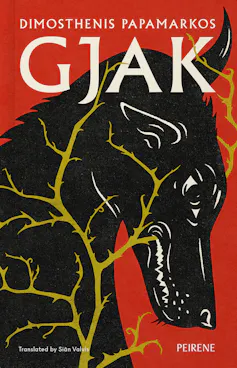
Blood is the word. Blood in every sense. Gjak: Tales of Blood, written by Dimosthenis Papamarkos, was a massive success on publication in 2014. It won the prestigious Academy of Athens award and has become one of the most widely discussed works of 21st-century Greek literature.
Now it has found its perfect voice in English in the 2026 translation by Siân Valvis, a British-Greek literary translator working across Greek, Russian, French and Portuguese.
With her translation of Gjak, Valvis has now also successfully navigated the language and ethos of the Arvanite villages. The Arvanites are a bilingual group, descendants of migrants from Albania in the 13th to 16th centuries who settled in central and southern Greece. Their language, Arvanitic, is an Albanian dialect seasoned with loans from other languages and dialects.
Gjak was written in a dialect blending elements of Arvanitic into Greek. Valvis’s English translation is startling: a vivid, at times raw, at times highly lyrical text.
As an expert in the trauma of 20th-century Greek warfare, the weight of cultural memory and the complex historical identity of the Arvanite people, seldom have I read a work that exudes so much linguistic and cultural ruggedness and sensitivity all at once. I came away with a sense of uneasy familiarity and I am sure you will too, for there is no place to hide from the bloodlines and trails that link us all.
Gjak is series of interconnected short stories, which strive to portray what ordinary life was like remote villages that had become more Greek as they were formalised as part of the Greek nation state. Each explores what it was like living in the aftermath of the Greco-Turkish wars of 1919 to 1922.
With Greek and Arvanite soldiers returning to their villages, peace – internal as well as external – should have had a real chance at being restored. No such thing. These warriors carry blood and guilt with them and these infiltrate deeply into blood lines, family and fraternal bonds, love and homoerotic relationships, village and community dynamics, even relations across borders and oceans (to reach the diaspora communities of the New World).
Blood and the guilt associated with death become the proverbial red threads tying Papamarkos’s short stories together. These connected bloody threads are also revealed in the ballad-style poem that functions as an intermezzo at the book’s midway point. This ballad is not an interlude of lightness. It is, rather, the lyric tale of a courageous woman’s encounter with bloodthirsty Death himself. With this ballad, too, the female voice appears loud and strong in the text and in the translation. Women are subjects in most of the stories otherwise, strong though they may be – and certainly no strangers to blood and violence.
Valvis’s translation does these bloody threads justice at every turn. The work here pushes at the boundaries of literature, linguistics, history and nationalism. But even more so, the translator has unflinchingly portrayed PTSD (post-traumatic stress disorder). Papamarkos does not hold back when describing how victims of PTSD behave, with continued violence that can turn very visceral, and Valvis has managed to translate this vividly and sensitively.
Thankfully, the translator carefully explains in a note what is at stake, what choices she has made and what the trajectory of the translation has been (a five-year-long process for a book of about 140 pages).
Valvis’s unsettlingly direct language succeeds in having the readers question themselves. Can we write off violence and revenge as belonging to others or are we complicit too? The character aptly called the “knocker” explains, in Valvis’s deliberately ironic (misspelled) language and grammar:
Folk don’t mind foulness so long as it stays out of sight and it’s not their hands getting dirty. So long as they can go out, dressed up, arm in arm wi their lady friends, free of stink, and pick up cutlery with hands that aren’t swollen with blood and tuck into their steak without getting dirty. That’s what it means to be sivilized. Stepping on shit in high heels. It’s hidden, the work I do at Union, just like what I did in the war was hidden.
Valvis’s translation enjoys the endorsement of Papamarkos, who received the prestigious Academy of Athens award for Gjak. This English translation is the rightful winner of the Elizabeth Constantinides Translation Prize, given out by the Modern Greek Studies Association of North America. I fully expect that more accolades will follow for a translation so rich and so bold. Papamarkos’s stories have been adapted for the stage many times, and I anticipate that Gjak in translation will see successful production runs as well.
This article features references to books that have been included for editorial reasons, and may contain links to bookshop.org. If you click on one of the links and go on to buy something, The Conversation UK may earn a commission.