
It’s 4 pm on an unusually warm first day of October as a small crowd begins forming outside the Bristol Royal Infirmary, the south-west UK city’s central hospital. Outpatients arriving for appointments begin to take notice as the demonstration against US company Palantir’s involvement with the UK’s health service starts to take shape.
Placards are raised: “No Palantir in our NHS”, “Ditch Palantir”, “Good at harvesting your NHS data”. The passing traffic starts beeping its support.
Bristol is one of the 45 locations across over 30 cities around the UK where people are taking to the streets on October 1, 2026. The biggest action rolled out in front of Palantir’s London offices in London, with hundreds there to protest. Here, the number is closer to a vocal 50 or so.
Former and current health workers, campaigners from Amnesty International, the Good Law Project and more, and concerned citizens have all joined the International Day against Palantir to ask the British government to stop paying a US firm to manage UK citizens' health data.
Headquartered in Miami, Palantir Technologies is a data analytics firm specialising in AI-powered tools designed to manage large datasets. Its flagship software platforms, Gotham and Foundry, are widely used by government organizations and businesses globally to uncover data patterns and support decision-making operations.
The promise of its products certainly makes sense. Its list of clients, however, is what today’s demonstrators find less than palatable.
Among its most controversial partners is the US Immigration and Customs Enforcement, better known as ICE, which has been using Palantir tech for over a decade. More recently, the Israeli military has also begun using its powerful software to assist with on-the-ground operations.
It was in 2023 that Palantir managed to secure a £330 million contract within the UK public health sector. The then-Prime Minister Rishi Sunak tasked the American company with building a new platform to manage all UK citizens' health data across the country in what was called the NHS Federated Data Platform (FDP).
Three years and two Prime Ministers later, the project is under increasing scrutiny, with some suggestions from insiders that many of the hospitals that have been signed up to Palantir are still yet to even log into the system.
With more than one reason for complaint on the table, TechRadar went along to the Bristol arm of the International Day of Action to find out what it was the demonstrators cared about the most — their data, their finances or their politics?
The privacy concerns with Palantir’s NHS Federated Data Platform (FDP)
A national programme led by NHS England, the Federated Data Platform (FDP) is designed to help NHS organisations bring together information from hundreds of different databases in a single platform. The goal is undoubtedly attractive: improve efficiency by supporting health workers' delivery of patient care, improving operational performance, and assisting staff to make better-informed decisions.
According to the NHS security and privacy page, “the protection of people’s data is at the heart” of FDP’s design, with measures like strong network security, purpose-based access to data, and encryption all in place. It certainly sounds well conceived and considered.
Furthermore, under the terms of the contract with the NHS, Palantir Technologies is named strictly as a "data processor". That means it cannot decide how the information that its software processes is used. In other words, Palantir could face direct liability should it fail to secure this data or violate NHS instructions.
A Palantir spokesperson explained to TechRadar that FDP is a software that helps the NHS better manage the data it already holds. “How that software is used is controlled by the NHS Trusts who use it, with data — legally and contractually — only able to be processed strictly in accordance with their instructions, and all data remaining in the UK,” they added.
Despite these rules of engagement, all of the protestors expressed their lack of trust in Palantir when it came to handling their most sensitive data. They were not convinced that Palantir was not able to access their information at will.
“We simply cannot believe this won’t happen,” one protester told us.
These concerns do not exist in a vacuum. In May, the Financial Times reported on an internal NHS briefing note which explicitly earmarked "unlimited access" to identifiable patient data for certain contractor admin roles.
Most protesters also expressed their fear that Palantir’s NHS system could also be repurposed one day for wider surveillance across different government bodies, such as immigration.
Matt, a health worker and campaigner in Bristol, told TechRadar that there’s both an emotional and technical component to his worries about Palantir. “All Palantir software is interoperable with each other. So, the data that is collected under the FDP can be dragged and dropped to their policing software if a government chose to do that,” he said.
Matt refers to what came out of a January investigation by The Nerve that found 34 active contracts across at least 10 UK government departments, as well as local councils and police authorities. A scenario that, according to opponents, could make it technically easier for a cross-pollination of healthcare data and law enforcement work to occur.
Again, these fears aren’t exactly unfounded. While Palantir’s UK CEO, Louis Mosley, insists that Palantir has “no interest” in UK patient data, the company’s track record outside the country seems to tell a different story. Revelations from 404Media suggest, in fact, that US citizen health data is fed to a Palantir-developed app called ELITE, which is used by Immigration and Customs Enforcement (ICE) agents to map and target suspected illegal immigrants.
While Palantir’s UK CEO, Louis Mosley, insists that Palantir has “no interest” in UK patient data, the company’s track record outside the country seems to tell a different story.
404Media revealed that, in the US, citizen health data is fed to a Palantir-developed app called ELITE, which is used by ICE agents to map and target suspected illegal immigrants.
Small wonder, then, why Matt and others outside the Bristol Royal Infirmary are expressing their concerns.
Is Palantir’s technology worth the risk?
Make no mistake, though. This was mostly a protest of politics rather than privacy. Most people at the rally were here to object to Palantir's deal with the NHS based on the company’s involvement in ongoing global conflicts and immigration raids.
Either way, though, as the Head of Tech and Data at Good Law Project (one of the campaigns behind the UK actions), Duncan McCann, told TechRadar, procurement decisions based on ethics and morals are rare, whatever field of concern they lie in. The hard facts of cost and utility most usually win the day.
Despite this, McCann explains that the tide is turning against the US firm.
“When we started working on this campaign a year ago, all the momentum was with Palantir. They were getting new contracts all the time. The assumption was that this contract was just going to get renewed. It wasn't even really a question. Now, when I look around, I see them losing contracts,” said McCann, mentioning the Homes for Ukraine as the most telling example.
And, for McCann, the reason for Palantir’s decline is simpler than the politics. Its technology isn’t just more expensive — Ukraine said the government saved millions by replacing Palantir’s software — but it seems to be actually failing in its goal of making the NHS more efficient.

: — A weekly newsletter on digital privacy and online surveillance.
Leave No Trace investigates the companies and governments putting our digital freedom at risk — and the people fighting back.
📩 Subscribe now to get every edition delivered to your inbox every Friday, launching this September.
While the UK government claims to have already seen significant improvements in its data management flow, there have been multiple reports alleging that the FDP software is not delivering on that promise.
A report by Democracy for Sale, for example, says that staff have found that Palantir's newly built platform is 10 times slower than the existing system, citing an internal NHS document.
Palantir has strongly rejected these allegations, however. In a statement to Democracy for Sale, the US firm argued that "comparing the two systems is not like-for-like," adding that its platform "introduces guardrails to improve data correctness, enforce purpose-based access and allow more controlled data sharing".
Approached by TechRadar, a Palantir spokesperson said: “Palantir software is helping to deliver better care, with Trusts using it recording 117,000 additional operations, a 14.3 per cent reduction in discharge delays for long stay patients and a 5.6 per cent improvement in the number of people finding out whether or not they have cancer within 28 days.”
Impressive-sounding stats, but back in June 2026, the Financial Times reported that England’s health service acknowledged that its main claims about the benefits of the FDP aren’t backed up by robust evidence, with MPs now calling for a new audit.
The jury, it seems, is still out on the Palantir systems’ efficacy, leaving the company’s reputation a peg or two lower than where it stood when the 2023 government originally signed the deal.
How likely is it for Burnham to scrap the deal?
As the deadline to renew the deal approaches, campaigners feel that now is their best shot to make the government listen to their concerns. Indeed, this may be more likely than some people realise, given the Prime Minister’s position on digital policy. During Andy Burnham’s almost decade as Mayor of Greater Manchester, neither municipal nor public health departments awarded any contracts to Palantir. Instead, Manchester’s NHS leaders spent six years building their own analytics infrastructure.
For campaigners against Palantir’s involvement in the NHS, then, scrapping the deal could then be a good fit for Burnham’s political agenda.
"It proves that we can do it ourselves and save money by doing that, while creating new jobs,” McCann from the Good Law Project told TechRadar.
What’s certain is that the new Prime Minister is under increasing political pressure to act.
During this week's Labour Party conference, 20,000 party members backed a motion to cancel the contract with the US firm. Although the motion was not chosen for debate in the end, the number of signatories still signals the general discontent among the political rows.
A great majority of Labour voters (76%) also believe Palantir’s contract should not be renewed when it expires in February 2027. That echoes the views of the Science, Innovation and Technology Committee that, in June, urged the government to exercise the 2027 break clause and “either develop an in-house replacement or seek an alternative UK provider”.
That said, as Wired reported, there are plenty of politicians and advisers close to Burnham who are also quietly advocating for the company’s work in the UK. The recent announcement that former Labour Deputy Leader, Tom Watson, is joining Palantir as senior vice president perfectly paints the rifts within the governing Party.
For the people filling the streets, however, it isn’t negotiable to make their voice heard. Ultimately, as health worker and campaigner Matt points out, the change could, and should, start locally.
"Here, in Bristol," he says, "we're really trying to build up the pressure and give the message that NHS Trusts actually do have the right to refuse to use the software. We really want them to take a strong stance on that."
What Palantir’s critics are asking for
By Wednesday, September 30, the day before the demonstrations, 44,000 people had filed legal objections to their health data being shared with, stored in, or used by the FDP system operated using the US company’s AI technology. Thousands of people have also signed petitions to ask to scrap the £330 million deal in the past months.
Currently, patients cannot opt out of having their sensitive healthcare data stored on the FDP, despite a 2023 YouGov poll finding that nearly half of all UK adults would likely opt out of data sharing if a private company like Palantir began processing their personal information.
“I think when people are aware of it, they're very concerned,” health worker Matt told TechRadar, pointing out the number of people turning up to the rally. “It really shows the strength of the public feeling about this.”
The erosion of trust in the NHS was a recurrent topic when we spoke to those opposing Palantir in Bristol. Many told TechRadar that they would opt out if they could.
And while people admitted that a better system to manage health data may be needed, they didn’t feel that Palantir should be the answer. “We do need platforms that can speak to each other, but we need ones that we can trust,” another protester told us.
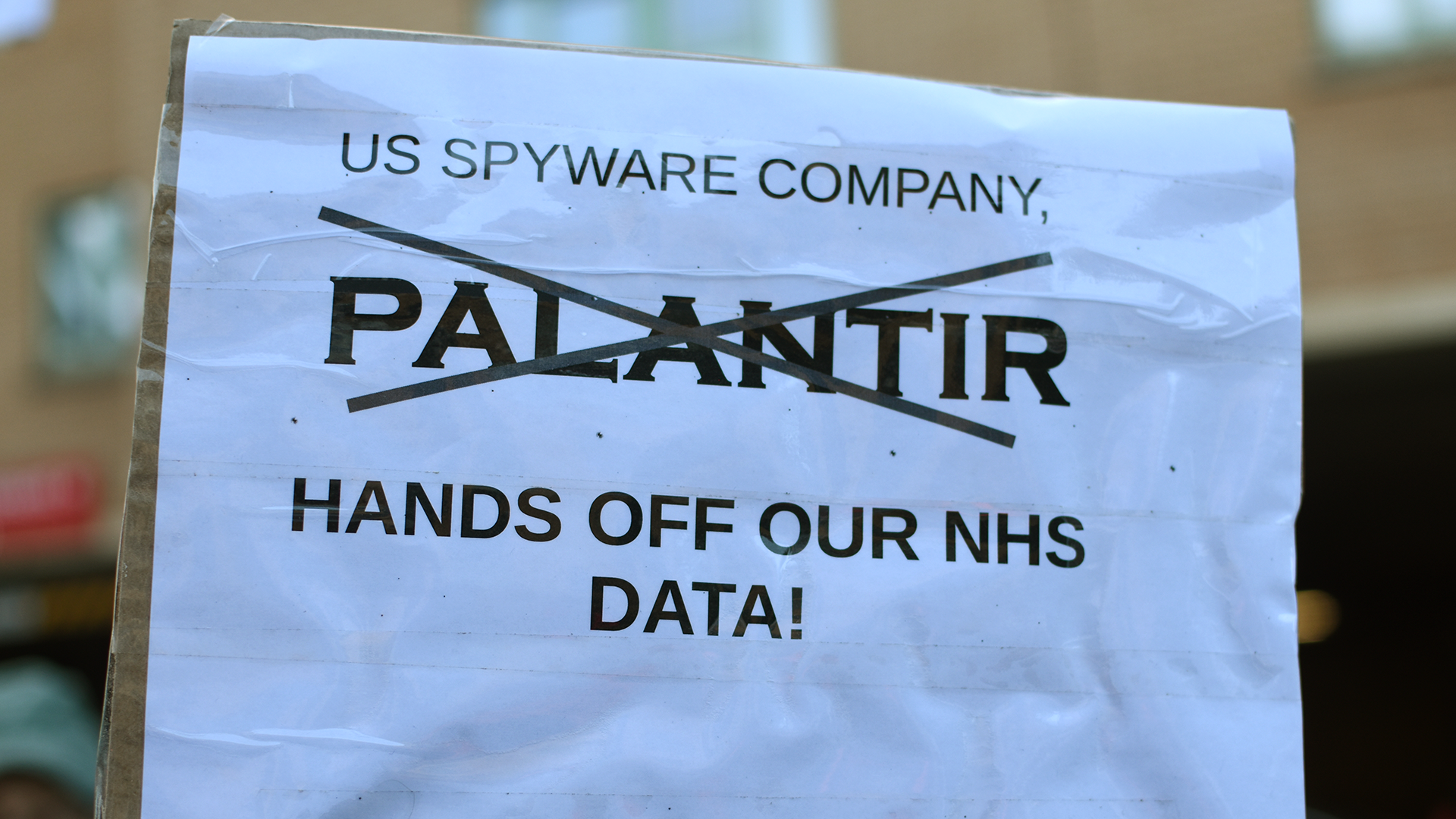
Most people said that they would feel more comfortable if a UK company managed their data instead. They said a domestic firm would be easier to oversee and hold to account.
Economics was also a big concern. "Why can't these jobs be kept in Britain for British companies to run these systems? Why do we need to have a foreign company coming in and have dangerous motives to actually do this work? It's not necessary," another protester told us.
As I leave the protest, the rally wrapping up in the distance and the hospital entrance regaining its usual look, I cannot help but wonder how data privacy isn’t just about the tech. Politics is inevitably tangled up in every line of code. At its very core, the entire issue around people’s health data privacy hinges on public trust.
Demonstrators in Bristol weren't rallying around a single, isolated grievance. They were there, together, rather to resist a model where healthcare, data, and defense contracts bleed into one another.
Whether driven by fear over corporate overreach, frustration at the misuse of government funds, or deep ethical objections, the battle over Palantir goes far beyond digital security — it is a fundamental tug-of-war over whether the public is demanding assurance about who holds their most sensitive data and, for those taking to the streets yesterday, the US tech giant certainly failed to earn their trust.
Chiara is a multimedia journalist committed to covering stories to help promote the rights and denounce the abuses of the digital side of life – wherever cybersecurity, markets, and politics tangle up. She believes an open, uncensored, and private internet is a basic human need and wants to use her knowledge of VPNs to help readers take back control. She writes news, interviews, and analysis on data privacy, online censorship, digital rights, tech policies, and security software, with a special focus on VPNs, for TechRadar and TechRadar Pro. Got a story, tip-off, or something tech-interesting to say? Reach out to chiara.castro@futurenet.com