First awarded by France Football magazine in 1956, the Ballon d’Or has grown from a relatively modest sporting honour into football’s most prestigious individual accolade. Its recent history has been dominated by the superstar rivalry between Argentina’s Lionel Messi and Portugal’s Cristiano Ronaldo, who combined have won 13 Ballon d'Or awards between 2008 and 2023.
I hate what it has become. The glitz and glamour. The simpering, Oscar-esque campaigning. Above all, I hate how it reduces football, that most beautiful of collective endeavours, to a procession of individual superstars competing for their place in some manufactured celebrity hierarchy of greatness.
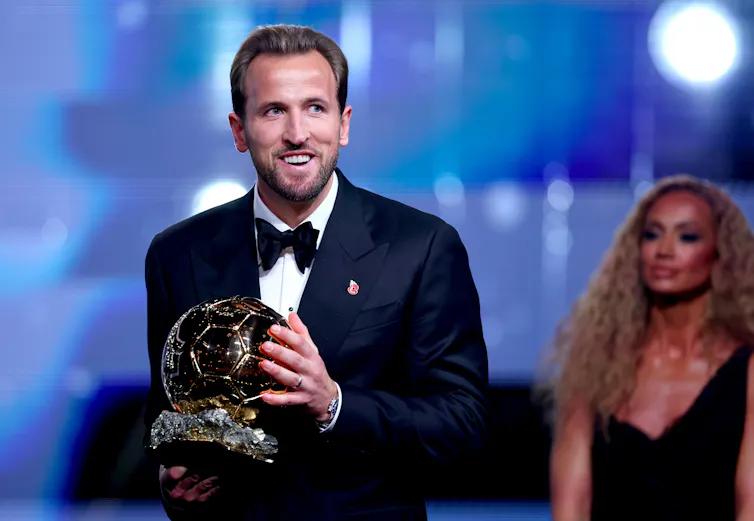
So imagine my surprise when I found myself lying in darkness, laptop propped on my chest, glued to the BBC’s coverage. And imagine my even greater astonishment when, as England’s Harry Kane was named this year’s men’s winner, I found myself experiencing a genuine swell of emotion.
Why had an award that seemed to embody everything I despised about modern football moved me so profoundly?
My research examines football support as a form of living cultural heritage. One of my central arguments is that football heritage is about far more than historic stadiums, trophies or great players immortalised in bronze.
Instead, heritage lives in the relationships, shared memories, traditions and values that supporters sustain and transmit across generations. Heritage, in other words, is not simply about celebrating what has gone before. It is about deciding what we value from the past and present, and what we want to carry into the future.
In this sense, Kane’s significance goes beyond sporting achievements or the memories he has created for football fans. The heroes we choose to celebrate help shape our understanding of what football represents, and what we believe it ought to be.
Kane’s win points towards the future of football I and many fans would like to see. We spend so much time worrying about what modern football is becoming, Harry Kane reminds us of what it can still be. And for one glorious evening, the qualities and values I cherish most in football seemed to have won too.
A different kind of footballing greatness
There’s no argument that in footballing terms, this award is utterly deserved. England’s all-time leading male goalscorer and Tottenham Hotspur’s greatest marksman, Kane is now also the first Englishman to win the Ballon d'Or since Michael Owen in 2001. He is undoubtedly one of the greatest English footballers of all time.
Yet, statistics barely capture his brilliance. A genuine footballing artist, Kane combines terrifying finishing ability with exquisite technique, spatial awareness and an extraordinary passing range. His genius is understated: his trundling style makes his shattering performances of the last year for his current club Bayern Munich seem deceptively routine. His leadership style is through relentless self-improvement, personal discipline and an unwavering commitment to the collective cause.
We live in an era when football seems increasingly consumed by celebrity, conspicuous wealth and the relentless cultivation of personal brands. Take the two most awarded players in Ballon d'Or history. In 2025, Cristiano Ronaldo and Lionel Messi earned an estimated US$120 million (£90 million) between them from off-field commercial activities alone.
But the consequences run deeper than money. My research looks into football supporters’ ideas of authenticity in the game. Speaking with fans, I have explored how the game’s transformation into a global entertainment product can leave supporters feeling marginalised. Traditionally, football has been an intergenerational cultural tradition rooted in collective identity, shared values and community relationships; however, it is increasingly repackaged around individual celebrity and consumption.
The danger is not commercialisation itself, but that football’s identity as an entertainment product increasingly threatens to overshadow its significance as a living cultural tradition.
Against this backdrop, Kane feels like a glorious throwback. Grounded, sensible, quietly charming and refreshingly unostentatious, he seems almost defiantly ordinary for someone possessing such extraordinary talents.
There was something wonderfully incongruous about watching him collect football’s most ostentatious individual award. His shiny-eyed awe, his impish grin, his apparent lack of interest in the celebrity circus surrounding this most deserved of accolades.
Kane has spent his career quietly perfecting his craft, allowing his football to speak more eloquently than any carefully cultivated public persona. He is no celebrity; he is a sportsman.
In his humility, professionalism, quiet leadership and extraordinary dedication to his craft, Kane embodies precisely the values I would love future generations of footballers and supporters to inherit. His Ballon d'Or victory is therefore a wonderfully paradoxical triumph: a seemingly old-fashioned footballer conquering the most conspicuous symbol of modern football’s celebrity culture.