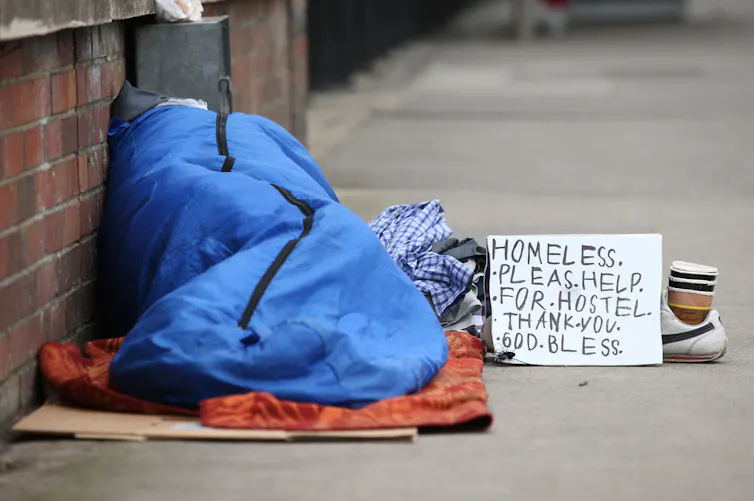
From the start of October, people sleeping rough or staying in homeless hostels and night shelters in England can get a free flu vaccine for the first time. But will the jab reach those who need it?
The case for eligibility is not in doubt. The UK’s Joint Committee on Vaccination and Immunisation (JCVI) based its recommendation on evidence that homeless people face a similar risk of hospitalisation and death from flu as people aged 65 and over. Many also live in shared dormitories, day centres and crowded hostels, where respiratory viruses are likely to spread easily.
A record 4,793 people were counted sleeping rough in autumn 2025. The figure reflects a single night. The hostel and shelter population is likely to be far larger.
The problem is that eligibility may not be the main barrier. Many homeless adults were already eligible for a flu jab long before this change. Most were not getting one.
A London survey during the 2011-12 flu season found that 42% of homeless people were entitled to the vaccine because of their health, mostly because of lung disease, liver disease or problems with their immune system. Less than a quarter of those eligible (24%) had been vaccinated, compared with over half nationally (53%) for the same risk groups.
The obstacles are practical. For many people, the flu programme works through GP registration, an invitation sent to a home address and an appointment at a surgery. Someone sleeping rough may have none of those, so the offer never reaches them and, if it does, there is nowhere convenient to take it up.
COVID showed us that the same gap exists, even when homeless people were explicitly prioritised. In Wales, researchers linked health and housing records for 1,595 people who had recently been homeless. By the end of November 2021, 57% had received at least one dose of the vaccine, compared with 81% of a matched group of adults in Wales of similar age, sex and economic circumstances who were not homeless. Reaching these participants took an average of 55 days longer than for the comparison population.
Reasons for optimism
There is, however, reason to be optimistic: we already know what closes the gap.
In March 2020, three days into the first lockdown, the government launched Everyone In, an emergency scheme in which every council in England was asked to find accommodation for rough sleepers within days. Around 15,000 people were moved into hotels and other emergency housing within weeks. Modelling of 46,565 homeless people in England – including those in hostels and night shelters and those sleeping rough – estimated that the first-wave measures avoided 266 deaths, 1,164 hospital admissions and over 21,000 infections.
Vaccination during COVID showed similar positive results. In Liverpool, a two-day campaign took teams of GPs, medical students and outreach workers into hostels, hotels and rehab units and vaccinated 363 people.
In Winchester, a primary care network built its own list of 114 people through hostels and charities and ran two vaccination sessions at a day centre. The team vaccinated 60% of them overall, ranging from 56% in hostels to 90% at the local night shelter. Along the way, it found that 37 of the 114 had the wrong addresses on their medical records.
The ingredients for success are consistent. Go to where people are rather than waiting for them to come to a surgery. Use staff people already trust. Give every vaccine someone is due – flu, pneumococcal, hepatitis B – in the same sitting. Fix the record so that next year’s invitation actually arrives.
Some of this is already in place. NHS England has told practices how to record vaccinations for people who are not registered and has promised posters, flyers, a pocket guide and a multi-agency toolkit. Pneumococcal vaccine, which protects against a common cause of pneumonia, meningitis and sepsis, was extended to the same group in July, and it can be given at the same appointment as flu.
What is missing is any national requirement or funding for outreach. This season’s GP guidance sets out how to record the jab for someone not registered with the practice, but says nothing about how to find them. So hostel clinics and walk-in access will exist where a council, charity, or the local integrated care board (the NHS body that plans and pays for services in each area of England) choose to run them – and not elsewhere.
And this is happening as the health bill, now in the House of Lords, abolishes NHS England by March 2027 and passes its work to the Department of Health and to integrated care boards, which are themselves being told to make deep cuts to their running costs by 2028. So the national body that added rough sleepers to the list will not exist to see the programme through, and the local bodies expected to organise and pay for outreach are shedding the staff who would do it.
A new offer to a hard-to-reach group is therefore launching at a time when responsibility for making that offer accessible locally is unclear.
Success depends on four things
None of this means the policy will fail, but it does mean success depends on four things that are not yet guaranteed.
First, someone in each integrated care board area needs to know how many people are in hostels and shelters, and who is going to offer them the jab. Second, the charities and outreach teams that already know those people need to be commissioned to run clinics, since during COVID that work was done largely on goodwill. Third, pharmacies need clear instructions that they can vaccinate someone who is not registered with a GP. And, finally, the UK Health Security Agency (UKHSA), which publishes the national uptake figures, needs to report this group alongside other risk groups.
Neither the flu letter nor the service specification says how that will be done, and the UKHSA’s own pneumococcal guidance, issued jointly with NHS England, concedes that routine health data struggles to identify this group at all.
Everyone In showed that when the state decides to reach this population, it can do so in weeks. The flu jab is a smaller version of the same task. The eligibility decision has been made. What will be harder is counting, contacting and offering the vaccine to those who are eligible, and that will depend on what happens in hostels and day centres rather than in Whitehall.